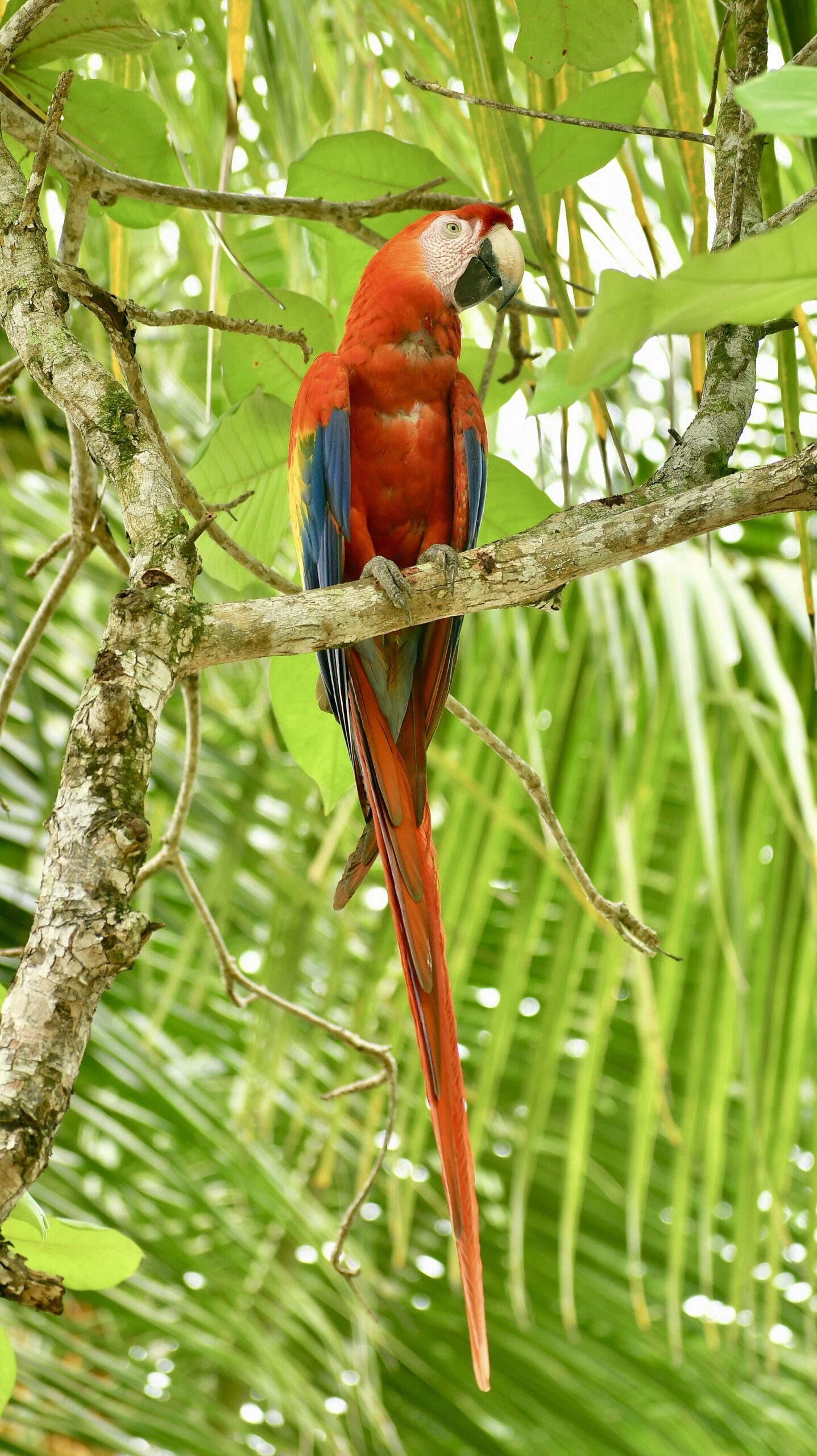
Scarlet Macaw
Ara macao
Characteristics
Temperament
Diurnal, social, hyper-social, lifelong monogamous (30-50 years). Inseparable pair always flies side by side. Lives in flocks of 20-100 individuals. Exceptionally intelligent: 50-100 "words" learned. Powerful vocalisations (1-2 km). Sacred to Aztecs and Mayas.
Diet
Granivore-frugivore: seeds, nuts (breaks Brazil nuts!), fruit, flowers, nectar. Bite force 200-300 psi. Practices geophagism: eats clay at Amazonian "clay licks" to neutralise food toxins. 150-250 g food/day.
The Scarlet Macaw (Ara macao), also known as Ara Macao, is one of the largest and most colourful parrots in the world, iconic symbol of the neotropical forests of Central and South America. Its brilliant plumage — intense red on head, chest and back, golden yellow on wings, deep blue on flight feathers and tail — makes it one of the most photographed birds on the planet. Distributed from southern Mexico to Brazil and Bolivia, it lives in rainforests, wooded savannas and lowland rivers. It weighs 0.9-1.5 kg and reaches a length of 80-90 cm (of which the tail is half). It is a highly intelligent bird, lifelong monogamous (couple longevity 30-50 years), with a complex social language. Its life expectancy is exceptional: 30-50 years in nature, up to 75 years in captivity. The global IUCN conservation status is Least Concern (LC) since 2018, but Central American populations are declining due to habitat loss and capture for the illegal trade in pet parrots.
Classification and category
The Scarlet Macaw belongs to the order Psittaciformes, family Psittacidae, subfamily Arinae, genus Ara. The genus comprises 8 species of "Great Macaws" of the Americas: A. macao (Scarlet), A. ararauna (Blue-and-Yellow), A. chloropterus (Green-Winged), A. militaris (Military), A. ambiguus (Buffon), A. rubrogenys (Bolivian), A. severus (Chestnut-fronted), A. glaucogularis (Blue-throated). The species was scientifically described by Linnaeus in 1758 with its current name.
There are 2 recognised subspecies:
- A. m. macao — South America (Bolivia, Brazil, Colombia, Ecuador, Peru, Venezuela, Guyana)
- A. m. cyanopterus — Central America (Mexico, Belize, Guatemala, Honduras, Nicaragua, Costa Rica, Panama)
The dimensions are: length 80-89 cm (of which tail 36-46 cm), weight 0.9-1.5 kg (average males 1.1 kg, females 1.0 kg). The wingspan is 110-125 cm. Sexual dimorphism is practically absent: males and females are externally identical — only molecular sex determination (DNA) distinguishes sex with certainty. Longevity is 30-50 years in the wild, 50-75 years in captivity (documented record: the specimen "Charlie" from Walthamstow Zoo, UK, reached 87 years in 2002).
Habitat and distribution
The habitat of the Scarlet Macaw consists of humid rainforests, semi-deciduous forests, wooded savannas (cerrado), gallery river forests, swamp margins. It prefers areas with tall mature trees (40-50 m) that present cavities for nesting (old woodpecker nests, rotten trunks, natural cracks). It is found up to 1,000 m of altitude (more rarely up to 1,500 m). It frequents the clay licks: walls of mud/clay along Amazonian rivers, where dozens of parrots gather every morning to eat clay — behaviour called "geophagism" — necessary to neutralise tannins and toxic alkaloids from the seeds they eat.
The distribution includes: southern Mexico (Chiapas, Tabasco, Campeche, Quintana Roo — historical population), Belize, Guatemala, Honduras, Nicaragua, Costa Rica (Central American population, ~1,500 specimens remaining), Panama, Colombia, Venezuela (Amazonian population, millions), Ecuador, Peru, Bolivia, Brazil, Guyana, Suriname, French Guiana. The species is now extinct in El Salvador and nearly extinct in some areas of Mexico. The global population is estimated at 500,000-1 million specimens. The IUCN conservation status is Least Concern (LC) since 2018 (previously Vulnerable at regional level). Threats include: habitat loss (Amazonian deforestation, 17% lost since 1980), illegal capture (Scarlet Macaw chicks have a black market of 3,000-10,000 USD/bird in Asia and Europe), hunting for feathers (some indigenous tribes), conflict with farmers (eat crops). The species is protected by CITES Appendix I since 1981 (one of the maximum protection levels) — international trade is almost totally prohibited. Active conservation programmes: Macaw Recovery Network (Costa Rica), ARA Project (Costa Rica), Tambopata Macaw Project (Peru).
Diet
The Scarlet Macaw is a granivore-frugivore with varied diet: seeds (of palms, legumes, Brazil nuts, almonds), nuts (most require breaking very hard shells), fruits (figs, mangoes, palms), flowers, nectar, occasionally insects and clay. The ability to break very hard nuts is an exceptional characteristic: the beak of the Scarlet Macaw is one of the most powerful among birds — can exert a bite force of 200-300 psi, sufficient to break Brazil nuts (12-15 mm thick shells that humans must open with hammers or pliers). Only the Scarlet Macaw (and other macaws) and humans manage to break these nuts. A single macaw can consume 20-30 large nuts per day.
The most famous characteristic is the "clay lick". Every morning, at dawn, hundreds of macaws, parrots and other birds gather on the clay walls along Amazonian rivers (Manu, Tambopata in Peru are the most famous sites), where they ingest mud and clay for about 30 minutes. The function is debated: the main theory is the neutralisation of toxins (the seeds they eat contain alkaloids and tannins; clay — montmorillonite or kaolinite — absorbs toxins like a natural antacid); other theories suggest mineral integration (sodium, calcium, iron). These gatherings constitute one of the most colourful natural spectacles in the world: hundreds of colourful parrots moving and shouting on the white-orange clay wall. The food requirement of an adult is 150-250 g of food per day (10-15% of weight). In captivity, the diet must be enriched with nuts, fresh fruit, vegetables, and specific granulate for large parrots — generic commercial foods cause vitamin A deficiency and beak malformation.
Physical features
The Scarlet Macaw has a robust, elongated body, with a characteristic silhouette with very long tail. The total length is 80-89 cm, of which the tail represents more than half (36-46 cm). The weight of adults is 0.9-1.5 kg; the wingspan 110-125 cm. The most distinctive characteristic is obviously the brilliant multicoloured plumage: intense red (crimson) on head, neck, chest, belly, back, and upper part of the tail; golden yellow on the middle wing coverts; deep blue on the primary flight feathers and on the lower part of the tail. There is also a small spot of blue feathers on the rump and azure on the nape. The distinctive colours derive from different pigments: red and yellow from carotenoids (acquired through diet), blue from microscopic structures of feathers that reflect blue light (there is no blue pigment in birds).
The beak is extraordinarily powerful: the upper maxilla (rhamphotheca) is pearly white-cream, the lower mandible black. The shape is hooked, of extreme robustness, equipped with a joint that allows movements on 4 axes (a "multi-articulated" beak). The bite force is 200-300 psi, capable of breaking Brazil nuts and hard woods. The beak grows continuously; to control the length, the bird must file it down by gnawing wood (in captivity this activity is essential to avoid malformations). The eyes are of pale yellow colour in adults (iris), black in juveniles up to 3-4 years. The pupils dilate and contract voluntarily with mood (excitement, fear, interest) — phenomenon called "flashing". The facial mask is an area of bare white skin around the eyes, traversed by thin lines of red feathers — pattern similar to a fingerprint, unique to each individual (used by researchers for identification). The legs are robust, grey-black in colour, with 4 toes per foot in zygodactyl configuration (2 anterior, 2 posterior) — suitable for grasping branches and food, and for manipulating objects like a hand.
Behaviour and curiosities
The Scarlet Macaw is a diurnal, social, lifelong monogamous bird. It lives in permanent pairs that remain together for the entire life (30-50 years). The pairs are inseparable: they always fly side by side at 20-30 cm distance, sleep and eat together, frequently touch each other with the beak. When the pair is separated even for a few minutes, they vocalise high-pitched calls until they meet again. During the day, the pairs gather in larger flocks of 20-100 individuals to go to feeding sites and clay licks. The pairs communicate constantly with powerful vocalisations — squawking sounds like "raaaak" "raaaak" — audible at 1-2 km distance. The flight is characteristic: slow and powerful rhythm, wings bent downwards, tail spread out as a rudder. Cruising speed: 56 km/h; continuous flight duration: 4-6 hours.
Reproduction: season November-April (depending on the region). The pair finds a cavity in a large dead tree (usually Dipteryx, Mauritia palm, ceiba) between 20 and 40 m of height. The female lays 2-4 white eggs (usually 2); incubation lasts 24-28 days, conducted only by the female. The male brings food. The chicks are born naked, blind, completely dependent. Development is slow: at 10 weeks the chicks have acquired all the feathers; at 3-4 months they leave the nest for the first time. However, they remain with the parents for 1-2 years, learning: where the clay licks are, which fruits are ripe (Scarlet Macaws learn to recognise hundreds of tree species), how to break different nuts, how to navigate the forest. It is the longest learning period of birds (matched only by corvids). Sexual maturity is at 4-5 years. Adult females lay 1 clutch per year (very low reproduction rate); average reproductive success is 0.5-1 chick per year per pair — one of the lowest of all birds.
Famous curiosities: the intelligence of macaws is documented: "problem-solving" (resolution of complex problems), rudimentary theory of mind, social language. In controlled studies, Scarlet Macaws have learned 50-100 "words" in English or Spanish, and manage to associate objects, colours, and actions to specific words. The famous "Alex the Parrot" (an African grey, not a macaw, but related genus) reached a vocabulary of 100+ words and abstraction abilities equivalent to a 5-year-old child. Cultural curiosity: Scarlet Macaws were sacred to the Aztecs and Mayas. Red and blue feathers were used for ceremonial headdresses and royal cloaks; "Quetzalcoatl" (feathered serpent), Central American deity, was often represented with Scarlet Macaw feathers mixed with those of the Quetzal. Anatomical curiosity: Scarlet Macaws can learn to call by name every member of their flock (humans included). 2011 studies (Cornell University) have shown that each macaw has a "signature contact call" — a unique call that functions as a "name", learned from parents during growth. Breeding curiosity: Scarlet Macaws are among the most complex pet birds to keep. They require: giant cages (minimum 2×2×3 m), 4-6 hours of interaction time per day, varied and specific diet, company of another macaw (loneliness causes feather-plucking and psychological disorders), beak training with wooden toys. The longevity of 50-75 years means that those who take a Scarlet Macaw commit to its care for life, and often these birds outlive their owners, ending up in sanctuaries. Strength curiosity: Scarlet Macaws can fly 25 km a day in search of food, and return to their common dormitory every evening (behaviour called "roosting commute"). Illegal trade curiosity: Scarlet Macaw chicks are often smuggled in suitcases through international airports. Survival of transit is 10-20% (most die of stress, hunger, hypothermia). The global illegal parrot trade is the 3rd in value in the world after weapons and drugs.
Pros
- Pappagallo iconico: piumaggio rosso-giallo-blu spettacolare
- Intelligenza eccezionale: 50-100 parole apprese, problem-solving complesso
- Longevità straordinaria (30-50 anni in natura, 75+ in cattività)
- Fedelta di coppia eccezionale: monogamo a vita
Cons
- CITES Appendice I: commercio internazionale quasi totalmente vietato
- Detenzione complessa: gabbia 2×2×3 m, 4-6 ore interazione/giorno
- Molto costoso (€8.000-15.000 per esemplare legale + €200-300/mese cibo specifico)
- Longevità = impegno per la vita (sopravvive ai proprietari)