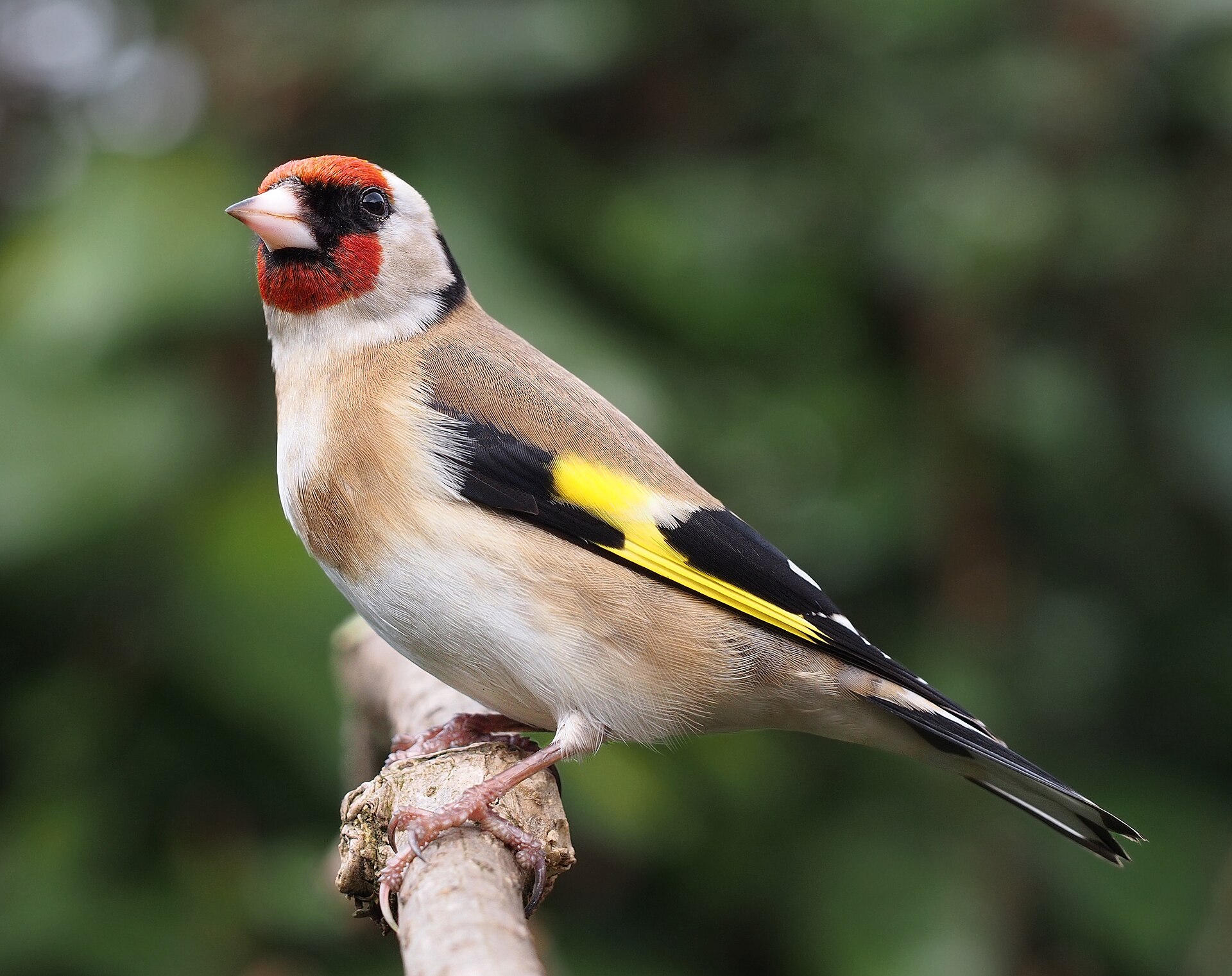
European Goldfinch
Carduelis carduelis
Characteristics
Temperament
A small, lively, social and tuneful wild passerine, active by day. Outside the breeding season it is gregarious and forms cheerful flocks that comb fallow fields and thistle patches for seeds. It is agile and acrobatic at extracting seeds from spiny seed-heads, and has a clear, tinkling, much-admired song. It is NOT a cage bird: it is protected wild birdlife, to be observed and safeguarded in freedom; it can be helped by keeping fallow ground, hedges and seed plants (thistles, dandelion) and by providing water and feeders with small seeds.
Diet
A specialised seed-eater, especially fond of the seeds of thistles, teasel and dandelion, as well as other composites and wild herbs (sunflower, burdock, knapweed); it supplements with small insects in spring, to feed the nestlings. The slender, conical, pointed bill is a perfect "tweezer" for extracting seeds from the spiny thistle-heads, an almost exclusive resource. It feeds with great agility, often upside down on the seed-heads, and out of season in flocks, combing fallow fields.
The European Goldfinch (Carduelis carduelis) is one of the most colourful, elegant and beloved small passerines of the continent: a winged jewel of bright hues and melodious song. Famous for:
- The red face: the characteristic red "mask" around the bill makes it unmistakable
- The yellow wing-bars: broad bands of vivid yellow stand out on the black wings
- The bond with thistles: it feeds on the seeds of thistles and spiny plants, hence its scientific name
- The melodious song: a clear, tinkling warble
- The symbolic richness: for centuries a star of art and culture
- Life in flocks: in English a group of goldfinches is poetically called a "charm"
IUCN status: Least Concern (LC). It enters the portal among the passerines, alongside the European Robin: another familiar, much-loved small bird, enriching the portal's category of songbirds.
Classification and category
Order Passeriformes (the passerines, the songbirds), family Fringillidae (the finches and allies). The European species is Carduelis carduelis. In the portal it is placed among the passerines. It is useful to tell it apart from similar or confusingly named species: the American goldfinch (Spinus tristis) is another species — the male in breeding dress is bright yellow with a black cap, quite different from our goldfinch's red face; other European finches such as the greenfinch, the siskin and the linnet lack the red mask and the broad yellow bars; young goldfinches do not yet have the red face — they have a greyish, streaked head and develop the "mask" only as they grow. Etymology: both the scientific name Carduelis and the Italian "cardellino" come from the Latin carduus, "thistle": a direct reference to the spiny plant whose seeds the bird relishes; the name thus tells, in a word, the species' ecology. Parameters: Length about 12-13 cm. Weight about 14-19 g. Wingspan about 21-25 cm. Longevity: in the wild the average life is short, often two or three years, but some individuals can exceed 8 years. Reproduction: it builds a small, exquisitely neat cup nest, often at the tips of tree branches.
Habitat and distribution
The goldfinch is widely distributed across the western Palearctic: its range covers Europe, North Africa and western and central Asia; it has also been introduced elsewhere (Australia, New Zealand, South America). Northern populations are partly migratory, more southern ones (including Italy) largely resident. Preferred habitats — open and semi-open settings rich in grasses and seed plants: countryside, fallow land and flowery meadows, rich in thistles, dandelions and other composites; orchards, vineyards, hedgerows and field margins; and parks, gardens and green areas, even in towns. It is a social, gregarious bird, especially outside the breeding season, when it forms cheerful flocks that move in search of fields of thistles and other plants gone to seed. It is often seen clinging, in acrobatic balance, to dry seed-heads, busy extracting the seeds. It is tied to traditional farmland and fallow ground: the loss of hedgerows, flowery meadows and fallow can locally reduce its resources. IUCN: Least Concern. It is still common and widespread, but in the past it suffered in some areas from capture for the cage-bird trade. Today, like all native small wild birds, it is a protected species.
Diet
The goldfinch is a specialised seed-eater, with a particular fondness for the seeds of spiny plants. It feeds on: the seeds of thistles, teasel and dandelion (its favourite foods); the seeds of other composites and wild herbs (sunflower, burdock, knapweed and many others); and small insects (especially in spring, to feed the nestlings). Feeding habits: the acrobatic extraction of seeds (the slender, conical, pointed bill is a perfect "tweezer" for extracting seeds from the spiny thistle-heads that other birds cannot exploit); balancing (it clings to and climbs over the seed-heads, often upside down, with great agility); and flock feeding (out of season it feeds in groups, combing fallow fields). Crucially, specialization on thistle seeds is the ecological trait that defines the goldfinch, gave it its name and lets it exploit an almost exclusive resource, reducing competition with other seed-eating birds.
Physical features
A small finch of vivid colours and unmistakable pattern. The "masked" head — the distinguishing trait: a showy red mask around the bill, extending around the eyes; white cheeks and sides of the head; and a black cap descending to the sides of the neck. The wings and body: broad, bright yellow wing-bars, very conspicuous against the black of the wings — the most striking sign in flight; a warm brown back and whitish underparts with buff flanks; and a slender, conical, pointed whitish bill, suited to seeds. Peculiarities: males and females look very alike — subtle differences, such as the extent of the red beyond the eye; the young are very different — lacking red and black on the head, with a greyish, streaked head; for this they are sometimes called "grey goldfinches" until they mature.
Curiosities, culture and behaviour
The goldfinch is a lively, social, tuneful bird, active by day, with an undulating flight and a tinkling call. Beyond its beauty, it is famous for its deep bond with European culture and art, and for a not always happy history with humans.
The name that is an ecology: few species have so "transparent" a name; "goldfinch"/"cardellino" and Carduelis all relate to the thistle: the bond with this spiny plant, whose seeds the bird relishes, is written into its very name; to watch a goldfinch extract seeds from a thistle is to see a perfect evolutionary adaptation at work. The "charm" of goldfinches: in English a group of goldfinches is poetically called "a charm of goldfinches"; the term evokes both the appeal of their colours and their tinkling song and calls, which in a flock create a pleasant, diffuse melody. The symbol in art: the goldfinch is one of the most depicted birds in the history of painting; in Christian art it became a symbol of the soul, the Passion and the Resurrection, precisely because it feeds on spiny plants, associated with the crown of thorns; it appears in very many works, including famous Renaissance Madonnas — such as Raphael's "Madonna of the Goldfinch" — and in celebrated paintings such as Carel Fabritius's "The Goldfinch". The (bitter) cage bird: precisely for the beauty of its plumage and song, the goldfinch was for centuries one of the most sought-after cage birds, and in some areas it suffered heavily from illegal capture; today it is a protected wild species: the right thing is to admire it free, encouraging its presence with habitats rich in thistles and seed plants, certainly not to keep it captive. The "tailor-made" bill: the goldfinch's slender, pointed bill is a precision tool, shaped by evolution to reach and extract the seeds hidden among the spines of thistles and teasels; it is a textbook example of how the shape of a bird's bill tells of its diet. The artist's nest: the goldfinch builds a small, deep, exquisitely neat cup nest, weaving blades of grass, rootlets, moss and lichen and lining it with soft materials; it often places it well hidden at the tips of branches, where it is harder for predators to reach.
Pros
- Piccolo uccello bellissimo e inconfondibile, dai colori vivaci
- Canto limpido e melodioso, molto apprezzato
- Utile in natura: si nutre di semi di cardi e erbacce, ed è facile da osservare
- IUCN Least Concern: ancora comune e diffuso in gran parte d'Europa
Cons
- NON è un uccello da gabbia: è avifauna selvatica protetta
- In passato pesantemente catturato (anche illegalmente) per il commercio
- Risente della perdita di incolti, siepi e prati fioriti
- Vita media breve in natura, con alta mortalità giovanile