Photo: No machine-readable author provided. Stavenn assumed (based on copyright claims). · CC BY-SA 3.0
Superb lyrebird
Menura novaehollandiae
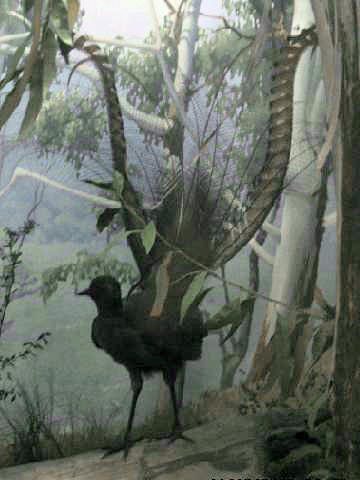
With its spectacular lyre-shaped tail and an extraordinary talent for imitating any sound, the superb lyrebird is one of the most fascinating inhabitants of the Australian forests.
Characteristics
Temperament
Ground-dwelling, shy, extraordinary mimic
Diet
Insectivore: insects, spiders, earthworms, larvae
The master of imitation
The superb lyrebird is one of the most extraordinary birds in the world, famous above all for two unique features. The first is the male's tail: during courtship, it spreads and raises it over its head in a fan of white and silvery feathers, with two large curved outer feathers recalling the shape of a lyre, the ancient musical instrument. The second, even more incredible, is its voice: the lyrebird is considered the most skilful vocal mimic in the animal kingdom.
Habitat and distribution
It lives in the humid and rainforests of south-eastern Australia, in dense environments rich in undergrowth. It is a mainly ground-dwelling bird: despite its large size, it spends much of its time on the ground, where it scratches among the leaves and soil in search of food. It flies rarely and clumsily, preferring to move by running and hopping through the vegetation.
The extraordinary song
The lyrebird's true marvel is its song. The male is able to reproduce, with astonishing accuracy, the calls of dozens of other bird species, but also a great variety of environmental sounds. Its repertoire can include natural noises and even artificial sounds heard in the forests. This talent serves above all to attract females during courtship, when the male combines the spectacular display of its tail with a long and complex concert of imitations.
Behaviour and feeding
It feeds on small invertebrates that it seeks by turning over the ground with its strong legs: insects, spiders, earthworms and larvae. By scratching, it helps to mix the forest litter, playing a useful role in the forest ecosystem. It is a rather shy animal, which reveals itself more often through its song than by sight.
Conservation
The superb lyrebird is classified as a species of least concern, with populations on the whole stable. Locally it can suffer from the loss and fragmentation of forests and from fires. Conserving the humid Australian forests where it lives is important to ensure the survival of this extraordinary singer.
Pros
- The most skilful vocal mimic in the animal kingdom
- Spectacular lyre-shaped tail in males
- Useful 'gardener' of the forest floor
- Populations on the whole stable
Cons
- Flies rarely and clumsily
- Shy, more often heard than seen
- Sensitive to forest loss and fires