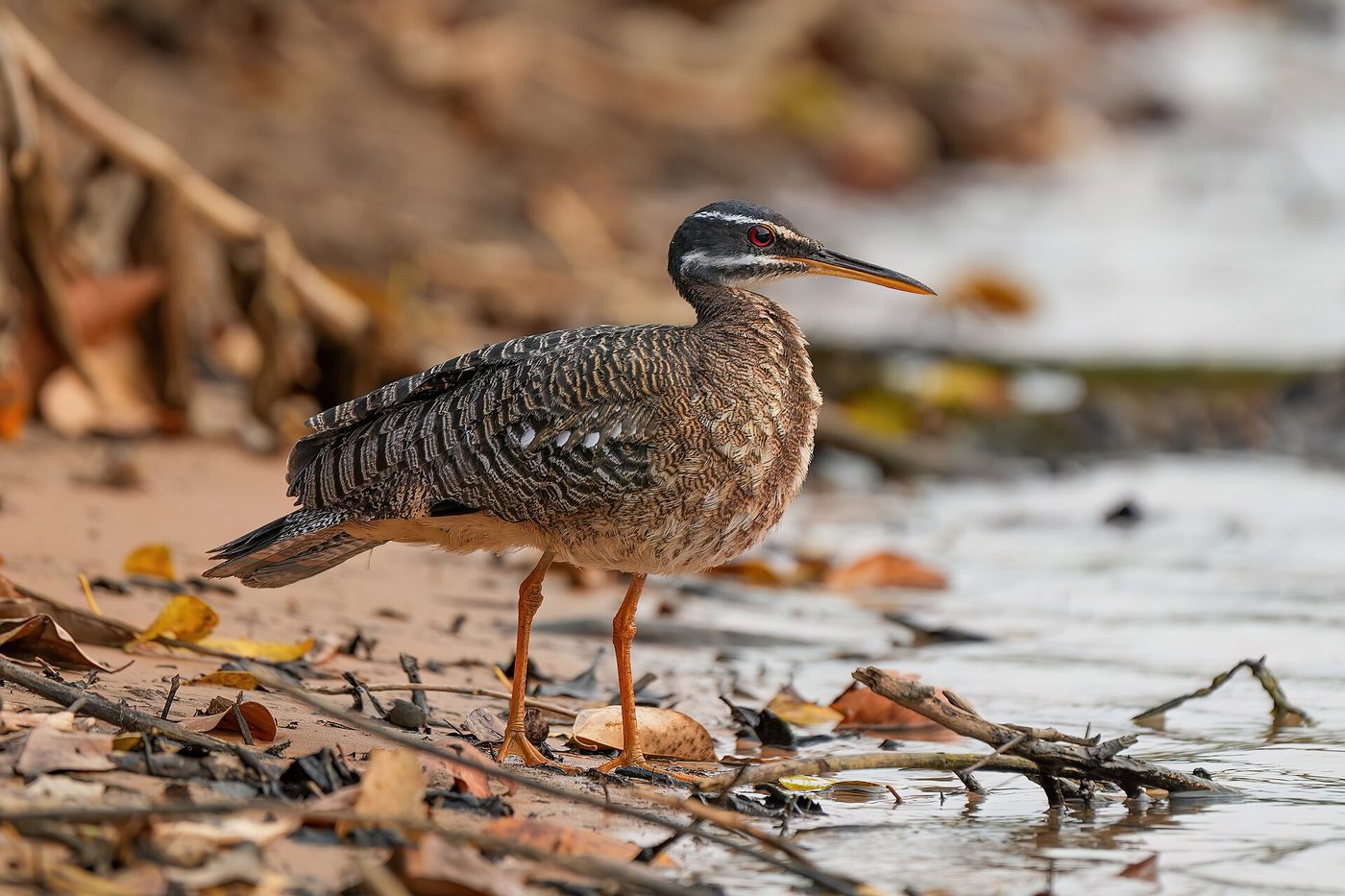
Photo: Giles Laurent · CC BY-SA 4.0
Sunbittern
Eurypyga helias
Discreet and cryptic, the sunbittern hides a surprising spectacle: when it opens its wings, two great 'eyes' appear on them that look like a shining sun.
Characteristics
Temperament
Solitary, shy, cryptic
Diet
Carnivore: insects, crustaceans, spiders and small fish
A bird of double nature
The sunbittern is a slender, elegant bird of the tropical rivers of the Americas, with long legs, a thin neck and a sharp beak. At rest, its plumage is a refined mosaic of grey, brown, black and rust, finely barred and vermiculated, which makes it almost invisible among the banks and the vegetation. But this soberness hides a spectacular surprise, which gives the bird its name.
The sun display
When it feels threatened or during courtship, the sunbittern suddenly spreads its large wings and brings them forward like a fan. On the open wings there then appear two broad circular patches, of reddish, orange and yellow colour, edged with black: two great 'eyes' which, together, recall a shining sun or an enormous face. This display serves to frighten predators, making them give up, and is at the same time an element of courtship.
Habitat and distribution
It lives in the tropical regions of Central and South America, along shady watercourses, streams and riverbanks set within the forest. It is a solitary, shy bird, which moves with a slow, cautious step in search of food, blending into its surroundings thanks to its cryptic plumage.
Feeding and curiosities
It feeds on insects, crustaceans, spiders, small fish and other little animals that it catches along the banks with rapid pecks. Despite its name, it is not related to the true bitterns: it forms a family of its own, whose closest relative is the kagu of New Caledonia, a link that suggests very ancient origins going back to the ancient supercontinent Gondwana. It is classified as a species of least concern. (Note: the weight value on Wikidata, 227 kg, is clearly wrong; the real weight is around 180–220 grams.)
Pros
- Astonishing sun-shaped wing display
- Refined cryptic plumage
- Elegant and slender
- Unthreatened populations
Cons
- Shy and hard to observe
- Tied to forest watercourses
- Sensitive to alteration of river habitats