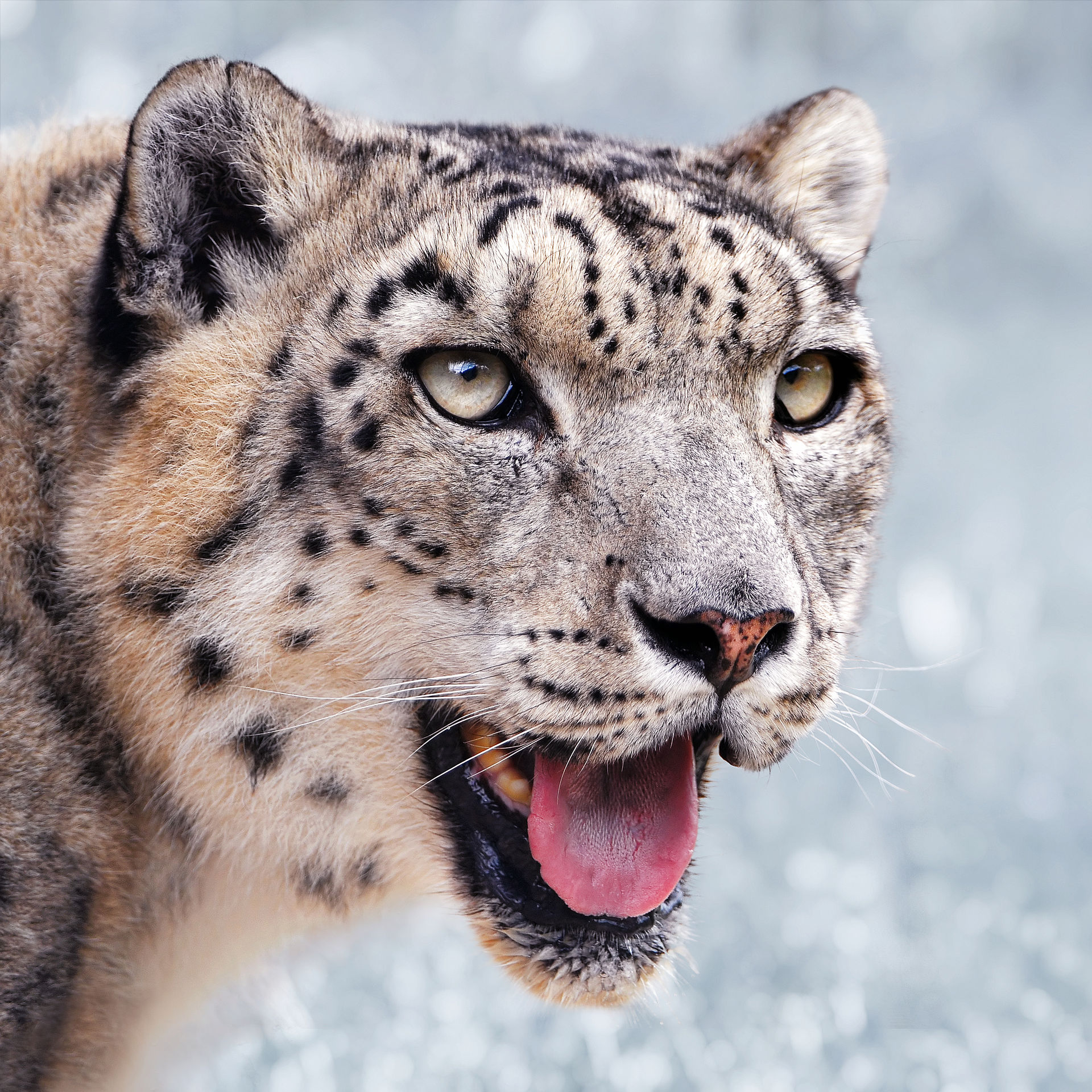
Snow Leopard
Panthera uncia
Characteristics
Temperament
Solitary, elusive, territorial. "Ghost of the Mountains". Only Big Cat that does NOT roar (hyoid bone not completely ossified): meows, hisses, chuffs, purrs. Record jumper: 16 m horizontal (felid record). Exceptionally long tail (75-90% of body) for balance.
Diet
Strict carnivore: mountain ungulates (argali, blue sheep, tahr, Siberian goat), marmots, alpine birds. Hunts by ambush from above, record jumps 14-16 m. Takes down prey 3× its own weight. 1-2 kg meat/day. Hunt success 15-25%.
The Snow Leopard (Panthera uncia) is one of the most mysterious and magnificent felids in the world, known as "the Ghost of the Mountains" for its elusive nature and rarity of sightings. Endemic to Central Asia, it is the only of the great felids specialised for high altitude: it lives between 3,000 and 5,500 metres above sea level in the mountain ranges of Himalaya, Karakoram, Pamir, Hindu Kush, Tian Shan, Altai, Sayan. The altitudinal record is 6,000 metres recorded on Mount Everest. It weighs 22-55 kg (females smaller) and is 1-1.3 m long with an iconic tail of 0.8-1.1 m (the longest in proportion among felids, used as "balance pole" on steep alpine terrain). The plumage is grey-white with rosettes dark grey, perfectly mimetic against snow and rocks. Above all, it is the only big cat that does not roar: its hyoid bone is not completely ossified, so it meows, hisses, snorts, chuffs — like domestic cats. It is classified as Vulnerable (VU) by IUCN since 2017 (previously Endangered until 2016); the global population is estimated at only 4,000-6,500 specimens in the wild.
Classification and category
The Snow Leopard belongs to the order Carnivora, family Felidae, subfamily Pantherinae, genus Panthera. The systematics has been the subject of intense debate: for over a century (1854-2008) it was classified in the monotypic genus Uncia. Genetic studies of 2008 (Johnson et al.) have shown that the snow leopard is genetically closer to the tiger (Panthera tigris) than to other leopards, and therefore has been reclassified as part of the Panthera genus. It separated evolutionarily from common ancestors about 2-3 million years ago.
The genus Panthera comprises 5 great cats that "roar" (or almost): lion (P. leo), tiger (P. tigris), jaguar (P. onca), leopard (P. pardus), snow leopard (P. uncia). The snow leopard is the exception of the genus: it cannot roar because the hyoid bone is only partially ossified (vs incomplete ossification typical of roaring Panthera). The species was scientifically described by Johann Christian Daniel von Schreber in 1775. There are 3 recognised subspecies (though controversial):
- P. u. uncia — Mongolia, Russia (Altai)
- P. u. uncioides — Himalaya, Karakoram, Hindu Kush
- P. u. baikalensis-romanii — south-east China (recent)
Adult dimensions are: head-body length 1-1.3 m, tail 0.8-1.1 m (the longest in proportion to the body among felids, representing 75-90% of body length), weight 22-55 kg (females 22-40 kg, males 30-55 kg, record 75 kg). Height at the withers is 60 cm. Sexual dimorphism is moderate (males 30-40% larger). Longevity is 10-15 years in nature, up to 22 years in captivity (record: female "Khulan", St. Louis Zoo, USA, 1996-2018, 22 years and 6 months).
Habitat and distribution
The Snow Leopard's habitat is exclusively high mountain of Central Asia. It lives in alpine steppes, rocky cliffs, glaciers, alpine valleys, always between 3,000 and 5,500 m a.s.l. (rarely lower in winter). It is perfectly adapted to the rarefied air and extreme cold of high altitude: night temperatures can drop down to -40°C in winter. Its metabolism is optimised for reduced oxygen: lungs are 30% larger than an African leopard of the same size, and blood has a high haemoglobin content.
The distribution covers 12 countries of Central Asia and the Himalaya:
- Mongolia — largest population, ~1,000 specimens (Altai, Gobi)
- China — ~2,000-2,500 specimens (Tibet, Xinjiang, Sichuan, Qinghai, Gansu — largest population in the world)
- India — 500-600 specimens (Ladakh, Uttarakhand, Sikkim, Arunachal Pradesh, Himachal Pradesh)
- Nepal — 300-500 specimens (Annapurna, Sagarmatha NP)
- Pakistan — 200-420 specimens (Karakoram, Hindu Kush)
- Russia — 70-90 specimens (Altai Republic, Tuva)
- Plus: Bhutan, Kyrgyzstan, Tajikistan, Uzbekistan, Kazakhstan, Afghanistan (minor populations)
The global total population is estimated at 4,000-6,500 specimens (2020 data, Snow Leopard Trust). The global IUCN conservation status is Vulnerable (VU) since 2017 — it was downgraded from "Endangered" (1986-2016) thanks to partial recoveries in Mongolia and China, but it remains a threatened species. CITES: Appendix I (maximum protection, international trade prohibited). Main threats are: habitat loss (global warming: alpine habitat is reducing by 30% for every 1°C increase — "mountain squeeze" model), poaching for fur and body parts (Chinese traditional medicine: bones, skin, teeth — 4,000-7,000 specimens killed in the last 20 years), conflict with herders (hunting of sheep, goats, yaks — herders kill in retaliation 300-450 leopards/year), decline in wild prey (wild goats, wild sheep), climate change (warming of the Himalaya). Active conservation programmes: Snow Leopard Trust (USA, 1981), Snow Leopard Conservancy (USA/India), GSLEP (Global Snow Leopard and Ecosystem Protection Program), WWF Snow Leopard Programme.
Diet
The Snow Leopard is a strict carnivore, opportunistic predator of high altitudes. The diet is composed mainly of mountain ungulates: argali (Ovis ammon, giant wild sheep), Siberian wild goat (Capra sibirica), Himalayan tahr (Hemitragus jemlahicus), blue sheep or bharal (Pseudois nayaur — favourite prey in Himalaya), wild sheep, musk deer, forest deer. It also hunts smaller prey: marmots, squirrels, pikas, alpine birds (capercaillie, snowcock, young lammergeiers). In areas inhabited by humans, it prefers domestic livestock: sheep, goats, young yaks, horses — causes conflict with herders.
The hunting technique is the ambush from altitude: the snow leopard hides among rocks above the prey path, and jumps from above to below. It is capable of horizontal jumps of 14-15 metres (record: 16 m documented in Mongolia, 2002 — the longest jump ever recorded in a felid), and vertical jumps of 6 metres. It is able to take down prey of 3 times its own weight (e.g. male argali of 120 kg vs snow leopard of 45 kg). After grabbing the prey by the throat, it drags it to a hiding place (cave, rocks, bushes) to consume it over several days. The food requirement is 1-2 kg of meat per day; it can fast 1-2 weeks between prey. Hunting success rate: 15-25% (lower than other felids, because mountain prey is very agile and fast on steep slopes). Characteristic: unlike African leopard and cheetah, the snow leopard DOES NOT climb trees for environmental reasons (above 3,000 m trees are rare or non-existent); however, it is an excellent climber of rocks and glaciers. A peculiarity: the snow leopard sometimes seems to "bite its own tail" during rest or ambush — behaviour observed for thermoregulation: the tail acts as a "thermal scarf" that protects the nose from the cold.
Physical features
The Snow Leopard has a compact, muscular, robust body, perfectly adapted to high mountain. Dimensions are modest compared to other great cats: head-body length 1-1.3 m, tail 0.8-1.1 m (exceptionally long), weight 22-55 kg, height at the withers 60 cm. The colour of the coat is its most iconic feature: grey-white base with yellowish or silvery shades, covered by dark rosettes (smaller and less defined than the African leopard), with the completely white ventral part. The head, throat and belly are spotted with solid black dots, not rosettes. The rosette pattern is unique to each individual (like a fingerprint): researchers use camera-traps to identify them individually.
The coat is exceptional: thick 5-12 cm, double layer (woolly undercoat + long outer hair), the most insulating among felids. It allows survival at -40°C. The whitish colour is perfectly mimetic against snow, glaciers and Himalayan limestone rocks. The ears are small, rounded (reduction of surface exposed to cold). The eyes are pale green-grey colour (characteristic of the genus — the only Panthera with this colour). The legs are wide, robust, equipped with "natural snowshoes": wide and hairy pads that work like snowshoes, distributing weight on fresh snow. The claws are retractable, 4 cm long, particularly strong for climbing and for the "anchor walk" on ice. The tail is the most diagnostic feature: 0.8-1.1 m long (75-90% of body length, the longest in proportion among felids), thick and hairy, grey-white with black rings. Tail functions:
- Balance on steep alpine slopes (essential for stability during jumps and climbing)
- "Thermal scarf": the leopard wraps its tail around the muzzle during rest to protect it from cold
- Fat storage: the tail contains adipose reserves for long winter fasts
The teeth include 30 total (typical of the Felidae family); the bite force is 400-500 psi (lower than African leopard and tiger, but sufficient for its prey). The skull is slightly shorter and stockier compared to the African leopard, with larger nasal cavities for breathing efficiency in rarefied air.
Behaviour and curiosities
The Snow Leopard is a solitary, territorial, predominantly nocturnal-crepuscular, elusive animal. Adult male territories cover 12-40 km² (in areas with abundant prey) or 100-1,000 km² (in arid areas poor in prey). Females have smaller territories (5-20 km²) that overlap with the territory of 1-2 males. It is extremely elusive: the first natural video of the snow leopard in the wild was recorded only in 2008 (NatGeo). Infrared camera-traps are the standard tool to monitor it. It is estimated that fewer than 100 close-up photographs (within 10 m) have been taken in History.
The snow leopard DOES NOT ROAR: the hyoid bone is only partially ossified (unlike the 4 great roaring felids). Its vocalisations include: chuff (friendly greeting), meow (call), hiss and snort (threat), purr (yes, it can purr like domestic cats!), long howl called "yowling" during the breeding season (January-March). The most characteristic sounds are the chuff and yowling.
Reproduction: the breeding season is January-March. Gestation lasts 90-100 days; the female gives birth to 1-5 cubs (average 2-3) in a hidden den among rocks, in spring-summer. The cubs weigh 300-600 g at birth, are blind, and covered in grey fur. They open their eyes at 7 days, begin to walk at 2-3 months, are weaned at 3-4 months. They remain with the mother for 18-22 months, learning to hunt. Sexual maturity: 2-3 years (females), 3-4 years (males). Cub survival rate: 40-50% in the first year (predation by foxes, eagles, adult leopards).
Famous curiosities: the "Ghost of the Mountains" is the iconic nickname of the snow leopard in Himalayan exploration literature. The book "The Snow Leopard" (1978) by Peter Matthiessen, winner of the National Book Award, tells the author's journey in Nepal in search of the snow leopard (which he never managed to see during the 250-day journey) — a classic of naturalist literature. Ethological curiosity: the snow leopard is one of the few felids that practises "mounting display" (mating display): during the breeding season, the male parades on the mountain ridges to attract females — visible for kilometres. Anatomical curiosity: the snow leopard has the "largest feet for body weight" among all felids: pad surface/body weight ratio 0.7 (vs 0.3 in African leopard). It works like a natural snowshoe: distributes weight on fresh snow without sinking. Medical curiosity: the snow leopard's fur is particularly dense: 26,000 hairs per cm² (vs 9,000 in African leopard) — the densest among felids. It is what it takes to survive at -40°C. Cultural curiosity: in Mongolian and Tibetan folklore, the snow leopard is a sacred creature associated with the deities of the mountain. Tibetan Buddhist monks consider the encounter with a snow leopard as a spiritual omen. The species is national symbol of Kyrgyzstan (on the 100 som banknote since 1999), and symbol of natural parks in Nepal (Sagarmatha NP). Conservation curiosity: October 27 is the international "Snow Leopard Day", established in 2014 by the 12 snow leopard countries at the Bishkek Declaration. Record curiosity: the longest jump documented of a felid is 16 metres, recorded of a snow leopard in Mongolia in 2002 (Snow Leopard Trust, camera-trap). Breed curiosity: the snow leopard is one of the few felids with a tail longer than the body in proportion — adaptation exclusive to the mountain environment.
Pros
- Specie iconica e mistica: "Fantasma delle Montagne"
- Adattamenti unici all'alta quota (3.000-5.500 m, fino a -40°C)
- Detentore del record di salto orizzontale tra i felini (16 m)
- Simbolo nazionale del Kirghizistan (su banknote da 100 som)
Cons
- Specie Vulnerabile IUCN: solo 4.000-6.500 esemplari in libertà
- Minacciata da cambiamento climatico, bracconaggio, conflitti con allevatori
- CITES Appendice I: massima protezione, commercio internazionale vietato
- Detenzione strettissimamente regolata: solo zoo qualificati e programmi conservazione