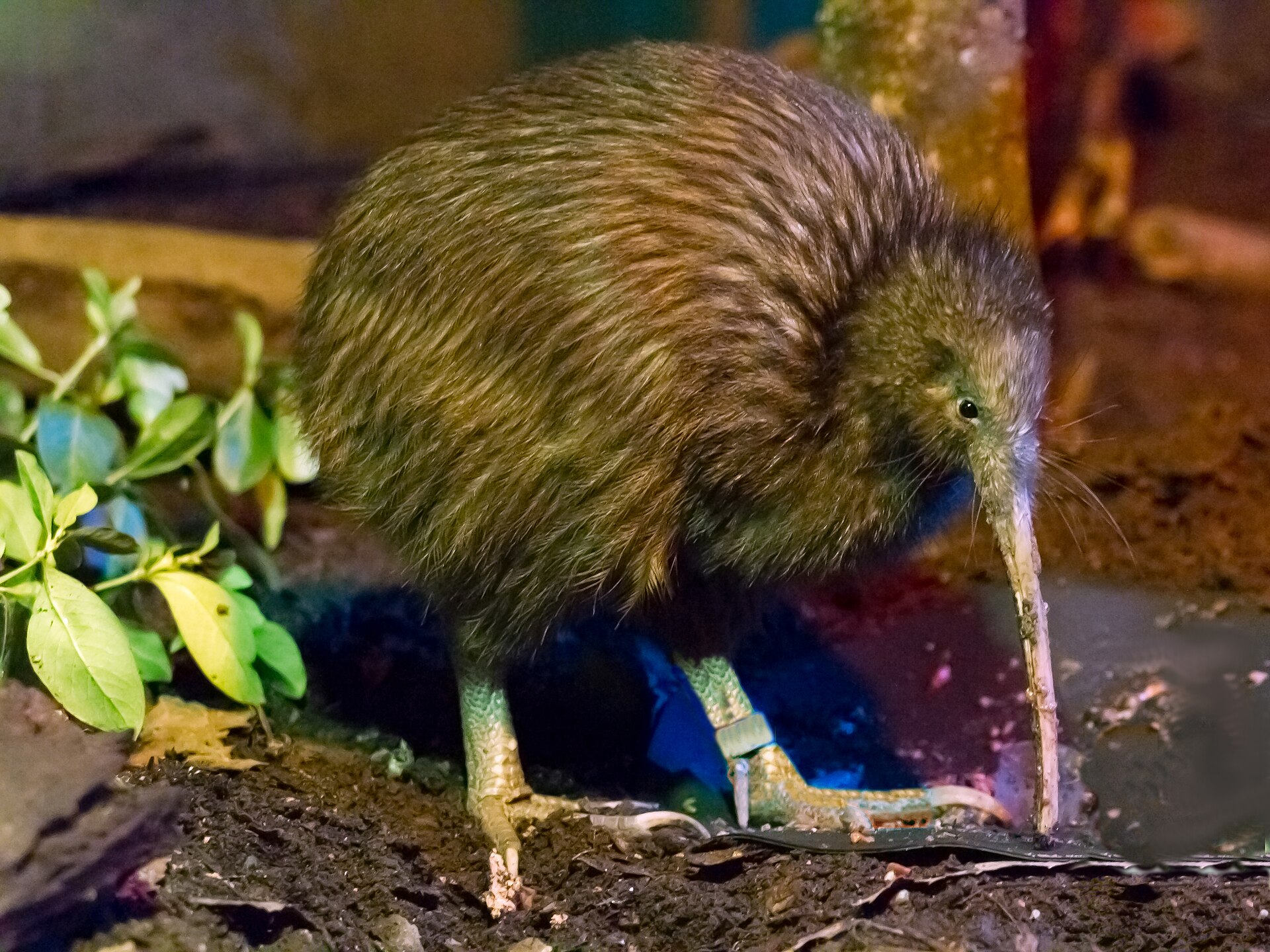
North Island Brown Kiwi
Apteryx mantelli
Characteristics
Temperament
Strictly nocturnal, monogamous, territorial. ONLY bird with nostrils at beak tip. Exceptional sense of smell (rare among birds). Hairlike feathers (no barbules, no flight). Giant egg 15-20% F weight. MALE incubates 74-85 days. Vibrissae and 38°C temperature "honorary mammal". Poor vision. NZ symbol.
Diet
Omnivore with preference for soil invertebrates. Worms (40-50%), larvae, insects, spiders, snails. Hunts with exceptional smell and long beak (12-15 cm) — nostrils at the beak TIP. Forages 6-10 nocturnal hours. 200-500 g food/day. Herbst vibrotactile sensors at beak tip.
The North Island Brown Kiwi (Apteryx mantelli), in Maori "kiwi-pukupuku", is one of 5 kiwi species endemic to New Zealand. It is a flightless ratite bird, similar in size to a chicken (height 35-45 cm, weight 1.3-3.3 kg), nocturnal and deeply iconic: national symbol of New Zealand to such an extent that its citizens are colloquially called "Kiwis". The kiwi is unique in the bird world for numerous anatomical and behavioural features: nostrils at the tip of the beak (unique case among the 11,000 bird species in the world!), exceptionally developed sense of smell (unusual for birds which generally have weak smell), "hairlike" feathers more similar to mammal fur than traditional feathers, and an extraordinary reproductive strategy: the female lays a single huge egg of 430-500 g representing 15-20% of the mother's body weight — the largest egg in proportion to body in the animal kingdom. Furthermore, contrary to most ratites (like the ostrich), in the kiwi it is the male who incubates the egg alone for 74-85 days. Sacred to the Maori who called it "Te Manu Huna a Tāne" (the hidden bird of Tāne), the god of the forest. IUCN status: Vulnerable (VU) — population of about 26,000 individuals declining by 2% per year due to introduced predators.
Classification and category
The North Island Brown Kiwi belongs to the order Apterygiformes ("apterygiformes", literally "without wings"), family Apterygidae (apterygids), genus Apteryx. Etymology: Apteryx from the Greek "a-" (without) + "pteryx" (wing) — referring to the atrophied and useless wings. The family Apterygidae is exclusively New Zealand and comprises 5 species:
- Apteryx mantelli — North Island Brown Kiwi (subject of this entry)
- Apteryx australis — Southern Brown Kiwi or Tokoeka (South Island)
- Apteryx owenii — Little Spotted Kiwi
- Apteryx haastii — Great Spotted Kiwi
- Apteryx rowi — Okarito Kiwi
The North Island Brown Kiwi A. mantelli was scientifically described by Bartlett in 1852, dedicated to the palaeontologist Gideon Mantell. Originally considered a subspecies of A. australis, it was elevated to a distinct species in 2003 based on mitochondrial DNA analyses (Burbidge et al.). The closest relatives of kiwis are the ratites (ostriches, emus, cassowaries, rheas, extinct moas). Recent genetic studies (Mitchell et al., 2014; Nature) have revolutionised our understanding: the kiwi is genetically closer to the moa (an extinct bird of Madagascar — not New Zealand!) and to the Australian emu rather than to the New Zealand moa. This suggests that kiwis arrived in NZ flying from Australia or Madagascar about 50-60 million years ago, subsequently losing the ability to fly.
The morphological parameters of the North Island Brown Kiwi:
- Height: 35-45 cm
- Weight: 1.3-3.3 kg (females notably larger than males — inversion of sexual dimorphism, rare among birds)
- Beak: 12-15 cm (1/3 of body length, very long in proportion!)
- Tail: reduced, almost absent (3-5 cm, covered by feathers)
- Wings: vestigial (3-4 cm, completely atrophied, hidden under body plumage); not functional
- Legs: short, sturdy, with 3 forward-facing toes and 1 reduced, strong nails
Longevity: 25-50 years in nature (exceptional for a medium-sized bird), record 60 years in captivity. Sexual maturity: 3-5 years (very late for a bird). Kiwis are monogamous and form pairs for life (up to 30+ years).
Habitat and distribution
The North Island Brown Kiwi is endemic to the North Island of New Zealand. Originally it inhabited the whole island, but today it is confined to fragmented populations in:
- Northland: largest population (~15,000 individuals)
- Coromandel Peninsula: ~3,000 individuals
- Aotuhia Forest: small protected population
- Eastern North Island: 6,000 individuals
- Volcanic Plateau: 2,000 individuals
- Tongariro National Park: small nucleus
- Capital Kiwi Project, Wellington: reintroduction 2018-present, first time in over 100 years
Preferred habitat:
- Indigenous temperate forests: New Zealand beech (Nothofagus), podocarp-broadleaf forests, manuka-kanuka
- Dense understorey with ferns, ground covered with leaf litter to dig in
- Soft and humid soil: the kiwi uses the long beak to hunt in the ground
- Near water courses: they drink and bathe
- Areas undisturbed by humans: extremely sensitive to noise and night light
The North Island Brown Kiwi does NOT tolerate: open grasslands, urban environments, forests with introduced predators (cats, stoats, rats). Estimated global population: 26,000 mature individuals (Department of Conservation NZ 2018), declining by 2% per year. IUCN status: Vulnerable (VU). Main threats:
- Introduced stoats (Mustela erminea): main predator of young, kills 95% of juvenile kiwis within 6 months without protection
- Stray and domestic cats: cause 50% of adult deaths
- Dogs: cause 10-20% of adult deaths (even pet dogs can kill kiwis)
- Rats: egg and chick predation
- Road accidents: 200-500 deaths/year
- Habitat loss: historic deforestation for pastures
Active conservation: the "Kiwi Recovery Programme" (Department of Conservation NZ, since 1991) is one of the best-funded conservation programmes in the world. Strategies: (1) "Operation Nest Egg" — eggs collected from the wild, incubated, chicks raised in captivity to 1 kg (resist predators), then released: increases survival from 5% to 65%. (2) Predator-Free Islands — eradication of all introduced mammals from nearby islands (e.g. Kapiti, Mokoia, Motuihe), kiwi transfer. (3) Predator-Free 2050 — national programme to eradicate rats, stoats and possums from the entire country by 2050. Species reduced from tens of millions (pre-European colonisation) to less than 100,000 total today (all 5 species).
Diet
The North Island Brown Kiwi is an omnivore, with preference for soil invertebrates. Diet:
- Worms (oligochaetes): preferred prey, constitutes 40-50% of diet — uses exceptional smell and long beak to hunt them underground (5-15 cm deep)
- Insect larvae and nymphs: cicadas, beetles, flies, ants — 30% diet
- Adult insects: giant weta, spiders, beetles, moths — 10-15%
- Terrestrial crustaceans: isopods, land scorpions
- Snails, slugs
- Fruit and berries: occasional, mainly in autumn-winter
- Seeds and leaves: rare, but can supplement
The hunting technique is extraordinary. The kiwi is one of the very few birds in the world with highly developed sense of smell (most birds have rudimentary or no sense of smell). The olfactory bulb in the kiwi's brain is proportionally 10 times larger than that of a swallow. The nostrils at the tip of the beak (unique feature in the bird world!) allow it to "smell" the ground as it walks, locating worms, larvae, underground insects up to 15 cm deep. When it detects prey, the kiwi:
- Marks with the beak the precise spot
- Inserts the long beak into the ground up to the worm/larva
- Grabs it with the beak tips (extremely sensitive)
- Extracts it with a "whip" movement of the head
The kiwi eats about 200-500 g of food/day (15-25% body weight, high due to fast metabolism). Forages for 6-10 nocturnal hours, mainly after dusk. A peculiarity: it has vibrotactile sensors at the tip of the beak (Herbst "organs") that detect movements of underground prey — unique combination of smell + tactile mechanoreception.
Physical features
The North Island Brown Kiwi has an unmistakable appearance, completely different from any other living bird. The shape is similar to that of a chicken or partridge: ovoid body, short legs, medium neck, small head. The beak is the most distinctive feature:
- Length: 12-15 cm — about 1/3 of body length!
- Shape: straight, thin, slightly curved downward
- Colour: ivory-pink
- Nostrils at the tip: the kiwi is the ONLY bird in the world with external nostrils at the tip of the beak (in all other birds they are at the base, near the eyes)
- Sensitivity: the tip is equipped with numerous mechanical receptors, chemoreceptors, and nerve fibres — it is considered one of the most sensitive biological sensors in the animal world
The plumage is extraordinarily different from traditional bird feathers:
- The feathers are fine, thin, similar to mammal hairs ("hairlike feathers")
- They have no barbules (normal feathers have thousands) — this means they are not waterproof and cannot fly
- Colour: brown-grey striped with reddish, camouflaging in the forest understorey
- Function: only thermoregulation (not aerodynamic)
Unique anatomical features:
- Atrophied wings: 3-4 cm, reduced to stumps, hidden under body plumage; not functional
- Sternum without keel: contrary to flying birds, the kiwi's sternum is flat (no attachment for flight muscles)
- Heavy bones: bones NOT hollow as in other birds, but full of marrow (reduces need for "lightness")
- Body temperature: 38°C (lower than average bird 41-42°C, closer to mammals)
- Vibrissae: sensory hairs at the base of the beak (like cat whiskers) — exceptional case among birds
- Heavy mantle: occupies most of the body cavity (rare among birds which have compact organs to minimise weight)
The eyes of the kiwi are small and relatively thin: vision is poor (one of the few birds not relying on sight). They compensate with smell and touch. The inner ear is large, hearing is excellent. The legs are strong, with well-developed fingers, robust curved nails for digging. Females are significantly larger than males (1.5-3.3 kg vs 1.3-2.5 kg) — inversion of normal avian sexual dimorphism.
Behaviour and curiosities
The North Island Brown Kiwi is a strictly nocturnal, monogamous, territorial bird. It comes out only after dusk (1 hour after sunset), active for 6-10 hours, then returns to the "den" at sunrise. The dens are cavities in the undergrowth, holes under tree roots, or cavities between stones — a kiwi has 5-50 different dens in its territory. Territory: 5-50 hectares per couple, aggressively defended. Territorial marking: vocalisations at dusk (very loud "kee-wee" sound, audible 1+ km), scratches on trunks, food remains.
The pair is monogamous for life. Male and female share the territory and call each other frequently with vocal duets (the male makes a high "kee-WEE", the female responds with a low grunt). Reproduction is one of the most extraordinary aspects of the species:
- Mating: August-September (austral winter)
- The giant egg: the female lays 1 single egg of 430-500 g — about 15-20% of her body weight. For comparison: a chicken (3 kg) lays eggs of 60-65 g (2% weight) — the kiwi has the largest egg in proportion to body in the bird world. In the last days before laying, the egg occupies the entire abdominal cavity of the female, who struggles to walk and eat
- MALE incubation: rare but not unique among ratites (emu male also incubates). The male incubates the egg alone for 74-85 days (longest incubation among ratites, surpassed only by albatross), losing up to 20% of his weight. The female can go away completely or help occasionally
- Hatching: the chick comes out fully developed, with adult plumage, eyes open, can walk in 2-3 days — completely different from chicks of other birds that are altricial
- Independence: the small one leaves the den after 1 week and becomes independent from the parent — the only ratite with such precocial chicks
Famous curiosities: the national symbol of New Zealand. The kiwi has appeared on NZ postal stamps since 1898, on the 1 dollar coin since 1991. New Zealand citizens have been colloquially called "Kiwis" since the First World War (ANZAC soldiers were called so). The national rugby team of New Zealand (All Blacks) has the kiwi on the emblem. The NZ dollar is called "kiwi-dollar". The kiwi-fruit (Actinidia deliciosa, Chinese fruit) took the name from this bird in 1959 when it was marketed in NZ.
"Flightless paradox" curiosity: kiwis show a classic case of regressive evolution. Their ancestors were flying (probably relatives of the pre-flight moa or emu). When they arrived in NZ (50-60 Mya), there were no terrestrial mammalian predators (NZ was separated from Australia 80 Mya). Without aerial predation pressure, developing/maintaining flight was energetically expensive and unnecessary. Result: in 50 Mya, they lost wings, sternum-keel, hollow bones, and developed nocturnal-olfactory adaptations typical of a mammal. For this reason kiwis are often called "honorary mammals".
Maori culture curiosity: the Maori call the kiwi "te manu huna a Tāne" (the hidden bird of Tāne — god of the forest). In Maori mythology, the kiwi once lived high in the trees together with other birds. When a demon began to devour the trees of the forest, Tāne asked which of the birds would give up the sky to come down to earth and protect the forest. Only the kiwi accepted the sacrifice. Tāne took away its colours, wings and ability to fly, but gave it eternal honour as "the guardian of the forest". The Maori never hunted the kiwi (sacred tapu); they only used feathers of naturally dead kiwi to make "kahukiwi" — sacred cloaks worn by tribal chiefs. A kahukiwi cloak required 11,000+ feathers and was a symbol of nobility.
"Genome" and colour blindness curiosity: genetic studies (2014) have shown that kiwis have lost the genes for colour vision (unlike other birds): they can see only in black and white. Furthermore, some genes for flight have become pseudogenes (present but not functional). The kiwi genome is one of the most studied in birds for studying regressive evolution.
"Death by dog" curiosity: the kiwi is particularly vulnerable to dogs due to a unique anatomy: its rib cage is keelless, making it fragile. A dog blow can perforate internal organs — a kiwi can die even if the dog did not intend to kill it. The Department of Conservation NZ has launched the "Dog control near kiwi" campaign to educate owners.
Longevity curiosity: kiwis are among the longest-lived birds in the world: 25-50 years in nature, 60+ in captivity. Absolute record: "Sue" — North Island brown kiwi female at Auckland zoo, lived 65 years (1958-2023). Body temperature curiosity: 38°C, very low for a bird (average is 41-42°C). This lower temperature, similar to that of mammals, is another example of evolutionary "mammalisation" of the kiwi. Vibrissae curiosity: the kiwi is the only bird with vibrissae (sensory hairs at the base of the beak). Vibrissae are typical of mammals (cats, mice, etc.) and are absent in all other living birds — another "mammal-like" adaptation. Kiwi diversity curiosity: 5 existing species, but there were hundreds of millions of kiwis before human arrival (1280 AD). Today all species are in decline or locally extinct. Capital Kiwi Project curiosity: since 2018, kiwis have been reintroduced to Wellington (NZ capital) for the first time in 100+ years, thanks to intensive predator eradication operations. The population is growing. "Kiwi intelligence" curiosity: recent studies (2020) have shown that kiwis have surprisingly developed cognitive abilities: individual recognition (recognise up to 50 conspecifics), spatial memory (remember hundreds of "dens" in their territories), and problem solving (in the laboratory solve simple puzzles to get food). "Kiwi fruit" curiosity: the Chinese gooseberry (Actinidia deliciosa) was renamed "kiwifruit" in 1959 when NZ began to export it, taking the name from the famous national bird. The fruit has no biological relation to the bird.
Pros
- Unicum mondiale: narici alla punta del becco, vibrisse, penne capelli
- Uovo più grande in proporzione al corpo del regno animale (15-20%)
- Simbolo nazionale NZ (cittadini = 'Kiwis', All Blacks rugby)
- Longevità eccezionale (25-50 anni in natura, record 65 in cattività)
Cons
- IUCN Vulnerable, in declino 2%/anno
- Predazione critica da ermellini, gatti, cani introdotti (95% mortalità giovanile)
- Gabbia toracica fragile (priva di chiglia): muore facilmente al primo morso
- Maturità sessuale tardiva (3-5 anni), riproduzione lenta (1 uovo/anno)