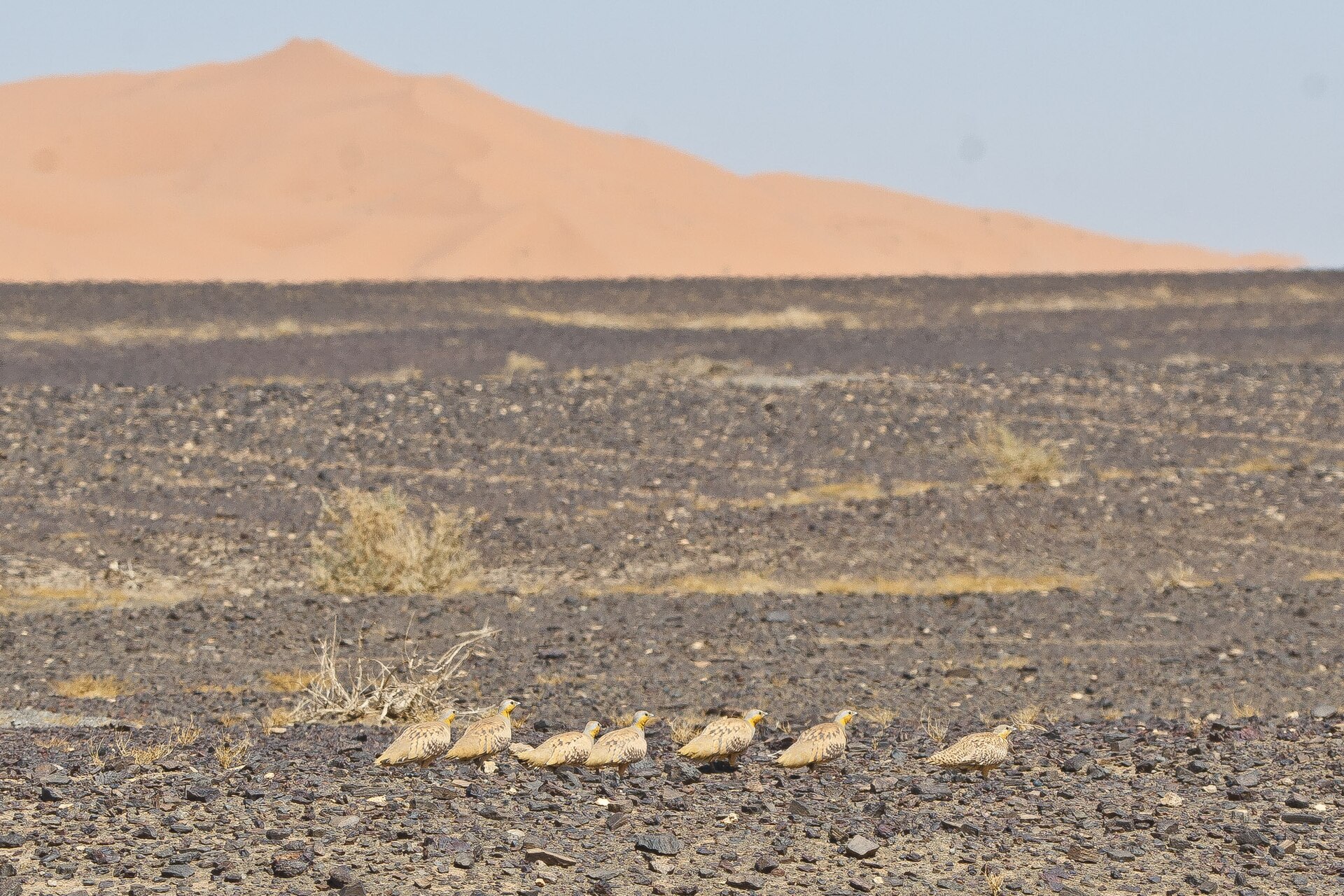
Spotted Sandgrouse
Pterocles senegallus
Characteristics
Temperament
Gregarious, diurnal, nomadic. Desert bird (Sahara, Arabia) sharing the range of Sand Cat and Jerboa. CARRIES WATER IN ITS FEATHERS: the male soaks his belly feathers like a sponge and flies up to 30 km to water the chicks (one of the most extraordinary parental adaptations!). Perfect sandy camouflage, very fast flier (~70 km/h). Lives in flocks gathering at water holes. Contrast with the Jerboa that never drinks.
Diet
Specialized granivore. Seeds (main: desert plants, grasses, legumes), occasional shoots/tender leaves, rare small invertebrates (chicks). Ground foraging in flocks. Dry diet (water-poor seeds) forcing regular drinking: flies to water holes at dawn/dusk and drinks large amounts rapidly, sucking like pigeons.
The Spotted Sandgrouse (Pterocles senegallus) is a desert bird iconic of Old World deserts (Sahara, Sahel, Arabia, to Pakistan and NW India). Famous for:
- CARRIES WATER IN ITS FEATHERS! The male has modified belly feathers that absorb water like a sponge. He flies up to 30 km to water holes, soaks his breast, and returns to the nest where chicks drink by stripping water from the feathers with their beaks — one of the most extraordinary parental adaptations in birds!
- Same desert as the Sand Cat and Jerboa (both in catalogue) — Sahara and Arabia
- Perfect camouflage: sandy plumage makes it invisible on desert ground
- Very fast flier: up to ~70 km/h, travels long distances to water at dawn/dusk
- Pin tail: male has elongated central tail feathers
- Lives in flocks: gathers in large groups at water holes
- Specialized granivore: feeds on desert plant seeds
IUCN status: Least Concern (LC). Common, widespread across North African, Middle Eastern and SW Asian deserts. THEMATIC CONTRAST: while the Jerboa (in catalogue) NEVER DRINKS (metabolic hydration), the sandgrouse MUST drink and travels huge distances for water, even carrying it in its feathers — two opposite strategies for the same arid desert.
Classification and category
Order Pterocliformes (sandgrouse), family Pteroclidae, genus Pterocles. Sandgrouse are a unique group of Old World desert/steppe birds, once thought related to grouse/pigeons, now placed in their own order (Pterocliformes), relatives of pigeons (Columbiformes). Pteroclidae: ~16 species in 2 genera (Pterocles 14 species, Syrrhaptes 2). Notable: P. senegallus (this entry), P. alchata (also in Spain), P. namaqua (famous Kalahari water-carrier), P. exustus. Etymology: "Pterocles" Greek "pteron" (wing) + "kleos" (glory); "senegallus" refers to Senegal. Parameters: Length 30-35 cm (with pin tail). Weight 250-340 g. Wingspan ~50-55 cm. Longevity 5-10 years. Monogamous, ground nest, 2-3 cryptic eggs, ~21-23 day incubation shared (female by day, male by night), precocial chicks.
Habitat and distribution
Old World deserts and semi-deserts: North Africa (Sahara, Sahel), arid East Africa (Sudan, Chad), Arabian Peninsula, Middle East and Asia (Iran, Afghanistan, Pakistan, NW India). Habitats: sandy/stony deserts (main), semi-deserts with sparse bushes, arid plains, wadis. Avoids forests, permanent wetlands, dense vegetation. Strongly water-dependent despite arid habitat: must drink regularly, travels up to 30-60 km to water at dawn/dusk in large flocks. IUCN: Least Concern, stable.
Diet
Specialized granivore. Diet: seeds (main — desert plants, grasses, legumes), occasional shoots/tender leaves, rare small invertebrates (growing chicks). Technique: ground foraging (walks collecting fallen seeds), feeds in flocks (exploits seed-rich areas after rains), dry diet (seeds very low in water — hence regular drinking), daily watering (flies to water holes, drinks large amounts rapidly). Unlike the Jerboa (in catalogue) which never drinks (metabolic hydration), the sandgrouse's dry seed diet forces regular drinking — driving its unique water-related behaviours: daily flights to water and water-carrying in the male's feathers.
Physical features
Compact, cryptic body adapted to desert life. Plumage: sandy/beige-fulvous/ochre base (perfect camouflage). Male: yellow-ochre face and throat, uniform grey-sand upperparts, dark belly line, ELONGATED central tail feathers (pin tail), belly feathers SPECIALIZED to absorb water. Female: more densely spotted/barred (hence "spotted"), even more cryptic. Body: small head, short stout granivore bill, compact pigeon-like body, long pointed wings (fast long-distance flight), short legs feathered to the toes (hot sandy ground). Physiology: male belly feathers with unique microstructure (coiled barbules) holding 25-40 ml water like a sponge; fast flight ~70 km/h; immobile camouflage; guttural/whistling flight calls coordinating flocks.
Behaviour and curiosities
Gregarious, diurnal, nomadic. Lives in flocks, movements dictated by water and seed availability (after rains). Monogamous, ground nest (simple scrape near a bush). 2-3 cryptic eggs, shared incubation (female day, male night — using their respective camouflage). Precocial nidifugous chicks, walk and peck soon but depend on water carried by father.
Famous: "water-carrying in feathers" — one of the most extraordinary parental adaptations in the animal kingdom. The male's belly feathers have a unique microstructure (modified barbules) acting like a SPONGE: (1) flies to nearest water hole (up to 30 km!), (2) immerses and "rocks" his breast to soak it, (3) feathers absorb 25-40 ml water, (4) flies back to nest (another 30 km), (5) chicks drink by stripping/nibbling the wet feathers with their beaks. Lets chicks survive in arid desert where they couldn't reach water themselves; repeated daily for weeks. "Contrast with the Jerboa": same desert, opposite water strategies (Jerboa never drinks; sandgrouse must drink and carries water). "Flocks at water": dawn/dusk gatherings of hundreds/thousands, drinking rapidly. "Perfect camouflage": flattens immobile, explodes into flight only at the last moment. "Drinks like pigeons": sucks water continuously without raising head (rare in birds — predator-time saver). "Feathered legs": heat protection, convergent with Sand Cat and Jerboa. "Misleading name": not related to grouse — closest to pigeons (Columbiformes). "Nomadism": movements follow irregular desert rains.
Pros
- Adattamento del trasporto d'acqua nelle piume — unico al mondo
- Mimetismo perfetto e volo velocissimo
- Uccello iconico dei deserti, ben distribuito
- IUCN Least Concern, popolazione stabile
Cons
- Fortemente dipendente dalle pozze d'acqua (vulnerabile alla siccità)
- Cacciata tradizionalmente ai punti d'acqua
- Nido a terra esposto a predatori
- Sensibile alla scomparsa delle fonti d'acqua nel deserto