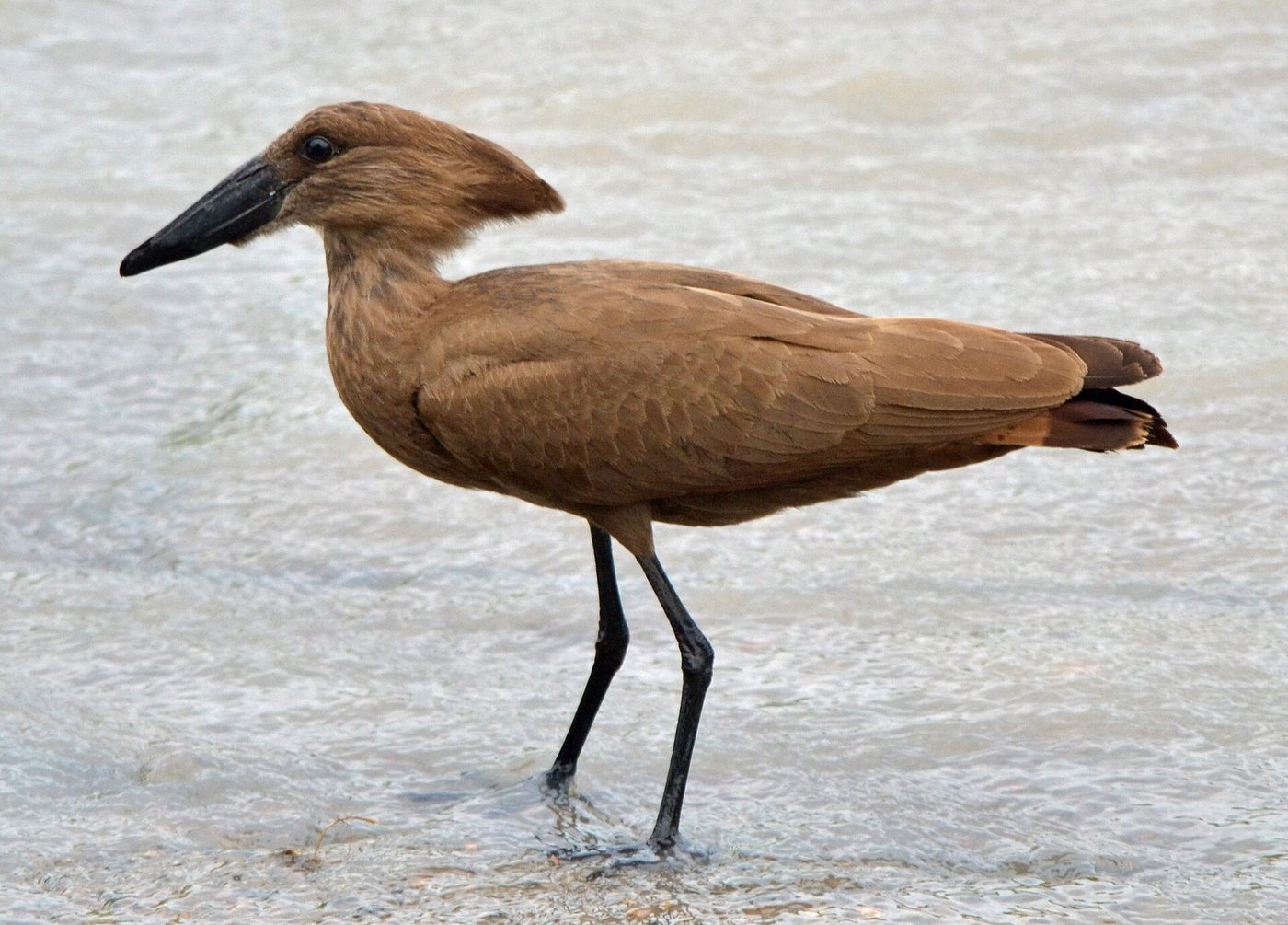
Photo: Voidoffrogs · CC0
Hamerkop
Scopus umbretta
With its hammer-shaped head and its reputation for building the largest nest of any bird, the hamerkop is a curious wader of the African wetlands.
Characteristics
Temperament
Calm, sedentary, great builder
Diet
Carnivore: amphibians, fish, insects and invertebrates
The bird with a hammer-shaped head
The hamerkop is a medium-sized wading bird with entirely brown plumage, elegant in its plainness. Its most curious feature is its head: the long, sturdy bill, combined with a crest of feathers pointing backwards at the nape, gives it a silhouette recalling a hammer, from which comes its name, hamerkop being the Afrikaans word for 'hammerhead'. It has long legs suited to wading in shallow water and a calm, deliberate bearing. It is the only species in its family, without close relatives among living birds except, distantly, pelicans and the shoebill.
Habitat and distribution
It lives across much of sub-Saharan Africa, as well as in Madagascar and the Arabian Peninsula. It frequents a wide variety of wetlands: lake and river banks, ponds, estuaries, marshes and even rocky coasts. It is a mainly sedentary bird, which nevertheless makes local movements in search of water and food.
The largest nest in the world
The most extraordinary feature of the hamerkop is its nest, the largest built by any bird. It is a huge domed structure, made of sticks, mud, grass and all kinds of material, with an internal cavity accessed through a side entrance. The nest can reach imposing dimensions and be so solid as to bear a person's weight. The pair works on it for weeks and often builds more than one; abandoned nests are then used by other animals.
Feeding and conservation
The hamerkop feeds mainly on amphibians, especially frogs and tadpoles, as well as small fish, insects and aquatic invertebrates, which it catches by wading patiently in shallow water. It is classified as a species of least concern, with large, widespread populations. In several African cultures it is surrounded by legends and sometimes regarded as a bird with special powers.
Pros
- Builds the largest nest of any bird
- Unmistakable head silhouette
- Large, unthreatened populations
- Valuable inhabitant of wetlands
Cons
- Depends on wetlands and water
- Sensitive to degradation of aquatic habitats
- Nests sometimes occupied or destroyed by other animals