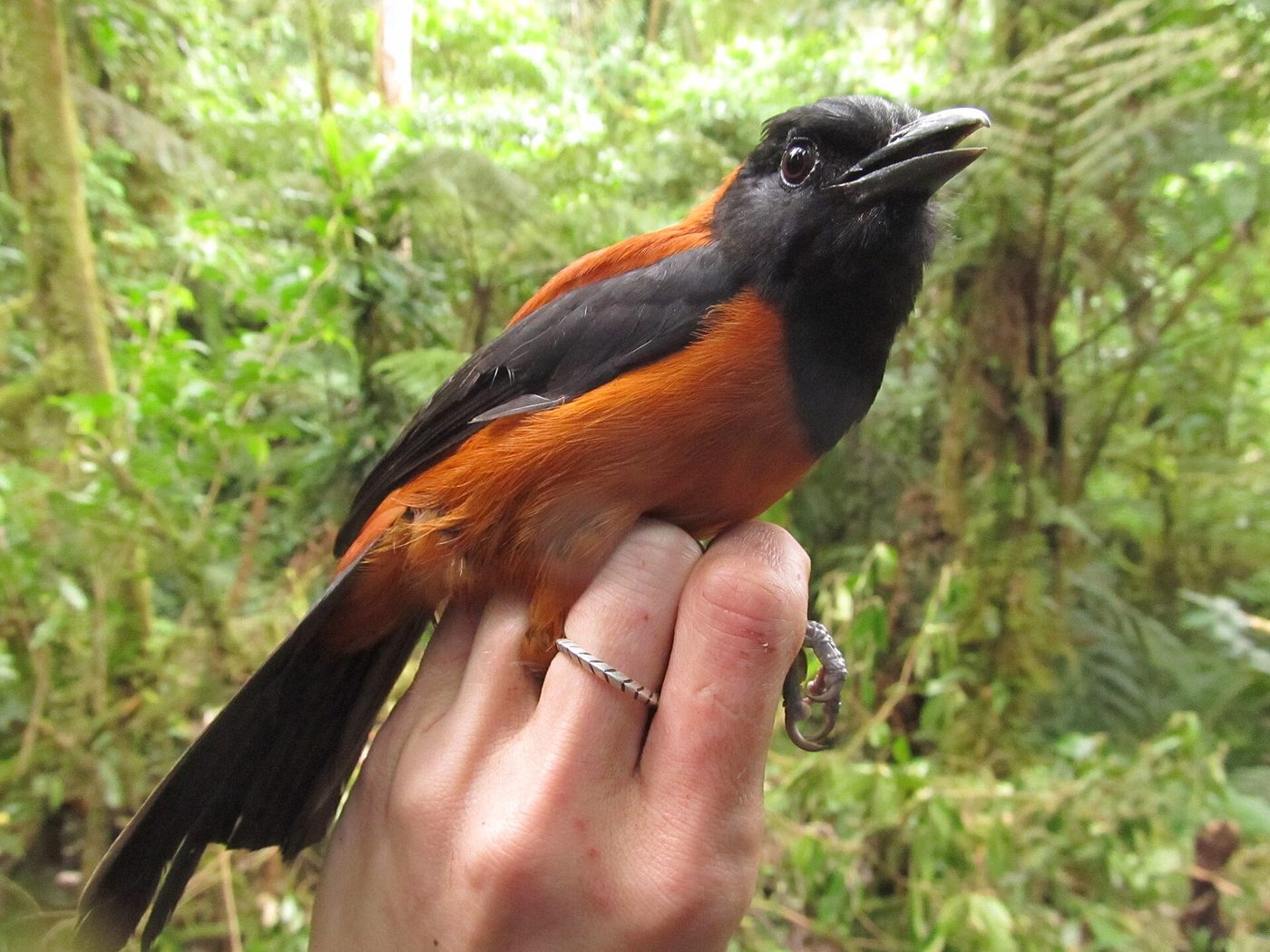
Photo: Benjamin Freeman · CC BY 4.0
Hooded pitohui
Pitohui dichrous
A black-and-orange bird of New Guinea, the hooded pitohui is one of the very few poisonous birds in the world: its skin and feathers hold a potent toxin.
Characteristics
Temperament
Active, arboreal, chemically defended
Diet
Omnivore: fruit, seeds, invertebrates
A rare poisonous bird
The hooded pitohui is a passerine of the oriole family, with plain but striking plumage: black head, wings and tail, and a rich rusty-orange back and belly.
(Note: the mass value given by Wikidata, 93 kg, is plainly wrong for a bird of this size; its true weight is around 65–75 grams.)
Its fame, however, comes not from its colours but from being one of the very few birds known to be poisonous. Its skin and feathers contain batrachotoxins, the same potent alkaloids found in the poison dart frogs of South America. Handling the bird can cause tingling and numbness, and the vivid colour contrast probably acts as a warning signal (aposematism).
Habitat and distribution
It is endemic to New Guinea, where it inhabits forests and hill woodland. It is a relatively common bird within its range.
Behaviour and diet
It feeds on fruit, seeds and invertebrates. The poison is thought to come from the diet: the birds acquire the toxins by eating small beetles of the genus Choresine, then store them in their tissues. The bright colour and pungent smell deter predators and perhaps also external parasites.
Curiosities
The discovery of the pitohui's toxicity, made almost by chance when researchers licked their fingers after handling it, overturned the idea that birds could not be poisonous. Local peoples of New Guinea had long known this foul-tasting "rubbish bird".
Conservation
The IUCN lists the species as Least Concern: it has a wide range and stable populations, with no significant known threats.
Pros
- One of the very few known poisonous birds
- Aposematic black-and-orange colouring
- Wide range and stable populations
Cons
- Toxic skin and feathers: not to be handled
- Not a pet: highly specialised wild needs
- Pungent smell and unpleasant taste