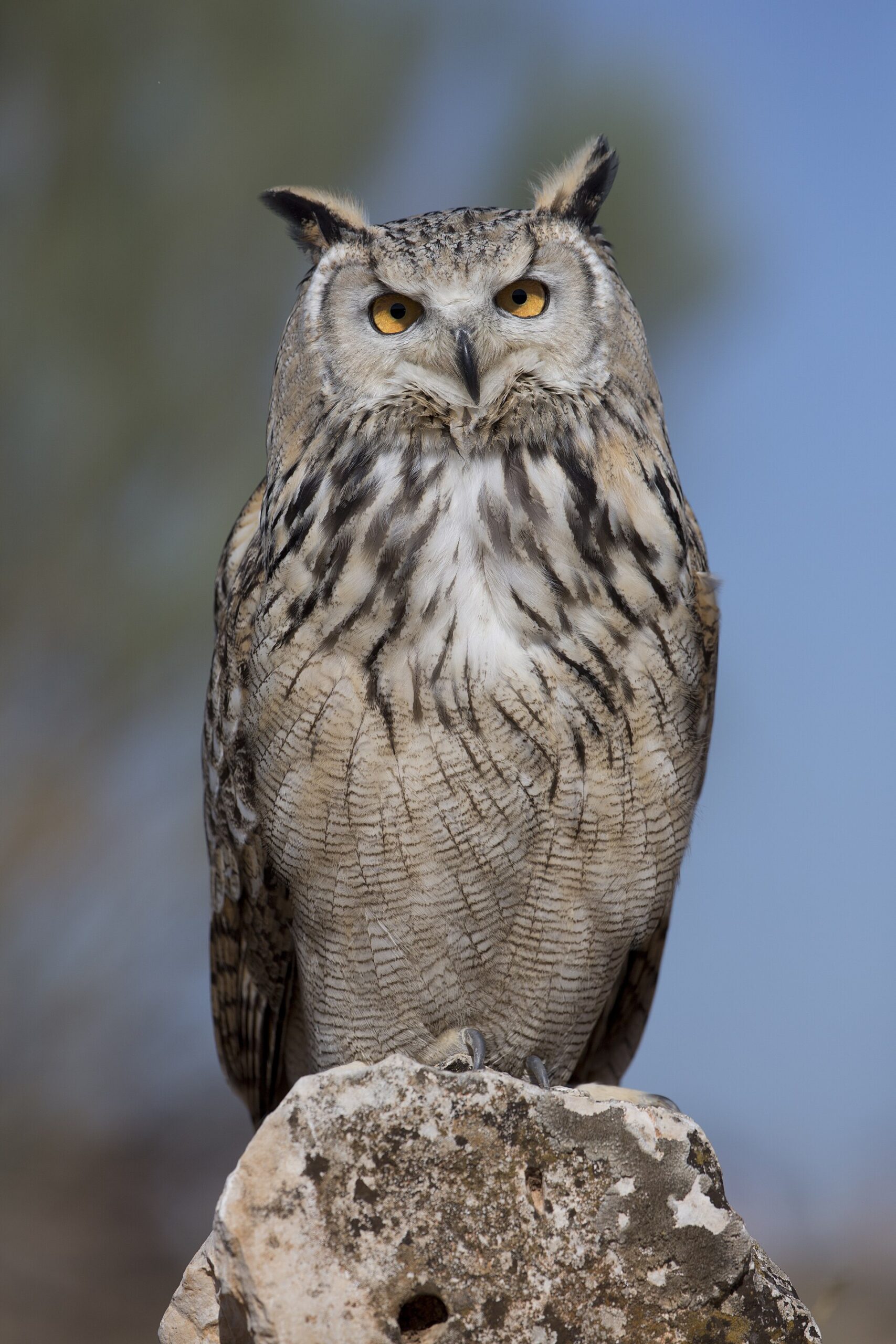
Eurasian Eagle-Owl
Bubo bubo
Characteristics
Temperament
Nocturnal, solitary, strongly territorial. Monogamous for life. Flies silently. Can rotate the head up to 270°. "Buho-buho" call audible for kilometres.
Diet
Opportunistic carnivore: rodents, hedgehogs, hares, rabbits, marmots, pheasants, ducks, even other raptors. Daily requirement: 250-400 g of meat.
The Eurasian Eagle-Owl (Bubo bubo) is the largest nocturnal raptor of the Palearctic and one of the most imposing owl species in the world. Recognisable by its great size, the "ear tufts" of feathers on the head (which are not actual ears but ornamental plumes) and its intense orange eyes, it is a silent and powerful hunter, the symbol of European and Asian forests and rocky cliffs.
Classification and category
The Eurasian Eagle-Owl belongs to the order Strigiformes, family Strigidae, genus Bubo. There are numerous subspecies distributed along the vast Eurasian range, with slight differences in size and colouration. It is a very large raptor: body length is 60-75 cm and wingspan reaches 160-188 cm; average adult weight is 1.5-4 kg, with females noticeably larger than males — the typical reverse sexual dimorphism of raptors, which allows pairs to exploit prey of different sizes.
Habitat and distribution
The Eurasian Eagle-Owl's habitat is extremely varied: rocky walls, gorges, old quarries, boreal forests, open mountain environments, wooded steppes and semi-deserts. Rocky walls are particularly important for nesting: the species does not build an actual nest but uses natural niches, ledges and rarely old nests of diurnal raptors. It prefers quiet areas, with little human presence and abundant prey.
Its range is enormous and covers practically all of Europe (excluding Iceland, Ireland and most of the United Kingdom), North Africa, the Middle East, much of Asia as far as Japan and Sakhalin, and south to the Himalayas. In Italy it is present with stable populations along the Alpine arc, on the Apennine ridge down to Calabria, in Sicily and in Sardinia, where an endemic subspecies (Bubo bubo sardus) lives. Its conservation status is listed as Least Concern (LC) by the IUCN, but the species is strictly protected by the EU Birds Directive (Annex I) and in many European countries is considered "specially protected". The main threats are electrocution on power lines, road collisions and illegal persecution.
Diet
The Eurasian Eagle-Owl is an opportunistic carnivore and one of the most versatile predators among raptors. Its diet is extremely wide: it includes rats, wild mice, hedgehogs (the only prey whose spines its feet can survive), rabbits, hares, marmots, beech martens, weasels, young foxes, and even large birds such as ducks, young geese, pheasants, corvids and even other diurnal raptors such as buzzards and kestrels.
Hunting takes place mainly at dusk and during the first hours of the night. It flies silently thanks to feathers with serrated edges that muffle the noise of air; it catches prey with a lightning-fast attack from above, using sturdy legs armed with claws up to 4 cm long. A large prey item (e.g. a rabbit) provides food for 2-3 nights; daily requirement is about 250-400 g of meat. Undigested residues (bones, fur, feathers) are regurgitated as pellets: elongated 5-10 cm pellets, very useful to zoologists for studying its diet.
Physical features
The Eurasian Eagle-Owl's plumage is a variable tawny brown, with more or less pronounced dark streaks, perfect for camouflage on bark. The belly is paler, streaked with black. The head is large and rounded, equipped with a slightly defined facial disc (unlike owls of the genus Strix) and two ear tufts of 6-9 cm, fully erectile and used as a visual signal in intraspecific interactions. The eyes are huge (occupying over 50% of the skull volume), of bright orange colour.
Like all strigiforms, the Eurasian Eagle-Owl can rotate its head up to 270° thanks to 14 cervical vertebrae (humans have 7) and a special vascular system that prevents interruption of blood flow during rotation. The beak is hooked and black. The legs are completely covered in feathers down to the talons, a useful feature for thermoregulation and silent capture.
Behaviour and curiosities
The Eurasian Eagle-Owl is a monogamous, sedentary and strongly territorial species. The pair remains stable for many years or for life and defends a territory of 15-80 km². The territorial song is one of the most characteristic and haunting sounds of the European night: a deep "buho-buho" that travels for kilometres (hence the scientific name Bubo bubo, onomatopoeic).
The breeding season starts very early, already in January-February, when pairs begin duetting. The female lays 1-4 eggs (usually 2-3) between late February and March, in a simple depression on a rocky ledge or in a shallow cave. Incubation lasts 32-36 days and is performed exclusively by the female; the male brings food. The young leave the nest at 5-7 weeks, even before being able to fly ("branchers"), and remain dependent on the parents for another 4-5 months. Lifespan is 15-20 years in the wild, up to 60 in captivity. In European mythology the Eurasian Eagle-Owl has long been an ambivalent symbol: in Ancient Greece it was sacred to Athena (goddess of wisdom), while in many medieval folk traditions it was considered an omen of death — a cultural paradox linked to its nocturnal song and its presence in lonely places.
Pros
- Predatore apicale, regola popolazioni di roditori
- Longevo (oltre 60 anni in cattività)
- Adattabile a molti ambienti
- Reintroduzione urbana successo (Berlino, Helsinki)
Cons
- Specie selvatica, NON è un animale da compagnia
- Elettrocuzione su linee elettriche: principale causa di mortalità
- Nidi accessibili: vulnerabili al disturbo umano
- Molto sensibile al rumore antropico