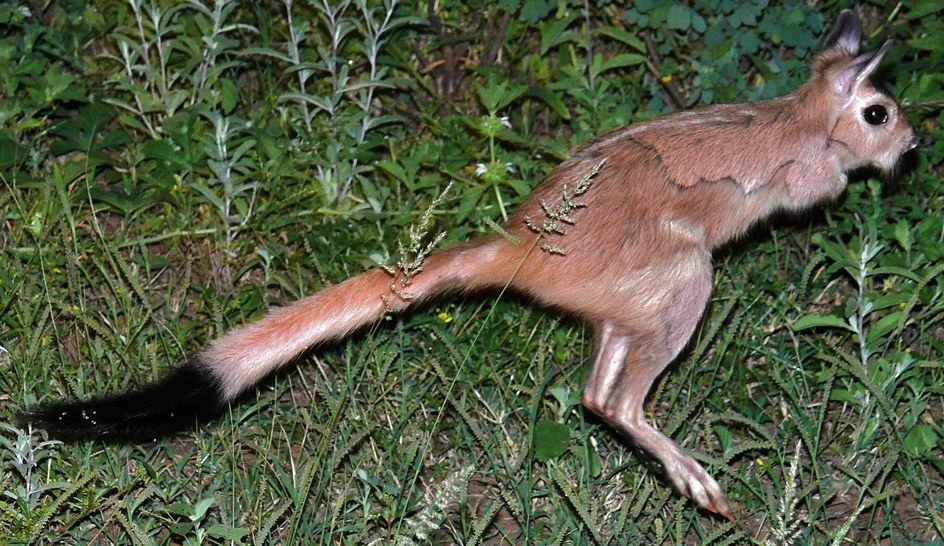
Springhare
Pedetes capensis
Characteristics
Temperament
Nocturnal, gregarious, semi-colonial. UNIQUE bipedal jumper among African rodents (convergence with kangaroos/American Kangaroo Rats). 2-3 m horizontal jumps at 50 km/h. Red-orange BIOFLUORESCENCE discovered 2021 (one of first documented biofluorescent mammals). MONOTYPIC family Pedetidae. Underground burrows with 3-5 exits. K-selected "single cub" strategy (rare among rodents).
Diet
Opportunistic herbivore/frugivore. Grasses 60-70% diet (Aristida, Eragrostis, Cynodon), roots/bulbs 10-15%, wild fruits, legume seeds, tender leaves, occasional crops (conflict source). ~150-300 g vegetation/day. NO cecotrophy (unlike rabbits). Tolerates long water absence, gets moisture from green grasses and roots. Grazes within 100-500 m of burrow.
The Springhare (Pedetes capensis), also known as the African Springhare, Springhaas (Afrikaans), is an African rodent with an extraordinarily unique appearance and behaviour. Distinctive features:
- Bipedal jumper: like a small kangaroo, hops on giant hind legs — horizontal jumps of 2-3 metres at 50 km/h
- BIOFLUORESCENCE discovered in 2021: red-orange under UV light (Olson et al., Scientific Reports, 2021) — one of the first documented biofluorescent mammals
- Evolutionary convergence with American Kangaroo Rats: same morphology, different families and orders (African Pedetidae vs American Heteromyidae)
- Deep underground burrows: digs 1-2 m systems with 3-5 exits
- Monotypic family: Pedetidae contains only the genus Pedetes
- Long furry tail: 35-45 cm with distinctive black tip — used as balance
- Nocturnal and gregarious: small family groups, not true packs
IUCN status: Least Concern (LC). Abundant population throughout sub-Saharan eastern and southern Africa. Local threats: habitat loss, persecution, illegal exotic pet trade.
Classification and category
Order Rodentia, suborder Anomaluromorpha, family Pedetidae, genus Pedetes. Family Pedetidae is essentially monotypic (only Pedetes). Genetically isolated branch within rodents (Murphy et al., 2001). Genus contains 2 living species (recently split): P. capensis (Southern African) and P. surdaster (Eastern African). Separation ~3-5 Mya.
Closest relatives: distantly related to African flying squirrels (Anomaluridae) — both in suborder Anomaluromorpha. Separation 40 Mya. Etymology: "Pedetes" from Greek "pedētēs" (jumper). "Capensis" from Latin "from Cape" (South Africa, Cape of Good Hope). Described by Forster in 1778. Parameters: Weight 3-4 kg (record 4.5). Head-body 35-45 cm. Tail 35-45 cm (equal body!). Total length 70-90 cm. Longevity 8-10 years natural, 14 captive. Sexual maturity 5-12 months. Gestation 80 days. Litter 1 cub (rarely 2) — exceptionally low. 2-4 litters/year.
Habitat and distribution
Endemic to sub-Saharan Africa, mainly southern and eastern dry zones. Main populations: South Africa (Free State, N. Cape, North West, Limpopo), Botswana (Kalahari), Namibia (arid zones), Angola, Zimbabwe, Zambia, Kenya, Tanzania, Uganda S., Ethiopia S. Habitats: dry savannas (main), arid plains (Kalahari, Namib margins), disturbed grasslands, sandy soils (crucial for digging). Avoids dense forests, wetlands, mountain zones above 2,000 m, intensive urban areas.
IUCN: Least Concern. Threats: habitat loss (intensive agriculture), traditional hunting (San, Maasai), persecution (crop damage), illegal pet trade, natural predation (leopards, servals, caracals, lions, hyenas, pythons, eagles). CITES: NOT included.
Diet
Opportunistic herbivore/frugivore. Diet: grasses (60-70% — Aristida, Eragrostis, Cynodon), roots and bulbs (10-15%), wild fruits, legume seeds, tender leaves, crops (peanuts, maize, cereals, vegetables — conflict source), occasional insects (5%). Consumption ~150-300 g vegetation/day. No cecotrophy — single digestion pass. Adapted to dry savannas: tolerates long water absence, gets moisture from green grasses and roots.
Physical features
UNIQUE silhouette — "yellowish hare + miniature kangaroo". Coat: pale yellow-brown, fulvous, sand-coloured (desert camouflage). White-cream belly. Furry tail 35-45 cm with distinctive BLACK TIP. Adults darker than juveniles. Head: large ears (5-8 cm) for nocturnal hearing, ENORMOUS eyes for night vision, short rabbit-like muzzle, long vibrissae. Body: GIANT HIND LEGS (very long, muscular — highest leg/body ratio among African rodents), SHORT forelimbs (1/3 of hind), 4 long hind toes with strong claws (lost forefoot thumb), tail equal to body length (used for balance during jumps), hollow lightweight bones (like birds). Speed: 50 km/h jumping, jumps 3 m horizontal, 1 m vertical record. BIOFLUORESCENCE: fur emits red-orange light under UV (2021 discovery). Vocalisations: high-pitch squeak (alarm), grunting (social), "thumping" with hind feet (alarm signal audible at 50+ m).
Behaviour and curiosities
Nocturnal, gregarious, semi-colonial (small family groups). Territory 5-15 ha. Polygamous. Year-round breeding with peaks in rains. Gestation 80 days. 1 cub/litter (very low) but PRECOCIAL (eyes open, fully furred, 250 g = 8-10% maternal weight). Independence 6-8 weeks. Defence: 2-3 m jump flight to burrow. Black tail tip = visual flag for conspecifics.
Famous curiosities: BIOFLUORESCENCE 2021 discovery. Olson et al. (Scientific Reports, 2021): springhare fur emits red-orange light under UV — among first documented biofluorescent mammals. Cause: porphyrins from blood-derived molecules biosynthesised in fur. Function debated: (1) intraspecific communication (springhares can see UV); (2) UV camouflage against UV-seeing predators; (3) evolutionary spandrel. Convergence with kangaroos: 4 separate lineages evolved bipedal hopping morphology (kangaroos, kangaroo rats, jerboas, springhares). Monotypic family: most genetically isolated African rodent. Two species: split in 2003 — P. capensis (south) and P. surdaster (east). African culture: San Bushmen hunt for food, Maasai imitate jumps in rituals, Setswana "tshipo". Jump record: 7.5:1 jump/body length ratio (highest among rodents). Bipedal posture diagnostic. "Thumping": hindfoot ground beats audible 50+ m. "One cub" strategy: K-selected reproduction (unusual for rodents) due to protective burrows. Multi-exit burrows: 3-5 exits at 1-2 m depth. 2003 space experiment: NASA sent springhares to study microgravity effects on jumping. Longevity: 12 years natural, 14 captive.
Pros
- Biofluorescenza scoperta nel 2021 — fascino scientifico unico
- Famiglia monotipica Pedetidae — fossile vivente
- IUCN Least Concern, popolazione stabile
- Convergenza evolutiva spettacolare con canguri
Cons
- Caccia tradizionale per cibo in alcune comunità africane
- Perdita habitat per agricoltura intensiva
- Cattura illegale per pet trade
- Vulnerabile a predazione da molteplici predatori africani