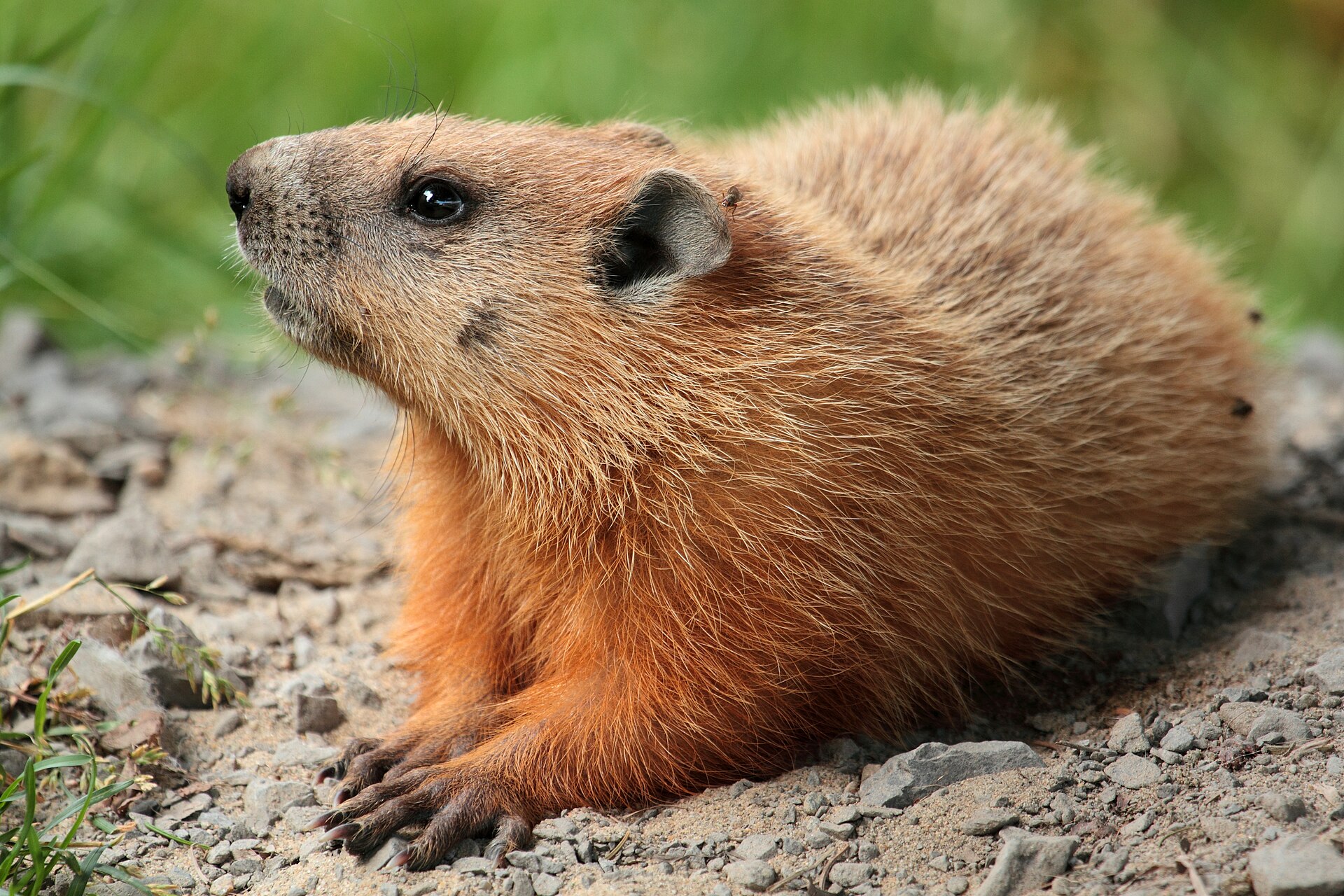
Groundhog
Marmota monax
Characteristics
Temperament
A solitary, diurnal wild rodent, calm but very alert and wary: at the first sign of danger it rears up on its hind legs, gives an alarm whistle and retreats into its burrow. A tireless, territorial digger, it spends most of the year near its own tunnel system and in winter vanishes into a very deep hibernation. It is NOT a pet: it is wildlife, often in conflict with vegetable gardens for its digging and its appetite for crops.
Diet
Essentially herbivorous: it feeds on grasses, clover and alfalfa, leaves, flowers, shoots and tender bark, and on garden vegetables and fruit (hence conflicts with gardeners); occasionally it eats insects and snails. Its whole biology revolves around hibernation: in summer and autumn it eats voraciously to build up large fat reserves, because — unlike squirrels — it does not store food for winter, but lives off those reserves during the months of hibernation, when it fasts entirely.
The Groundhog (Marmota monax), also called the woodchuck, is North America's most widespread lowland marmot: a stocky, robust rodent, a tireless digger and one of the few large mammals to undergo a true hibernation. Famous for:
- Digging skill: it builds extensive, complex burrows with several entrances and distinct chambers
- True hibernation: unlike many animals, it enters deep hibernation, with body temperature and heart rate plummeting
- Lowland life: unlike the alpine marmot, it prefers meadows, fields and forest edges at low elevation
- A stocky, powerful body: short legs, strong claws and muscles built for moving earth
- Worldwide fame: it is the star of the famous Groundhog Day
- The tongue twister: the famous "how much wood would a woodchuck chuck" is dedicated to it
IUCN status: Least Concern (LC), common and widespread. It is the second marmot in this portal and joins the Alpine Marmot in the Marmots group: together they represent the two faces of marmots — the European one of high altitudes and the American one of the lowlands — just as with the beavers and squirrels of the Old and New World.
Classification and category
Order Rodentia (the rodents), family Sciuridae — the same as the squirrels! Marmots are in fact large ground squirrels, and Marmota monax is one of the smaller but also most widespread marmots. In the portal it is placed in the Marmots group, alongside the Alpine Marmot. It is worth telling the Groundhog apart from its relatives: the Alpine Marmot lives in colonies on the European mountains, at high altitude, and is larger and more social; the Groundhog lives in the lowlands, often solitary, and is the most common and adaptable North American marmot; other sciurids in the portal, such as squirrels, chipmunks and prairie dogs, share its family. Etymology: "Marmota" is the scientific name of the marmots; "monax" comes from a Native American word meaning "the digger". The English names are curious: "groundhog" literally means "ground pig", while "woodchuck" has nothing to do with wood but probably derives from an Algonquian word (wuchak). Parameters: Length 40-65 cm body, plus 10-15 cm of tail. Weight 2-6 kg, with strong seasonal variation (much heavier in autumn, before hibernation). Size medium for a rodent, one of the largest in its range. Longevity in the wild about 3-6 years, up to 10-14 years in captivity. Reproduction: it mates in spring, right after hibernation; after about a month's gestation, 2-6 young are born, raised by the mother alone in the burrow and independent by summer.
Habitat and distribution
The Groundhog is the most widely distributed marmot in North America: much of Canada and the central-eastern United States, up to Alaska in the northwest. Preferred habitats — unlike the mountain marmots, it is a species of lowlands and open country: meadows, pastures and cultivated fields; forest edges and clearings; and roadsides, ditches, gardens and rural areas, where it finds abundant grass and easy-to-dig soil. It is a very adaptable species that has benefited from deforestation and agriculture, finding its ideal environment in open land. It spends most of its life near its own burrow, into which it retreats at the first sign of danger. It is diurnal and active mainly in the morning and late afternoon. In winter it disappears entirely, shut in the burrow in deep hibernation. IUCN: Least Concern. It is common and in many areas even abundant; locally it is considered a pest for gardens, crops and foundations, but it is of no conservation concern.
Diet
The Groundhog is essentially herbivorous, with a diet that changes drastically around hibernation. It eats: grasses, clover and alfalfa, the basis of its diet; leaves, flowers, shoots and tender bark; vegetables, fruit and garden produce, hence the conflicts with gardeners; and occasionally insects, snails and other small invertebrates. The seasonal strategy: summer-autumn fattening (ahead of hibernation it eats voraciously, building up large fat reserves that will sustain it all winter); no winter store (unlike squirrels, it does not stockpile food, but "carries" its energy as body fat); and total fasting (during hibernation it does not eat at all, living exclusively on its accumulated reserves). Crucially, the whole feeding biology of the Groundhog revolves around hibernation. Summer is a race to fatten as much as possible, because winter survival depends entirely on the fat set aside. A groundhog too thin in autumn risks not surviving the cold season.
Physical features
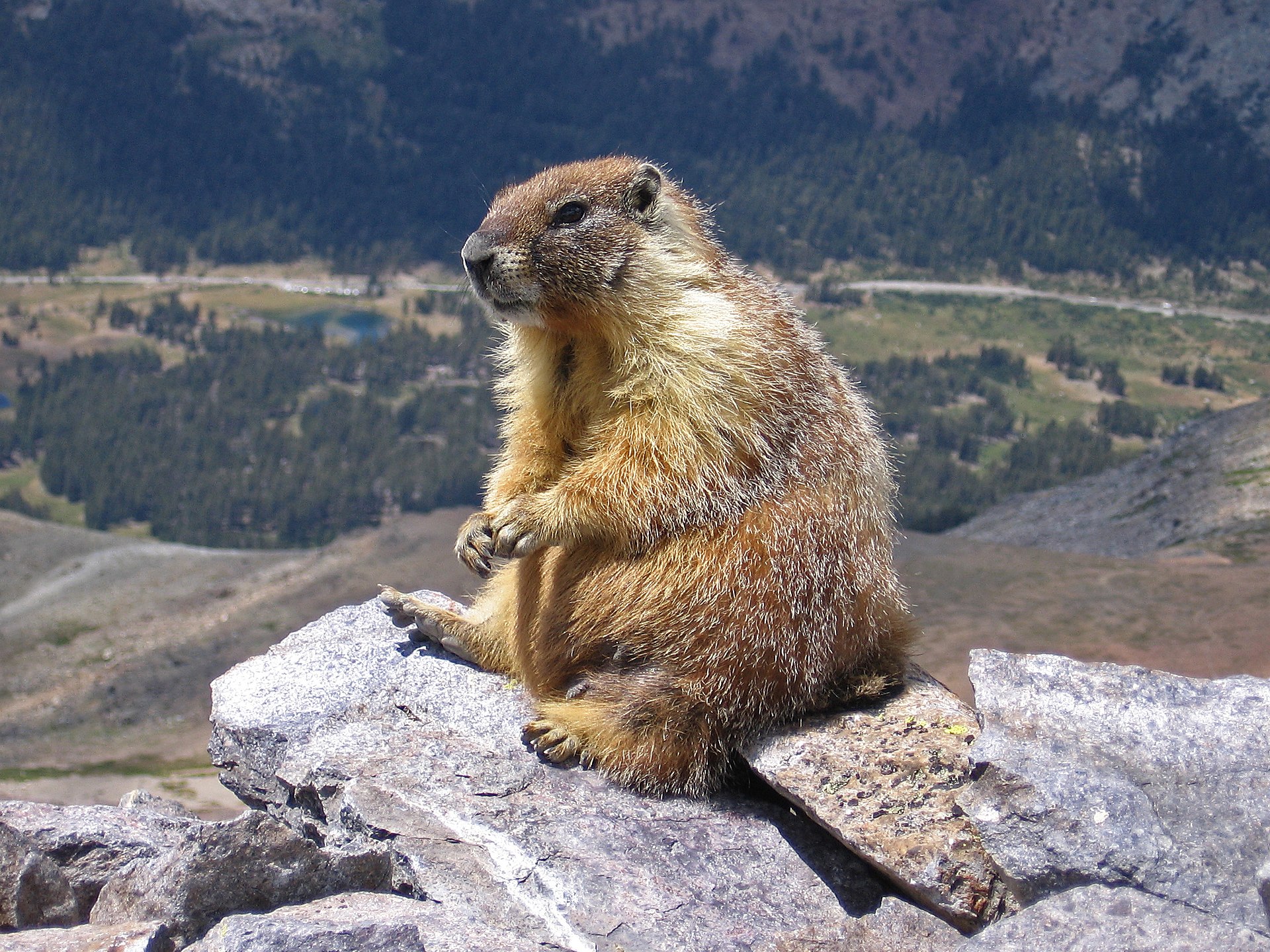
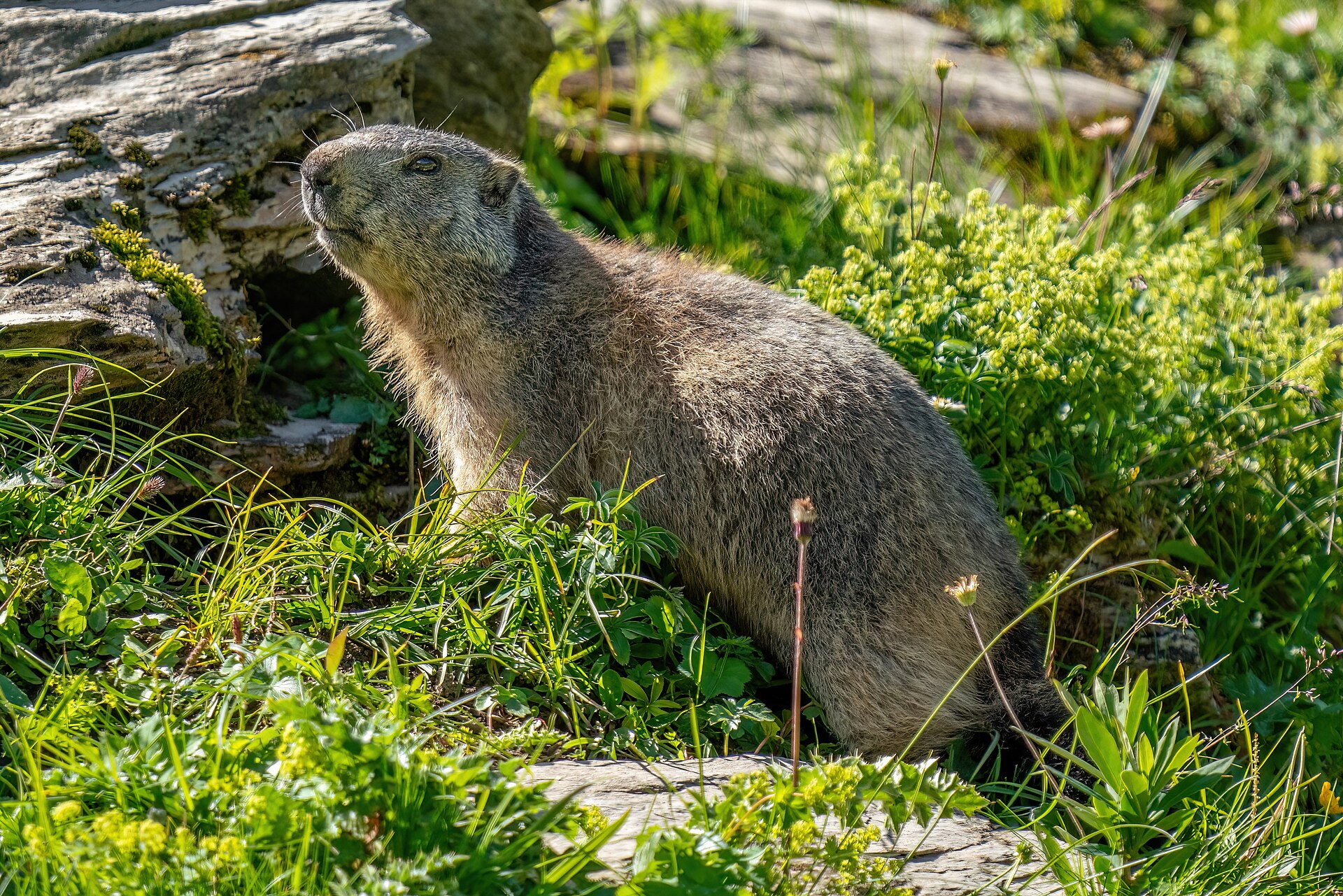
A stocky, robust, rounded rodent. Body and fur: a compact, heavy build with an arched back; dense fur, grizzled brown-grey in colour, often with lighter tips giving it a "frosted" look; a short, bushy tail. The digging tools: short, sturdy legs with strong, curved claws, perfect for digging; powerful shoulder and forelimb muscles; and robust, ever-growing incisors, typical of rodents. The head: a broad, flattened head with a short muzzle; small eyes and ears, set high, useful for watching the surroundings while barely poking out of the burrow. Performance: exceptional digging (it moves large amounts of earth to build complex burrows); an alarm whistle (it gives a shrill whistle when in danger, hence the nickname "whistle-pig"); and the ability to swim and climb trees when needed.
Behaviour and curiosities
The Groundhog is a solitary, diurnal animal, much more so than the sociable alpine marmot. Each individual defends its own burrow and the surrounding territory, and encounters between adults are usually brief, except in the breeding season. At the first sign of danger it rears up on its hind legs to look around, then whistles and dives into the burrow.
Groundhog Day: the Groundhog is famous worldwide for Groundhog Day, celebrated every February 2 in the United States and Canada. According to tradition, if on that day the groundhog comes out of its burrow and "sees its shadow" (that is, if it is sunny), it is frightened back underground and winter will last another six weeks; but if the sky is cloudy and there is no shadow, spring is near. The most famous groundhog is "Punxsutawney Phil", in Pennsylvania. The tradition derives from old European Candlemas customs, adapted to the groundhog by German settlers. The true hibernator: the Groundhog is one of the few large mammals to undergo a "true", deep hibernation. During hibernation, which can last several months, its body temperature drops by tens of degrees, approaching that of the environment, its heart rate slows from over a hundred to a few beats a minute, and its breathing becomes almost imperceptible; it is a genuine "suspension" of life, studied by scientists for its possible medical applications. The woodchuck tongue twister: the Groundhog has one of the most famous tongue twisters in the English language dedicated to it: "How much wood would a woodchuck chuck if a woodchuck could chuck wood?". In fact the woodchuck has nothing to do with wood: the name probably derives from a Native American word, and the tongue twister plays only on the assonance. The underground architect: the Groundhog's burrows are true feats of engineering — they can extend for several metres, reach over a metre deep and have several entrances, tunnels and specialized chambers: one for sleeping, a "nursery" for the young and even a separate latrine chamber; these shelters are used to take refuge, hibernate and raise offspring, and once abandoned they provide homes for many other animals, from foxes to rabbits; by digging, groundhogs mix and aerate the soil, but they can also damage crops and foundations. The lowland cousin: compared with the Alpine Marmot, also in the portal, the Groundhog shows a different "lifestyle": it lives in the lowlands rather than the mountains, is mostly solitary rather than colonial, and is one of the most adaptable and widespread marmots in the world; the two species nicely illustrate how the same group of animals — the marmots — has adapted to very different environments, from the American prairies to the peaks of the Alps.
Pros
- Animale affascinante e iconico (Giorno della Marmotta, scioglilingua del woodchuck)
- Vero ibernante: un modello prezioso per la ricerca scientifica
- Le sue tane arieggiano il terreno e offrono rifugio ad altri animali
- Comune e adattabile; IUCN Least Concern, nessun rischio di conservazione
Cons
- NON è un animale da compagnia: è un roditore selvatico
- Le tane e l'appetito per gli ortaggi creano conflitti con orti e giardini
- Le gallerie possono danneggiare colture, prati e fondamenta
- Visibile solo per metà anno: in inverno scompare in profondo letargo