Photo: Diego Delso · CC BY-SA 4.0
Kori bustard
Ardeotis kori
The kori bustard is the heaviest flying bird native to Africa, a slow-striding savanna giant famous for its balloon-throated courtship display.
Characteristics
Temperament
Wary, quiet and mostly solitary outside the breeding season
Diet
Omnivorous: insects, small vertebrates, seeds, berries, flowers and carrion
Africa's heaviest flier
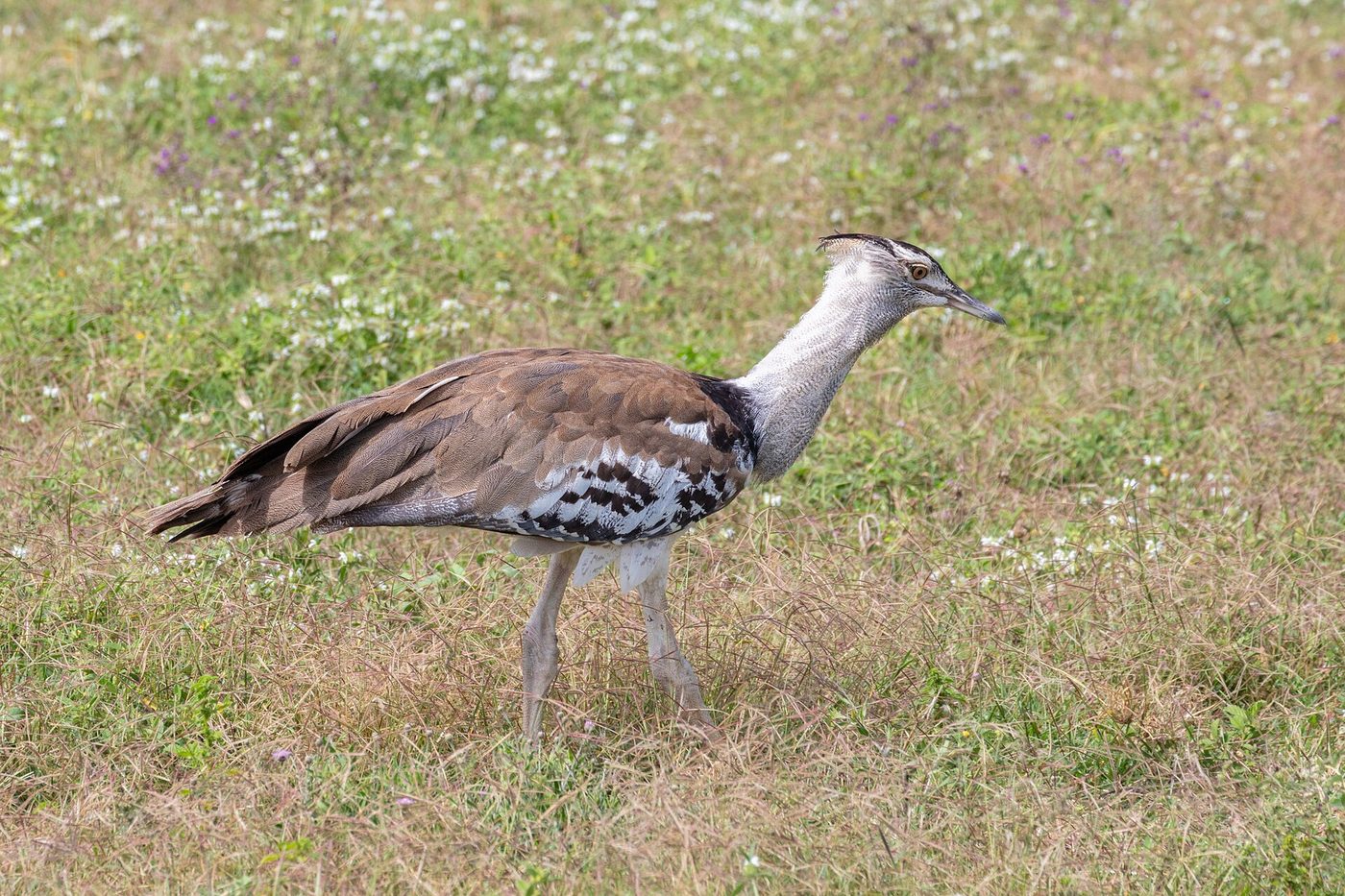
The kori bustard is widely regarded as the heaviest bird still capable of flight native to Africa. Adult males can weigh well over 12 kilograms and, exceptionally, approach twenty. It has a bulky body, a long neck and sturdy legs, with grey-brown, finely barred plumage that blends into dry grassland. A dark crest tops the head and a white band runs above the eye. (Note: the mass value reported by Wikidata, 158 kg, is clearly erroneous — no bustard reaches such weights; males range from about 7 to 19 kg.)
Habitat and range
It lives in open savanna, grassland and semi-arid plains across eastern and southern Africa, from Kenya down to South Africa. It favours grassy expanses dotted with scattered bushes, where it can walk for kilometres in search of food, avoiding dense forest and very wet ground.
Behaviour and diet
Largely ground-dwelling and omnivorous, it feeds on insects, small reptiles, seeds, berries, flowers and even carrion. It walks slowly with its neck held upright and flies only when forced to, using powerful wingbeats. In courtship the male inflates his neck into a great white puffball, cocks his tail over his back and utters deep booming calls audible far away.
Notable facts
The kori bustard has a striking relationship with carmine bee-eaters, which often perch on its back to snatch the insects it flushes as it strides through the grass. It is famously wary, slipping away on foot at the first hint of danger and relying on its cryptic plumage.
Conservation
The species is listed as Near Threatened by the IUCN. It is threatened by habitat loss, hunting, poisoning and collisions with power lines, to which its size and heavy flight make it especially vulnerable.
Pros
- Africa's heaviest flying bird
- Spectacular male courtship display
- Natural control of insect populations
Cons
- Highly sensitive to human disturbance
- Vulnerable to power-line collisions