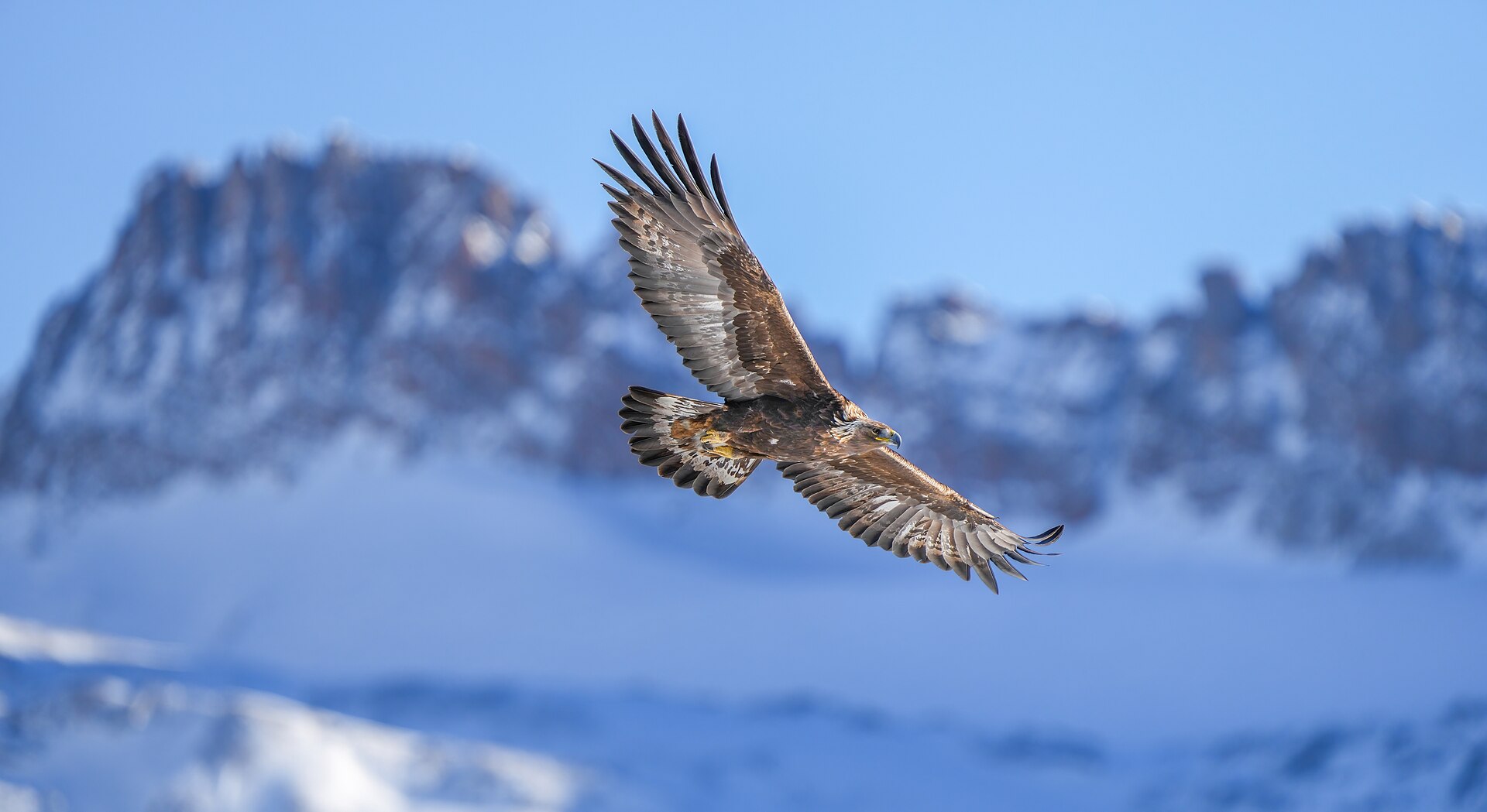
Golden Eagle
Aquila chrysaetos
Characteristics
Temperament
Lifelong monogamous, strongly territorial, long-lived (20-30 years). 320 km/h dive. Eyesight 8x sharper than human. Falconry with Golden Eagle is UNESCO tradition among Kazakh Berkutchi.
Diet
Generalist carnivore: marmots, hares, squirrels, young chamois, ptarmigans, tortoises, snakes. 200-300 g/day. 320 km/h dive, 7 cm talons with 200 kg/cm² grip.
The Golden Eagle (Aquila chrysaetos) is one of the largest and most powerful diurnal raptors of the Northern Hemisphere. Always considered a symbol of strength, freedom and dominion, it has been adopted as a national emblem by numerous countries (Mexico, Albania, Egypt, Austria, Imperial Germany) and has inspired myths, legends and military banners since antiquity. A majestic hunter of mountains, boreal forests and wide open spaces, the Golden Eagle has eyesight approximately eight times sharper than human vision and a wingspan exceeding 2 metres.
Classification and category
The Golden Eagle belongs to the order Accipitriformes, family Accipitridae, genus Aquila. The genus comprises 11 species of "true eagles" found worldwide. A. chrysaetos is the type species of the genus and is divided into six geographic subspecies: A. c. chrysaetos (Europe excluding Iberia), A. c. homeyeri (Iberia, North Africa, Middle East), A. c. daphanea (Central Asia), A. c. japonica (Japan and Korea), A. c. canadensis (North America) and A. c. kamtschatica (Eastern Siberia). It is a large raptor: body length 75-100 cm, wingspan 180-230 cm, weight 3-7 kg. Females are significantly larger than males (reverse sexual dimorphism, common in raptors).
Habitat and distribution
The natural habitat of the Golden Eagle consists of open and mountainous areas: high-altitude grasslands, tundra, steppes, open boreal forests, rocky deserts, sheer coasts. It needs vast territories (50-200 km²) with rocky cliffs or large trees for nesting and open areas for hunting. In Europe it is almost exclusively montane: it lives in the Alps, Pyrenees, Carpathians, Caucasus, Scotland, Norway and Apennines, generally above 1,000 m. In North America it descends to sea level in the Western steppes and Southwestern deserts.
The distribution is Holarctic: it covers the entire Northern Hemisphere from Alaska and Canada through the Western United States, Mexico, Eurasia (from Iberia to Japan), to North Africa (Morocco, Algeria, Tunisia, Libya). Conservation status is listed as Least Concern (LC) by the IUCN globally, but many national populations are in decline or vulnerable. In Italy the population is stable, estimated at 600-700 breeding pairs on the Alps and Apennines. The main threats are direct persecution, poisoning (baits and lead in carcasses), collision with power lines and wind turbines, loss of open habitat.
Diet
The Golden Eagle is a generalist predator with great dietary versatility. The diet depends on local availability: in the mountains it preys mainly on marmots, hares, alpine squirrels, young chamois and small ungulates. In steppes and deserts it feeds on hares, rabbits, ground squirrels and various rodents. In Scotland it preys on lambs, ptarmigans and grouse. It can also catch snakes, large birds (geese, wild turkeys, cranes), tortoises (which it drops on rocks to break the shell), and even young foxes.
The hunting technique consists of high-altitude patrols followed by dizzying dives: the eagle can reach 320 km/h in a stoop, one of the highest speeds in the animal kingdom. The talons, up to 7 cm long, generate a pressure of about 200 kg/cm², capable of killing prey instantly. It is also an opportunistic scavenger: in winter it often feeds on carcasses of ungulates killed by avalanches or starvation. Daily requirement is 200-300 g of meat, but it can ingest up to 2 kg in a single meal and then fast for days.
Physical features
The Golden Eagle has a robust and powerful body, with uniform dark brown plumage in adults, with characteristic golden feathers on the nape and neck (hence the scientific name chrysaetos, from Greek "golden eagle"). Juveniles have white patches on the tail and at the base of the primary wings, which progressively disappear reaching adult plumage at 4-5 years. The head is massive with curved yellow sharp beak, large yellow-amber eyes with extraordinary vision.
The wings are long and broad, perfect for low-energy soaring flight. The eagle exploits thermal currents and orographic currents to stay airborne for hours without flapping. The legs are fully feathered down to the talons (a feature of "true eagles" that distinguishes them from buzzards and kites). The four talons are curved, black and razor-sharp; the thumb is opposable to the other digits for a ring-grip. Vision is the dominant sense: the retina contains up to 1 million photoreceptors per mm² (humans have 200,000), allowing it to spot a hare from 3 km away. The head can rotate 270° thanks to 14 cervical vertebrae.
Behaviour and curiosities
The Golden Eagle is a lifelong monogamous animal, strongly territorial, long-lived. A pair maintains the same partner for decades (wild longevity: 20-30 years; in captivity recorded up to 46 years) and defends the same territory. They use 2-4 alternative nests called "aeries", large platforms of branches on rocky walls or large trees: they are reused and expanded year after year, reaching record dimensions of over 2 m in diameter and 5 m in height.
The female lays 1-3 eggs (usually 2) in March-April, with incubation of 41-45 days. Chicks are born covered in white down; the first born (asynchronous hatching) is almost always larger and often kills the smaller sibling to ensure all the food — a phenomenon called "cainism" very common in raptors. The juvenile leaves the nest at 65-80 days but depends on parents for another 2-3 months. Sexual maturity is reached at 4-5 years. Falconry traditions with the Golden Eagle date back over 4,000 years: the Kazakhs of Central Asia (the "Berkutchi" people) still today hunt foxes and wolves with trained eagles, a UNESCO Intangible Cultural Heritage of Humanity.
Pros
- Specie iconica e simbolo nazionale di molti paesi
- Longevità eccezionale (20-30 anni natura)
- Visione straordinaria (1 milione di fotorecettori/mm²)
- Monogama a vita, occupa territori per decenni
Cons
- NON è un animale da compagnia, è un rapace selvatico
- In Italia detenzione vietata senza permessi speciali
- Minacciata da avvelenamento, cavi elettrici, turbine eoliche
- Caìnismo: spesso un solo pulcino sopravvive per covata