Photo: Hajotthu · CC BY-SA 3.0
Spectacled owl
Pulsatrix perspicillata
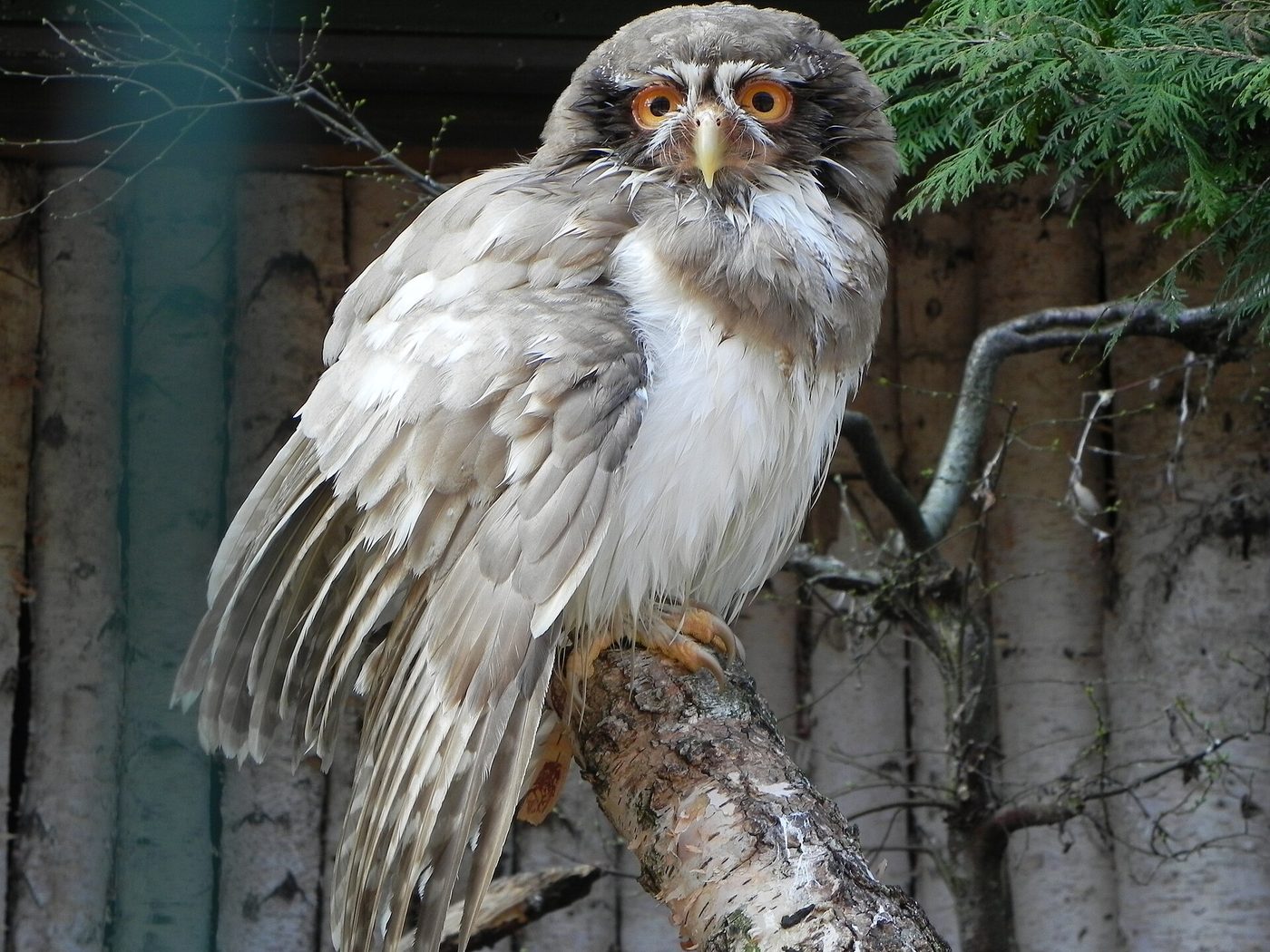
The largest owl of the American tropical forests, the spectacled owl is named for the bold white rings around its large dark eyes.
Characteristics
Temperament
Nocturnal, solitary, perch-and-pounce hunter
Diet
Carnivore: small mammals, birds, insects
A nocturnal raptor with 'spectacles'
The spectacled owl is the largest owl of the American tropics. It has a robust build, a large head without ear tufts, and strongly contrasting plumage: dark brown upperparts, a pale breast and, above all, an unmistakable face pattern. Around its large dark eyes run two broad rings of white feathers which, together with a pale band on the throat, resemble a pair of spectacles — hence the name.
(Note: the mass value given by Wikidata, 767 kg, is plainly wrong for a bird of this size; its true weight is about 600–900 grams.)
Habitat and distribution
It lives in the tropical and subtropical forests of Central and South America, from southern Mexico and Trinidad to southern Brazil, Paraguay and northern Argentina. It favours mature, dense forest but also frequents plantations and groves.
Behaviour and hunting
It is a nocturnal hunter that hunts from a perch, swooping silently onto its prey. It feeds mainly on small mammals, even the size of an opossum, as well as birds, insects and other small animals. Like all owls it has a very silent flight and very sharp hearing. Its call is a series of deep, rhythmic notes.
Curiosities
The young look almost the opposite of the adults: they are soft white with a dark face, a livery that camouflages them in the nest. The change into adult plumage takes several months.
Conservation
The IUCN lists the species as Least Concern: it has a very wide range. The destruction of tropical forests nonetheless remains a potential threat to local populations.
Pros
- The largest neotropical owl
- Unmistakable 'spectacle' face pattern
- Wide range, not threatened
Cons
- Depends on tropical forests
- Not a bird to keep: a wild raptor
- Elusive and active only at night