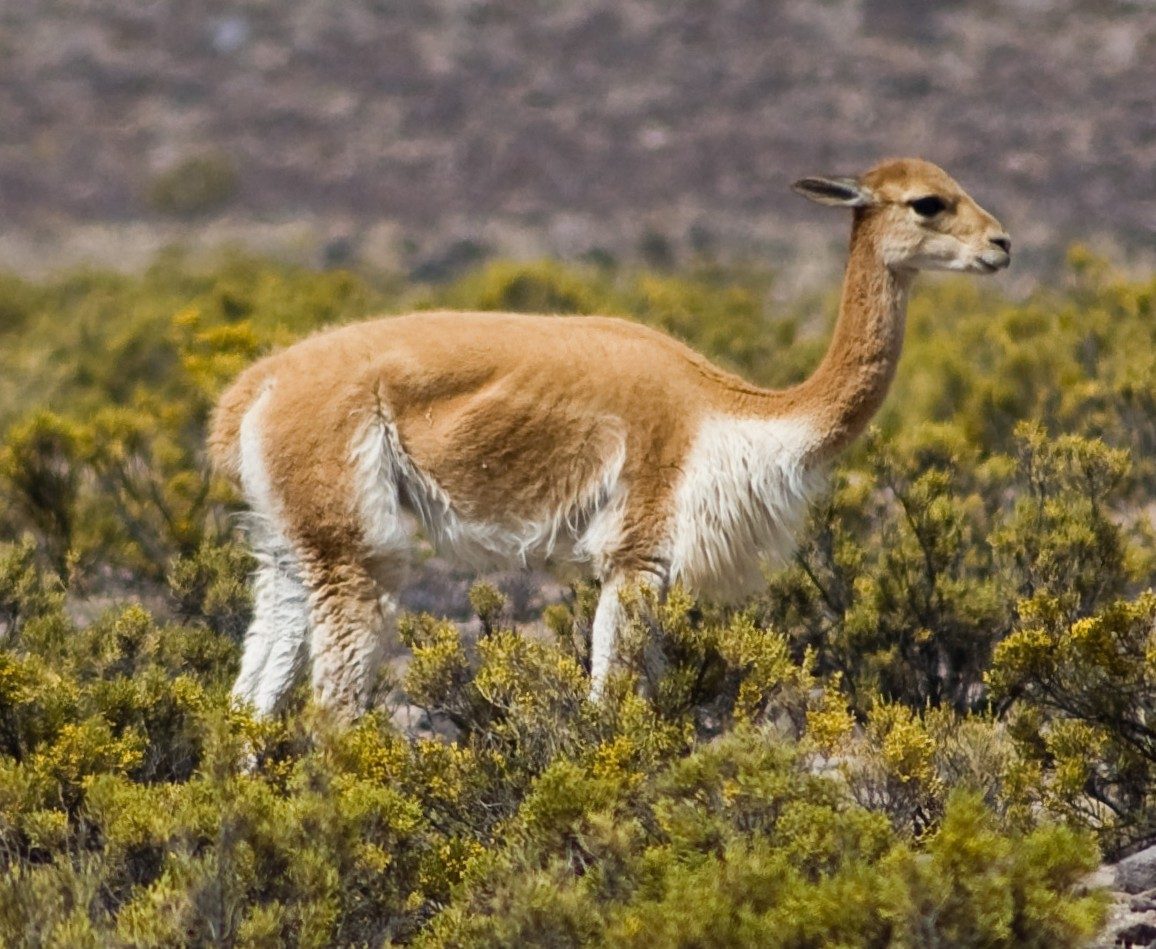
Photo: Alexandre Buisse (Nattfodd) · CC BY-SA 3.0
Vicuña
Vicugna vicugna
Elegant and slender, the vicuña is a small wild Andean camelid, famous for its very fine wool and for having escaped extinction.
Characteristics
Temperament
Shy, watchful, social and fast
Diet
Herbivore: low grasses of the high grasslands
An elegant camelid of the Andes
The vicuña is the smallest and most slender of the South American camelids, the same family as llamas, alpacas and guanacos. It has a graceful body, long slender legs, an upright neck and a small head with large dark eyes. Its coat is a characteristic cinnamon or tawny colour on the back, with a white belly and chest. Its wool is famous for being one of the finest, softest and most prized natural fibres in the world, so much so that it is considered a luxury fabric.
Habitat and distribution
The vicuña lives in the high-altitude regions of the Andes, across Peru, Bolivia, Chile and Argentina, in harsh environments such as the cold high grasslands and windy plateaus, often above three thousand metres. It is perfectly adapted to these extreme environments: its dense, very fine coat protects it from the intense cold and the great temperature swings typical of high altitudes.
Behaviour
It is a herbivorous animal, feeding on the low, tough grasses of the high grasslands. It lives in small social groups, generally made up of a male, several females and their young, which defend a territory. It is a shy and watchful animal, always ready to flee: when it senses danger, it gives an alarm call and moves off with fast, elegant runs.
A recovery story
The vicuña is a symbol of conservation success. Hunted for centuries for its precious wool, it had been brought to the brink of extinction. Thanks to strict protection measures, a hunting ban and programmes that allow wool to be gathered by shearing live animals without killing them, the populations have recovered remarkably, so much so that the species is no longer considered threatened today.
Conservation and curiosities
Today the vicuña is classified as a species of least concern. In many Andean cultures it is considered a sacred animal, and its wool was reserved, in ancient times, for the elite. Its story shows how sustainable management and protection can save a species while at the same time enhancing its resources.
Pros
- Wool among the finest and most prized in the world
- Perfectly adapted to the high Andes
- Symbol of a successful recovery and conservation
- Elegant and fascinating
Cons
- Hunted in the past almost to extinction
- Tied to specific high-altitude environments
- Shy and hard to approach