Photo: Raul654 · CC BY-SA 3.0
Okapi
Okapia johnstoni
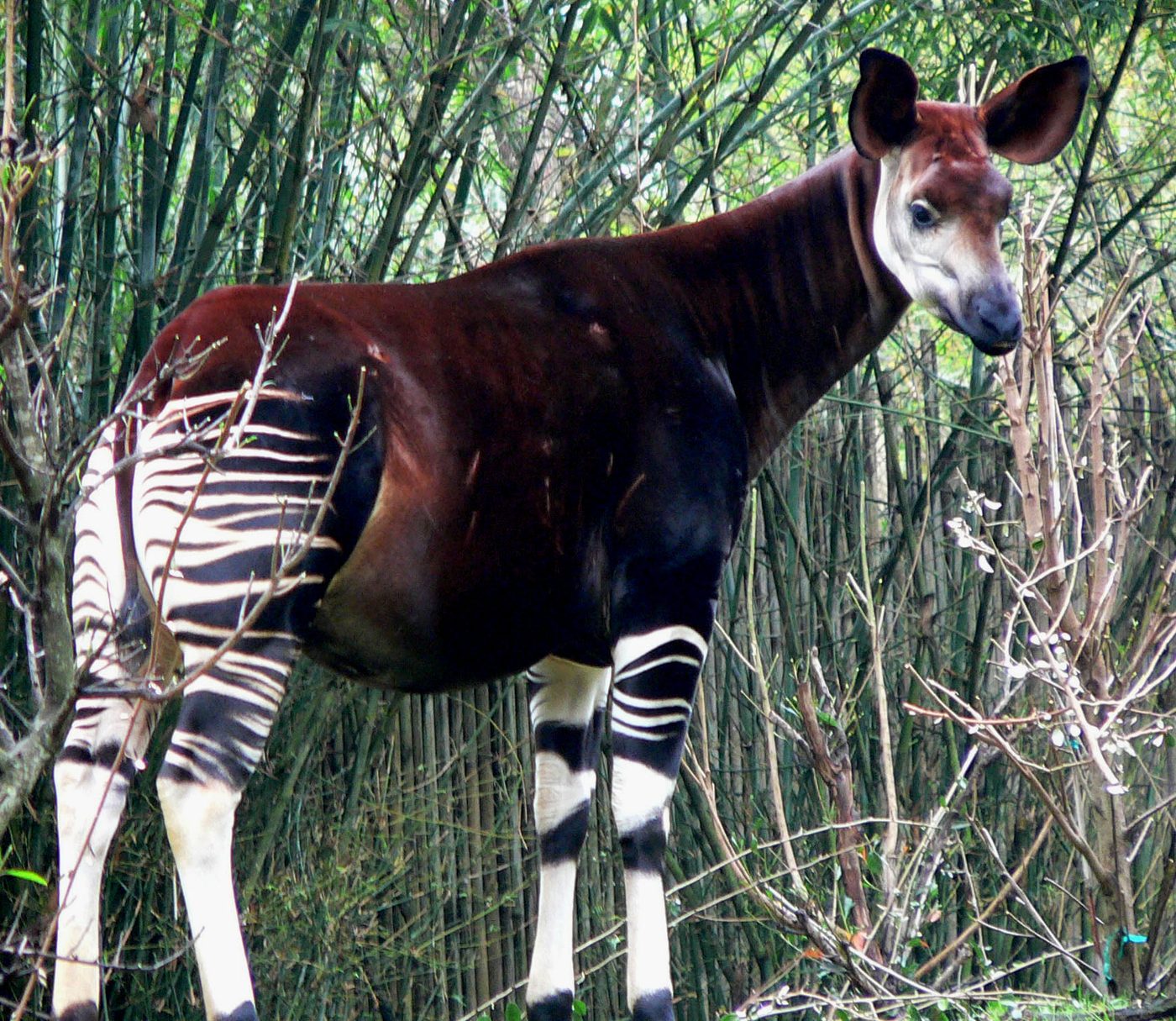
With the body of a brown horse and legs striped like a zebra, the okapi is the shy, solitary cousin of the giraffe, hidden in the forests of the Congo.
Characteristics
Temperament
Solitary, shy and silent
Diet
Herbivore: leaves, shoots, fruit and fungi
An animal of unmistakable appearance
The okapi is one of the most singular and fascinating mammals in the world. At first sight it looks like a cross between several animals: it has the sturdy body and velvety brown coat of a horse, but its hindquarters and legs are crossed by striking black-and-white stripes reminiscent of a zebra. In reality its closest relative is the giraffe, with which it shares a relatively long neck, hooves and, above all, a long, blackish, prehensile tongue that can reach as far as its ears. The males bear two small skin-covered horns, called ossicones.
Habitat and distribution
The okapi lives exclusively in the dense rainforests of the north-east of the Democratic Republic of the Congo, in central Africa. It is an inhabitant of the thick, humid undergrowth, where the dense vegetation and its colouring make it almost invisible. Precisely because of this hidden life, the okapi was described by Western science only in the early twentieth century, though it had always been known to local peoples.
Behaviour
It is a solitary, elusive animal, active mainly by day, moving silently among the trees along habitual paths. It feeds on leaves, shoots, buds, fruit and fungi, which it gathers with its agile tongue. The stripes on its legs, besides camouflaging it among the play of light in the forest, may help the young to follow their mother through the thickets. The okapi communicates with low-frequency calls, partly inaudible to the human ear.
Curiosities
The okapi's long tongue is so flexible that the animal can even use it to clean its eyes and ears. Its coat also has a peculiarity: it is covered with an oily substance that repels water, a valuable adaptation in the humid environment of the rainforest.
Conservation
The okapi is classified as an endangered species. The main threats are the destruction of the forest for agriculture and logging, poaching and the instability affecting the regions where it lives. It has become a symbol of nature conservation in the Congo, where reserves exist dedicated to its protection. Safeguarding its forests also means protecting the entire, immensely rich ecosystem that inhabits them.
Pros
- Unique, unmistakable appearance
- Living relative of the giraffe
- Symbol of the conservation of the Congo's forests
Cons
- Endangered species
- Extremely hard to observe in the wild
- Depends on increasingly threatened forests