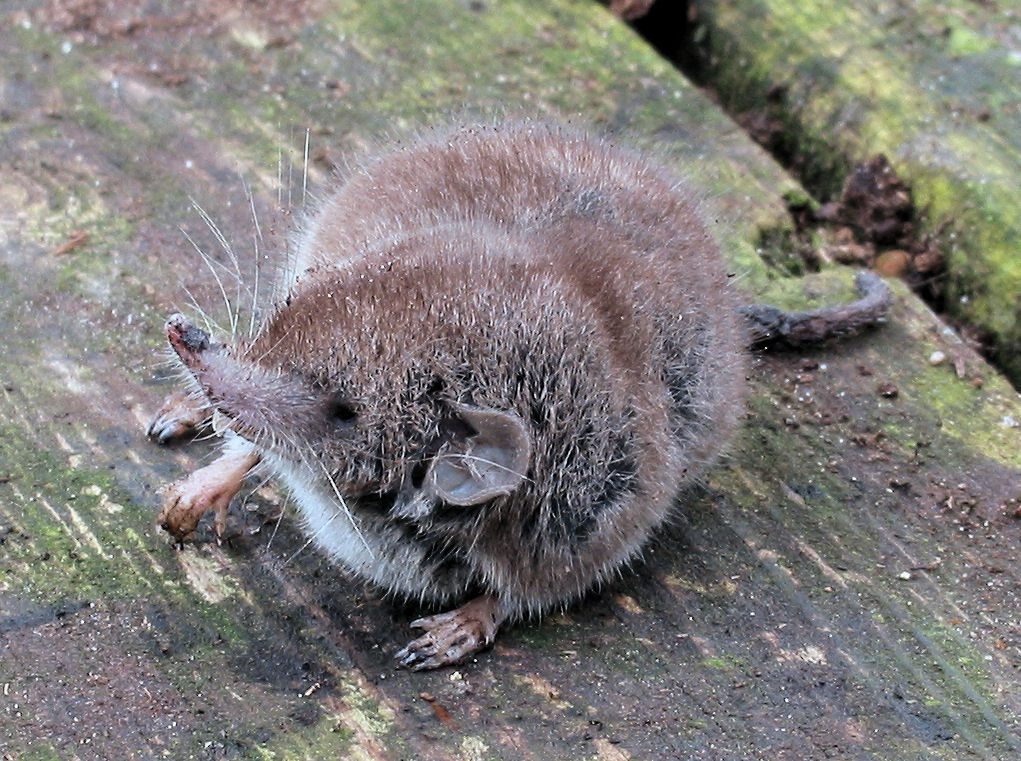
Photo: Rasbak · CC BY-SA 3.0
Greater white-toothed shrew
Crocidura russula
The greater white-toothed shrew is a tiny shrew with a pointed muzzle and white teeth, a hyperactive insect hunter common even near houses.
Characteristics
Temperament
Hyperactive, solitary, shy
Diet
Insects, spiders, earthworms and invertebrates
Description
The greater white-toothed shrew is a small insectivorous mammal of the shrew family. It has a minute body, 6-9 centimetres long plus the tail, a pointed, mobile muzzle, clearly visible ears and small eyes. Its coat is greyish-brown, paler on the belly. Unlike other shrews, its teeth are unpigmented, that is white, hence the name. The tail bears scattered long hairs.
Habitat and distribution
It is found in south-western and central Europe and North Africa. It frequents meadows, hedgerows, open woodland, gardens and farmland, and often comes close to houses, so much so that it is called the 'house shrew' in several languages. It favours dry, warm habitats.
Behaviour
It is a hyperactive animal with a very high metabolism: it must eat almost continuously to survive, feeding on insects, spiders, earthworms and small invertebrates. It is active day and night, in short cycles of hunting and rest. It is short-lived but highly productive.
Did you know?
The shrew's young show a curious behaviour: when the mother moves, they cling in a line, each biting the tail base of the one in front, forming a 'caravan' led by the mother. In cold periods it can enter a kind of torpor to save energy.
Conservation
It is classed as least concern and is common and widespread. It is a valuable natural predator of insects and invertebrates, useful in gardens and farmland.
Pros
- Valuable natural predator of insects
- Highly adaptable, common even near houses
- White teeth distinguish it from red-toothed shrews
Cons
- Very short life, about a year and a half
- Extreme metabolism, must eat constantly
- Shy and hard to observe