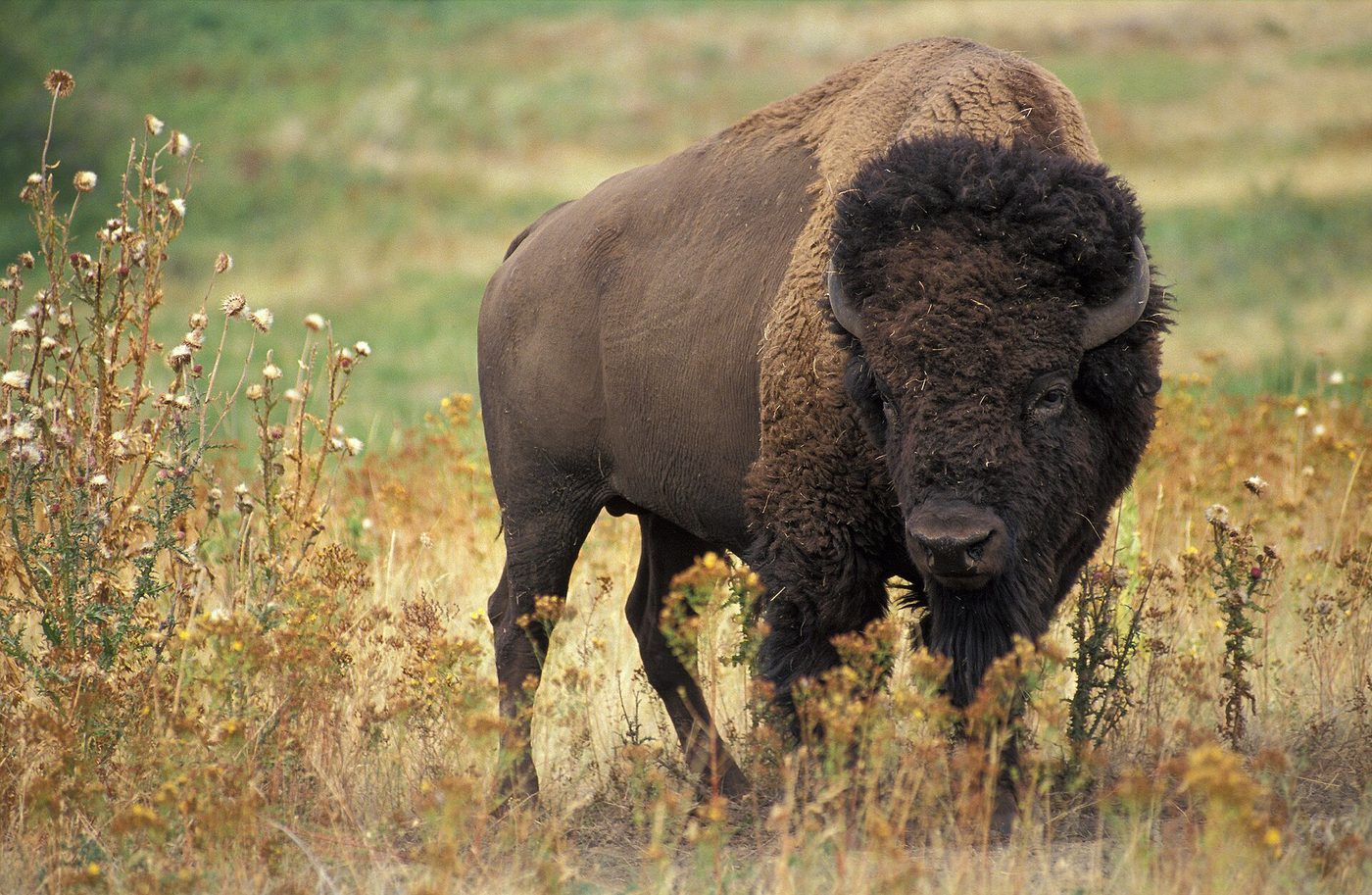
Photo: Jack Dykinga · Public domain
American bison
Bison bison
A symbol of the great North American prairies, the American bison is the continent's largest land mammal, back from the brink of extinction.
Characteristics
Temperament
A social herbivore, living in herds. Generally peaceful but unpredictable: if disturbed it can charge with surprising speed despite its bulk.
Diet
Herbivore: mainly the grasses of the great prairies, reached even under the snow in winter.
The giant of the prairies
The American bison is the largest land mammal in North America. It has a massive, unmistakable build: the front of the body is enormous, with a muscular hump on the shoulders and a large head bearing curved horns, covered in thick fur. The leaner hindquarters contrast with this imposing bulk. Despite its weight, which in males can approach a tonne, the bison is surprisingly agile and fast, able to run and even to jump.
Life on the prairie
The bison is a herbivore that feeds mainly on the grasses of the great plains. It lives in herds, once immense, that moved across the prairies following the growth of the grass. Its grazing and trampling have shaped the ecosystem of the Great Plains for millennia, favouring biodiversity: the bison is a true keystone species, whose presence models the environment to the benefit of many others.
The return from extinction
The story of the bison is emblematic. Tens of millions of individuals once populated North America, but in the nineteenth century unbridled hunting reduced them within a few decades to a few hundred, bringing the species to the brink of extinction. Thanks to some of the most famous conservation efforts in history, the populations slowly recovered, and today the bison has returned to parks and reserves, becoming a symbol of successful conservation.
Behaviour
The bison has a generally peaceful nature but can become dangerous if disturbed or if it feels threatened, charging with surprising speed. It likes to roll in the dust in hollows called 'wallows', a behaviour that helps it get rid of parasites and cool down. In winter it uses its large head to sweep away the snow and reach the grass beneath.
Conservation
The American bison is classified as near threatened. Although it has escaped extinction, many populations live in protected areas and the species has not yet returned to the numbers and freedom of the past. Its conservation remains an important commitment and a symbol of the relationship between humans and the wild.