Photo: markaharper1 · CC BY-SA 2.0
Superb bird-of-paradise
Lophorina latipennis
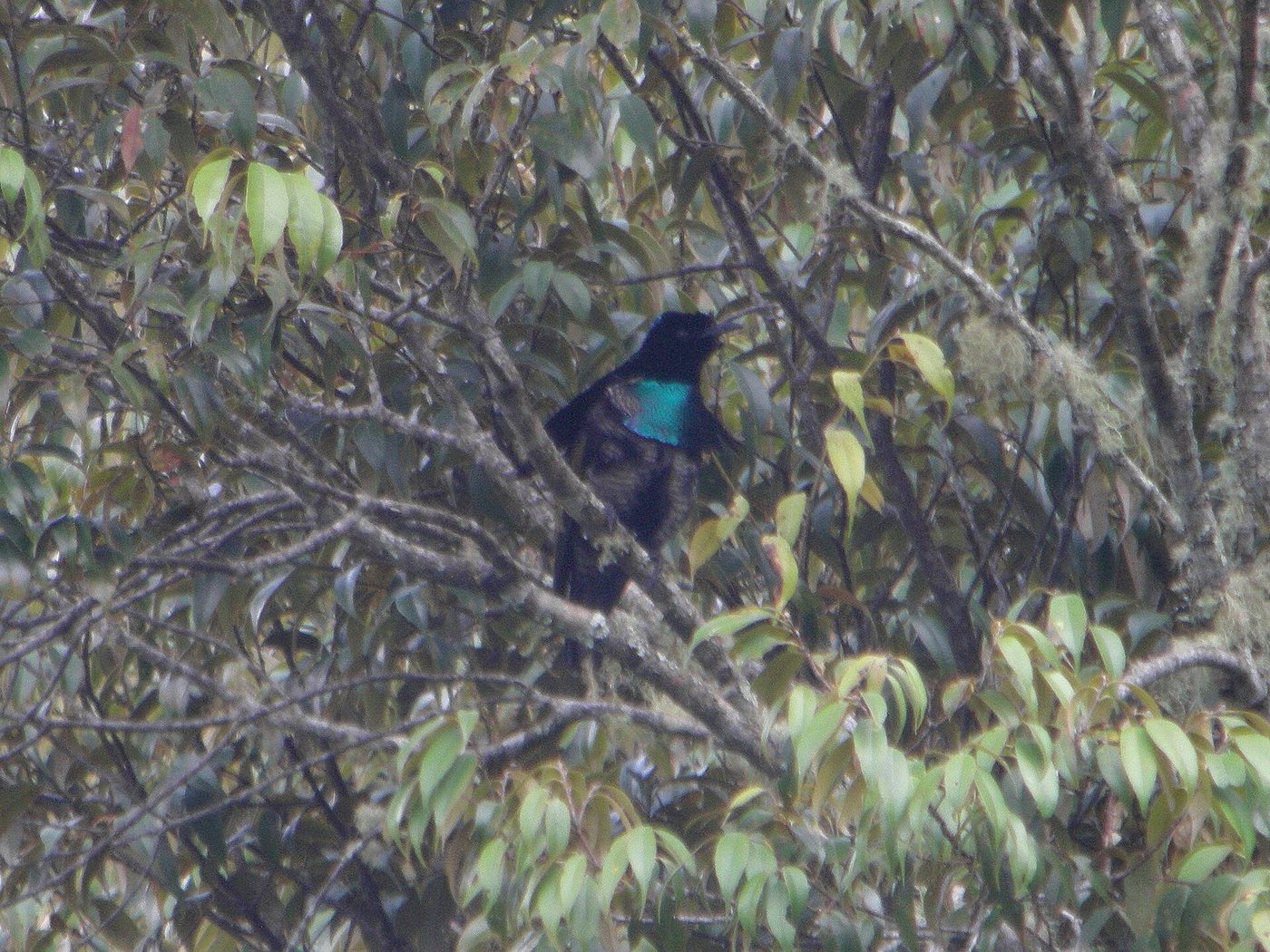
The superb bird-of-paradise is famous for the male's courtship dance, transforming into a black oval with an iridescent 'smiley face'.
Characteristics
Temperament
Diurnal; the male performs a spectacular courtship dance.
Diet
Omnivorous: fruit and invertebrates.
The most extraordinary dance in the forest
The superb bird-of-paradise (Lophorina latipennis), also called the greater lophorina and once treated as a subspecies of the superb bird-of-paradise, is a passerine of the family Paradisaeidae. The male is a deep velvety black, with a breast shield and a "crown" on the head of intense metallic blue-green. The female, as in many birds-of-paradise, is brown and cryptic. Its fame rests on one of the most incredible courtship displays in the animal kingdom.
Habitat and range
It lives in the montane forests of central and northeastern New Guinea. It is a relatively widespread and common bird, less sensitive than some relatives to changes in its habitat.
Courtship
When a female approaches, the male transforms: he raises and spreads the feathers of his cape and breast into a perfect black oval, from which the blue-green shield and two iridescent spots stand out like eyes, creating the illusion of a "smiley face". He then hops rapidly around the female, snapping his feathers. If she is unconvinced, the spell breaks and the bird returns to its normal shape.
Did you know?
The black of its plumage is among the "blackest" in nature: micro-structures on the feathers absorb almost all light, heightening the metallic colours of the breast shield by contrast — a visual trick to dazzle the female.
Conservation
It is considered relatively common and not threatened. Its tolerance of habitat disturbance makes it less vulnerable than other birds-of-paradise, though it still depends on montane forests.
Pros
- One of the most extraordinary courtship dances in the world
- 'Ultra-black' plumage and metallic colours
- Relatively common and not threatened
Cons
- Depends on New Guinea's montane forests
- Strong dimorphism: the female is drab
- Hard to observe deep in the forest