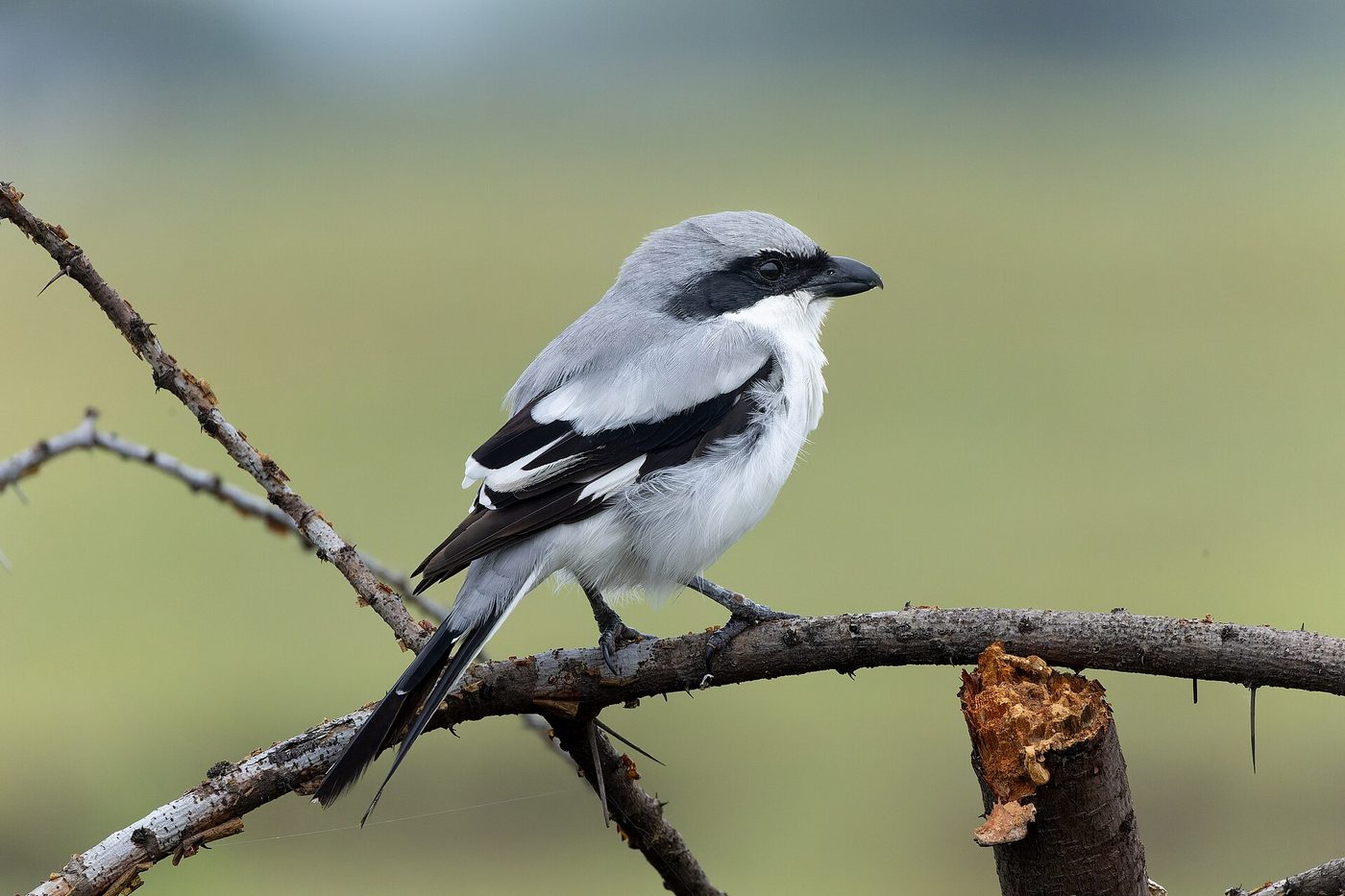
Photo: Tisha Mukherjee · CC BY-SA 4.0
Great grey shrike
Lanius excubitor
The great grey shrike is a grey, black and white predatory songbird, famous for impaling its prey on thorns like a larder.
Characteristics
Temperament
Predatory, territorial, watchful
Diet
Insects, small mammals, lizards and birds
Description
The great grey shrike is the largest of the European predatory songbirds of the shrike family. It has elegant plumage: pearly grey above, white below, with black wings and tail and a distinctive black mask running through the eye. Its bill is stout and hooked at the tip, a typical adaptation of a hunter. Males and females look very much alike.
Habitat and distribution
It breeds in the northern and temperate regions of Eurasia, in open habitats such as heaths, clearings, pastures and farmland with hedges and scattered trees. Many populations are migratory or wintering: in winter the shrike moves further south, where it is often seen perched atop bushes and fence posts.
Behaviour
Although a songbird, it hunts like a small raptor. It feeds on large insects, small mammals, lizards and birds, which it spots from its perch and seizes with a swift attack. Its most famous habit is impaling prey on thorns, sharp twigs or barbed wire, creating a larder it returns to later.
Did you know?
The scientific name excubitor means "sentinel", for its habit of watching over its territory from conspicuous perches. The impaled larders serve both to store food and, in males, to display during courtship.
Conservation
It is classed as least concern globally, but in many parts of western Europe populations are declining, owing to the loss of traditional farmed landscapes with hedges and insect-rich meadows.
(Note: the mass value given by Wikidata, 63.4 kg, is clearly wrong: the great grey shrike actually weighs about 60–70 grams.)
Pros
- Useful predator regulating insects and rodents
- Fascinating behaviour, easy to observe
- Conspicuous when perched atop hedges
Cons
- Declining through loss of farmed landscapes
- Needs open habitats with perches and prey
- Sensitive to pesticides that reduce insects