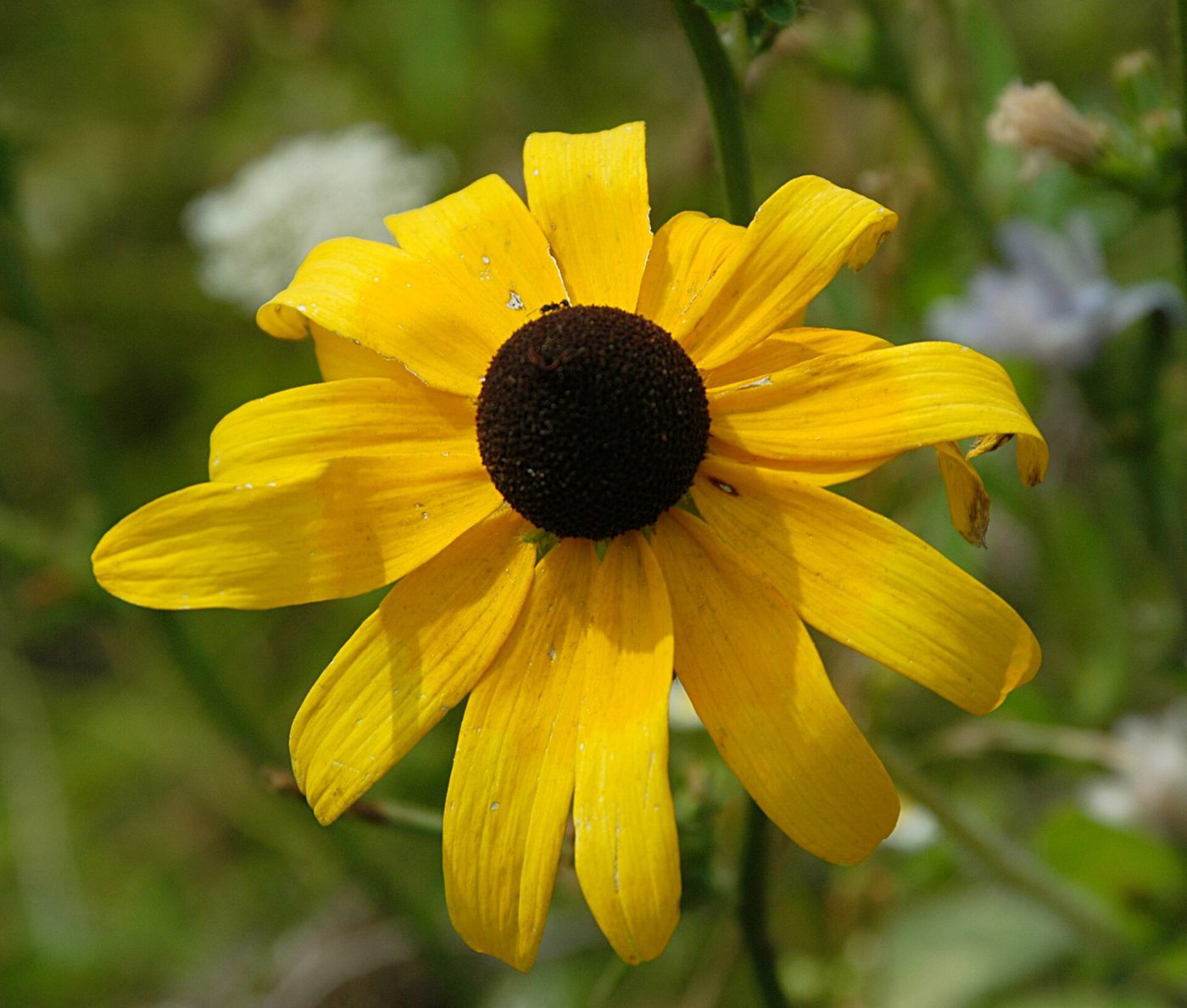
Photo: G. Edward Johnson · CC BY-SA 3.0
Black-eyed Susan
Rudbeckia hirta
The black-eyed Susan is a cheerful North American plant with golden-yellow daisy flowers and a characteristic dark centre.
Characteristics
Yellow daisies with a black heart
The black-eyed Susan is a herbaceous plant of the daisy family, Asteraceae, the same as sunflowers and daisies. Its flowers are large daisy-like heads, with ray petals of an intense golden-yellow arranged around a prominent brown-black central cone. This dark heart gives it its common name. The stems are upright and rough, the leaves hairy and bristly, hence the epithet hirta.
Origin and habitat
It is native to North America, where it grows wild in prairies, clearings and open ground. It is very adaptable and vigorous, and has naturalised in other regions too. It is the state flower of Maryland.
Cultivation
It is very easy to grow and much loved in gardens. It wants full sun and well-drained soil, even poor; once established it tolerates drought well. It flowers for a long season, from summer into autumn, and is a magnet for bees, butterflies and other pollinators. It can behave as an annual, biennial or short-lived perennial, and often self-seeds.
Ornamental use and tradition
It is a classic border and cut-flower plant, available in numerous cultivars in colours extending to orange and bronze. It was used medicinally by Native American peoples.
Care
It needs little attention: moderate watering and no waterlogging. Removing faded flowers prolongs the bloom, while leaving some dry heads in autumn provides seeds for birds.
Flowering season
Practical tips
Water needs: Moderate, drought-tolerant when mature — always check soil moisture before watering.
Prefers Full sun: provide the right light and rotate the plant for even growth.
Recommended soil: Well-drained, adaptable, even poor. Refresh the substrate every 1-2 years.
Dust the leaves with a damp cloth to support photosynthesis.
Feed during the growing season (spring-summer) and stop in winter.
Pros
- Long, luminous golden-yellow flowering
- A magnet for bees and butterflies
- Hardy, easy and drought-resistant
Cons
- Often short-lived as a perennial
- Can self-seed and spread