Photo: Michael Wolf · CC BY-SA 3.0
Living stones
Lithops
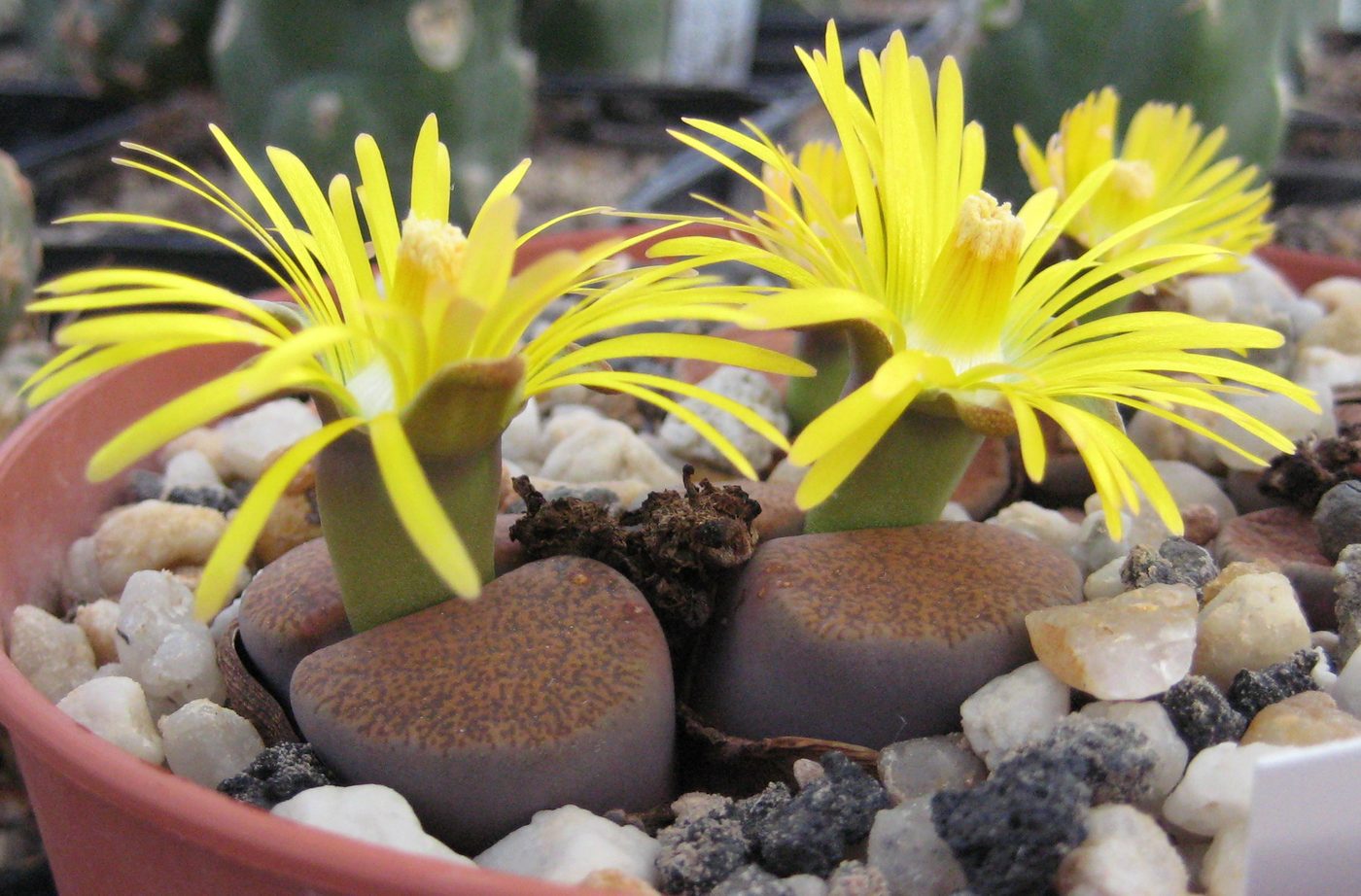
Plants that look like stones: lithops, or living stones, mimic the pebbles of the desert to escape herbivores, revealing themselves only when they bloom.
Characteristics
Plants disguised as stones
Lithops, commonly called 'living stones', are among the most curious and surprising succulents in the world. Native to the arid, desert regions of southern Africa, they have developed an appearance that perfectly mimics the pebbles and stones among which they grow. Each plant consists of just two fused, fleshy leaves, shaped like a small stone split at the top, with an upper surface often decorated with patterns and veining that complete the disguise. There are many species, of very different colours and patterns.
Mimicry to survive
The incredible resemblance to stones is no accident: it is a defensive strategy. In the arid environments where they live, where every succulent plant is a precious water reserve for animals, lithops escape herbivores by blending in with the surrounding stony ground. They remain almost invisible for much of the year, betraying their plant nature only in autumn, when a showy, daisy-like flower, yellow or white, emerges from the slit between the two leaves.
Cultivation and care
Lithops are fascinating but require careful attention, different from that of many other plants. The fundamental rule concerns water: they are extremely sensitive to excess and must be watered very little, following their natural cycle. In particular, they must not be watered during the period when they renew their leaves, in winter-spring, when the old leaves wither to make room for the new pair. They love plenty of light, extremely draining sandy soil, and fear damp cold.
The renewal of the leaves
A phenomenon typical of lithops is the annual renewal of the leaves: the new pair grows inside, absorbing the water and nutrients of the old one, which gradually dries up and detaches. During this phase the plant must absolutely not be watered, so as not to make it rot.
Conservation
As a genus, lithops are widely grown and loved by succulent collectors. In the wild some species are confined to restricted areas and may suffer from illegal collection and habitat destruction. Choosing cultivated specimens, rather than ones collected in the wild, is the more responsible way to enjoy these extraordinary plants.
Flowering season
Practical tips
Water needs: Very little, fears waterlogging — always check soil moisture before watering.
Prefers Plenty of light, direct sun: provide the right light and rotate the plant for even growth.
Recommended soil: Extremely draining and sandy. Refresh the substrate every 1-2 years.
Dust the leaves with a damp cloth to support photosynthesis.
Feed during the growing season (spring-summer) and stop in winter.
Pros
- Curious, unique look, mimicking stones
- Showy flowers in autumn
- Require very little water
- Perfect for collectors and small spaces
Cons
- Very sensitive to excess water
- Require careful attention and a precise watering cycle
- Extremely slow growth