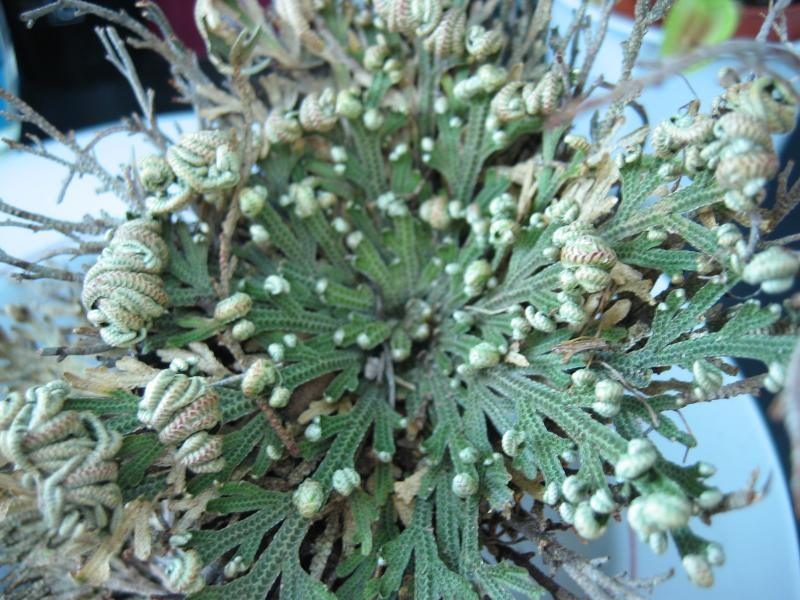
Photo: Wikimedia Commons · CC BY-SA 3.0
Resurrection plant
Selaginella lepidophylla
A small desert plant that can dry into a ball and "come back to life" at the first touch of water, the resurrection plant survives extreme desiccation.
Characteristics
A plant that "comes back to life"
The resurrection plant, also called the false rose of Jericho, is a small desert plant famous for a startling ability: it can lose almost all the water in its tissues, curl into a dry, seemingly dead ball, and then "revive", unfurling and turning green again as soon as it is rehydrated. It is not a true flowering plant but a spikemoss, related to mosses and ferns, and it reproduces by spores.
Habitat and distribution
It is native to the Chihuahuan Desert, between the United States and Mexico, where it faces long droughts alternating with rare rains. In the wild it stays curled up and dehydrated for long periods, reactivating only when moisture becomes available.
How the "miracle" works
The opening and closing movement is governed by the water content of the stems: when they dry out, their fibres curl into a spiral that closes the plant into a protective ball; when they absorb water, they unfurl again. This strategy, called poikilohydry or desiccation tolerance, lets it survive dehydration that would kill most plants.
Cultivation
It is often sold as a novelty: a dry ball that you simply set in a bowl with a little water to watch it open and green up within hours. To keep it healthy over the long term it needs bright indirect light, warmth and alternating cycles of moisture and dryness; it should not be left constantly soaked, to avoid rot.
Curiosities
It should be distinguished from the true Rose of Jericho (Anastatica hierochuntica), an entirely different plant from the Near East that nonetheless shares the same spectacular ability to open up with water.
Practical tips
Water needs: Low: tolerates long dry spells — always check soil moisture before watering.
Prefers Bright indirect light: provide the right light and rotate the plant for even growth.
Recommended soil: Sandy and free-draining, or on a bowl of water. Refresh the substrate every 1-2 years.
Dust the leaves with a damp cloth to support photosynthesis.
Feed during the growing season (spring-summer) and stop in winter.
Pros
- Spectacular ability to 'revive' with water
- Extremely drought-resistant
- Easy botanical curiosity to display
Cons
- Does not flower: reproduces by spores
- Rots if kept constantly wet
- Very slow growth