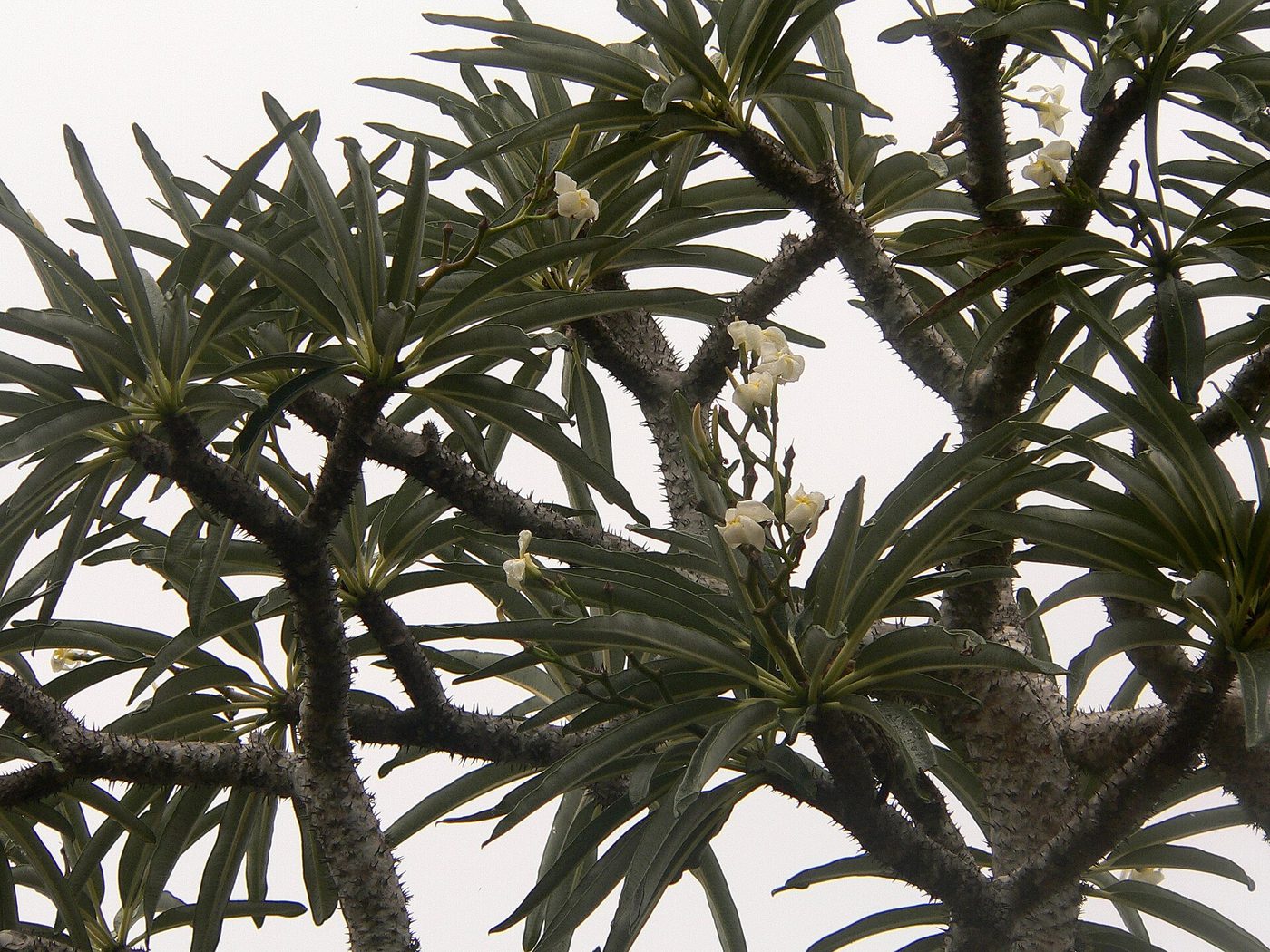
Photo: AxelStrauß · CC BY-SA 3.0
Madagascar palm
Pachypodium lamerei
The Madagascar palm is a succulent with a spiny columnar trunk topped by a tuft of leaves — despite the name, it is not a palm at all.
Characteristics
A spiny false palm
The Madagascar palm is a caulescent succulent with a silvery-grey columnar trunk covered in stout, sharp thorns arranged in groups. Unlike true palms — to which it is not related — it photosynthesises largely through its fleshy, water-storing trunk. Its long, narrow leaves are clustered only at the very top of the plant, giving the impression of a small palm. In summer it bears large, fragrant white flowers.
Origin and habitat
It is endemic to Madagascar, where it grows in the island's arid, rocky areas. Like many plants of the genus Pachypodium, it is adapted to a hot climate with long dry spells, which it survives thanks to the water reserves in its swollen trunk.
Cultivation
It is one of the most widely grown pachypodiums, being relatively easy to propagate and cultivate. It needs full sun or very bright light, a mineral, free-draining mix and sparing watering: let the soil dry out between waterings. It dreads cold and should be kept above 10–12 °C; in winter it goes dormant, drops its leaves and should be kept dry.
Warning
It belongs to the Apocynaceae, the oleander family: its sap is toxic if swallowed and the thorns are sharp, so handle it with care and keep it away from children and pets. It is often improperly marketed as a "palm".
Care
With plenty of light and little water, the Madagascar palm is long-lived and grows slowly, forming an ever-taller trunk. Repot it rarely, in heavy containers that balance its height.
Flowering season
Practical tips
Water needs: Low, soil dry between waterings — always check soil moisture before watering.
Prefers Full sun or very bright light: provide the right light and rotate the plant for even growth.
Recommended soil: Very free-draining, mineral succulent mix. Refresh the substrate every 1-2 years.
Dust the leaves with a damp cloth to support photosynthesis.
Feed during the growing season (spring-summer) and stop in winter.
Pros
- Sculptural, unusual habit
- Easy among exotic succulents
- Very drought-resistant
Cons
- Sharp thorns and toxic sap
- Does not tolerate cold or waterlogging