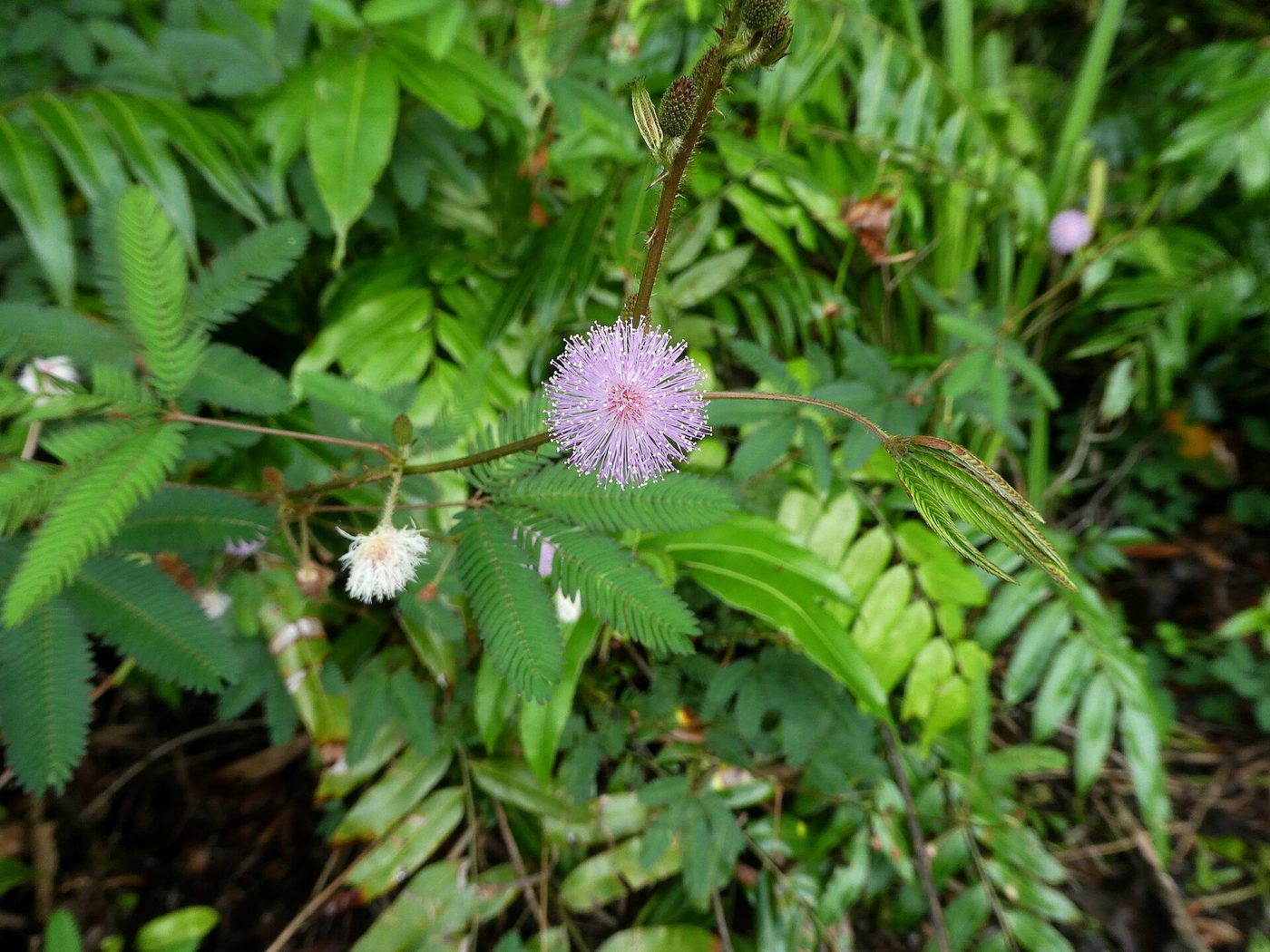
Photo: Steve Fitzgerald · CC BY-SA 4.0
Sensitive plant
Mimosa pudica
The sensitive plant is a tropical plant famous for a startling behaviour: when touched, it snaps its leaves shut, only to reopen them a few minutes later.
Characteristics
The plant that moves at a touch
The sensitive plant (Mimosa pudica) is a small creeping plant of the pea family Fabaceae, 10–40 cm tall, famous for a rare ability: when touched, shaken or blown on, it quickly folds its leaflets together and lowers its stalks, as if it were "shy". This very rapid movement, called thigmonasty, is one of the best-known forms of fast movement in the plant world; after a few minutes the leaves reopen. Its flowers are charming pink-lilac pompoms, small and globe-shaped.
Origin and habitat
It is native to the tropical regions of Central and South America but has become naturalised across much of the warm world, including Africa and Asia, where it often grows as a weed in disturbed ground.
Cultivation and care
It is easily grown as a curiosity, often in a pot and as an annual. It wants plenty of light or full sun, well-draining soil kept moist, and warm temperatures: it dislikes cold and cannot tolerate frost. It flowers in summer. In winter, in temperate climates, it should be kept sheltered in a bright, heated spot.
Did you know?
Besides its movement at a touch, the sensitive plant also makes "sleep" movements (nyctinasty): it closes its leaves in the dark and reopens them in light. The sudden folding probably serves to startle herbivorous insects or reduce exposure, as a defence against predators.
Conservation
It is not a threatened species; indeed, in many tropical regions it is considered a weed. Its worldwide spread is due precisely to the ease with which it adapts and reproduces.
Flowering season
Practical tips
Water needs: Regular: moist but not waterlogged — always check soil moisture before watering.
Prefers Full sun or very bright light: provide the right light and rotate the plant for even growth.
Recommended soil: Well-draining, slightly acid and rich. Refresh the substrate every 1-2 years.
Dust the leaves with a damp cloth to support photosynthesis.
Feed during the growing season (spring-summer) and stop in winter.
Pros
- Folds its leaves at a touch: fascinating and educational
- Pretty pink pompom flowers
- Easy to grow in a pot
Cons
- Dislikes cold and frost
- Can become a weed in tropical climates
- Has small prickles on the stems