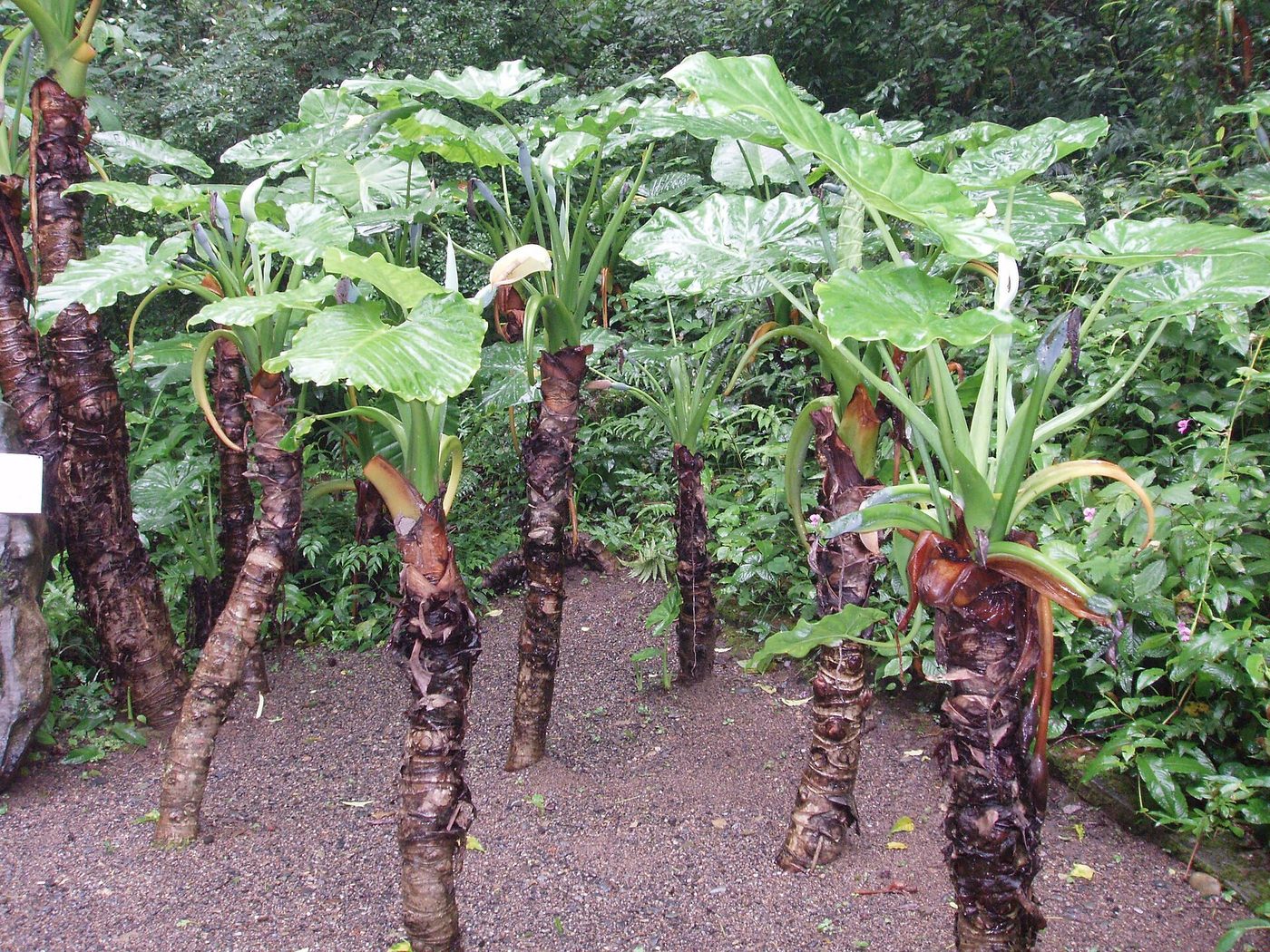
Photo: Taken by myself · CC BY-SA 3.0
Giant taro
Alocasia macrorrhizos
With its enormous heart- or arrow-shaped leaves, the giant taro is a spectacular tropical plant that brings a touch of the jungle to the home and garden.
Characteristics
Giant leaves from a real jungle
The giant taro, or giant alocasia, is a majestic tropical plant belonging to the arum family (Araceae). Its unmistakable feature is its leaves: enormous, glossy, heart- or arrow-shaped, held up by long and sturdy petioles. In nature they can reach impressive dimensions, giving the plant a lush and sculptural appearance. The leaves tend to turn upwards, like great outstretched ears, from which the common name comes.
Origin and distribution
It is native to the rainforests of Southeast Asia, New Guinea and some islands of northern Australia. It has been cultivated for thousands of years throughout the tropics, in South Asia, the Philippines and many Pacific islands, both as an ornamental plant and as a food plant, for its large rhizomes which are edible once cooked.
Cultivation and care
Being a tropical plant, the giant taro loves warmth and humidity. It should be grown in bright places but without direct sun, which could scorch its leaves. It requires a rich, constantly moist soil, but without waterlogging, and benefits from a humid atmosphere, which can be recreated by misting the leaves. It fears the cold: below 15 degrees it suffers, and it does not tolerate frost. In temperate climates it is grown in a pot, to be kept indoors or in a greenhouse during winter.
Warning: a toxic plant
Like many Araceae, the giant taro contains crystals of calcium oxalate, which make it toxic if eaten raw: it can cause irritation and burning of the mouth, throat and digestive tract. It should therefore be kept away from children and pets. The rhizomes only become edible after long and proper cooking, which neutralises these substances; they should never be eaten raw.
Practical tips
Water needs: Abundant, soil always moist — always check soil moisture before watering.
Prefers Bright but indirect light: provide the right light and rotate the plant for even growth.
Recommended soil: Rich, soft and well-drained. Refresh the substrate every 1-2 years.
Dust the leaves with a damp cloth to support photosynthesis.
Feed during the growing season (spring-summer) and stop in winter.
Pros
- Giant leaves with an exotic look
- Brings a touch of jungle indoors
- Fast growth when it thrives
- Rhizomes edible once cooked
Cons
- Toxic if eaten raw
- Fears cold and frost
- Requires constant high humidity