Photo: Abu Shawka · CC BY-SA 4.0
Zebra haworthia
Haworthia fasciata
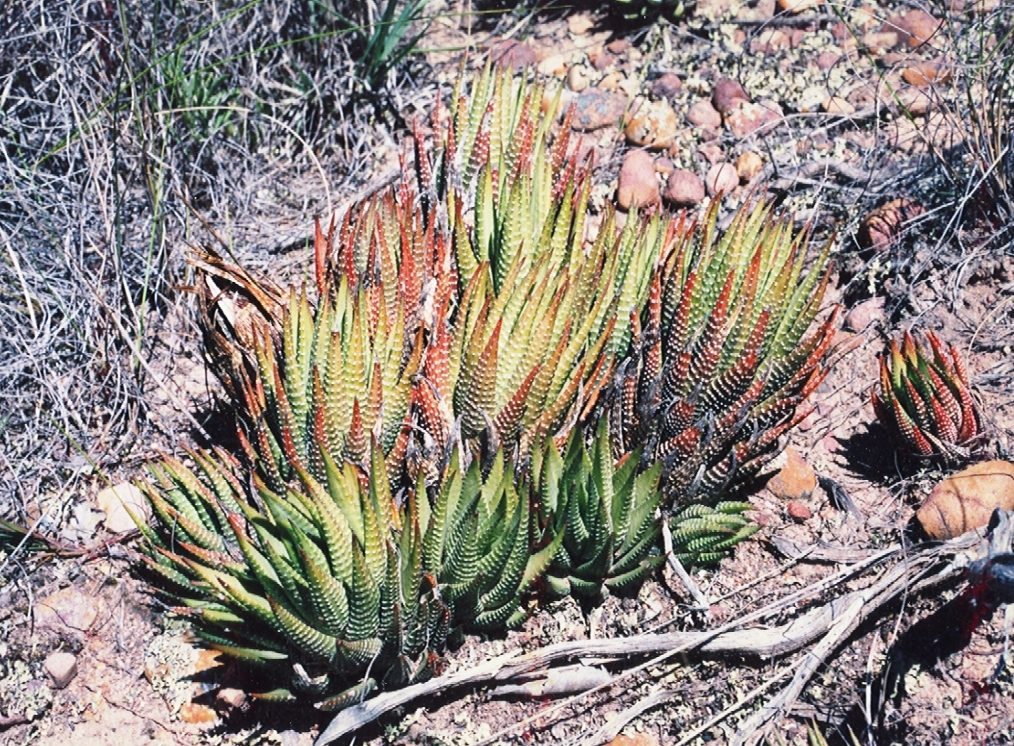
The zebra haworthia is a small ornamental succulent with pointed dark green leaves, striped with raised white bands like a zebra.
Characteristics
Description
The zebra haworthia is a small succulent much loved as a houseplant. It forms a compact rosette of fleshy, stiff, pointed leaves of a dark green, covered on the outside with characteristic bands of small white tubercles arranged in transverse rows, resembling the stripes of a zebra. It rarely exceeds 15 centimetres in height.
Origin
It is native to the Eastern Cape Province of South Africa, where it grows in arid, rocky habitats. It is a rare species in cultivation: many plants sold under this name actually belong to very similar related species.
Cultivation and care
It is a very easy succulent, ideal for beginners. It wants bright but indirect light, away from harsh direct sun which can scorch the leaves. The soil must be very free-draining, like cactus mix. Water moderately, letting the mix dry out well between waterings, and very little in winter. It dislikes waterlogging, the main cause of rot.
- Place near a bright window, without strong direct sun
- Water only when the soil is dry
- Repot rarely; it produces offsets easy to separate
Did you know?
Unlike cacti, the haworthia has no spines and is completely harmless to people and pets. It multiplies easily by detaching the small offsets that sprout at the base of the rosette.
Flowering season
Practical tips
Water needs: Low — always check soil moisture before watering.
Prefers Bright indirect light: provide the right light and rotate the plant for even growth.
Recommended soil: Sandy, very free-draining. Refresh the substrate every 1-2 years.
Dust the leaves with a damp cloth to support photosynthesis.
Feed during the growing season (spring-summer) and stop in winter.
Pros
- Very easy, perfect for beginners
- Compact and decorative, ideal indoors
- Non-toxic to people and pets
Cons
- Dislikes waterlogging and rot
- Strong direct sun can scorch the leaves
- Very slow growth