Photo: Stefan Berndtsson · CC BY 2.0
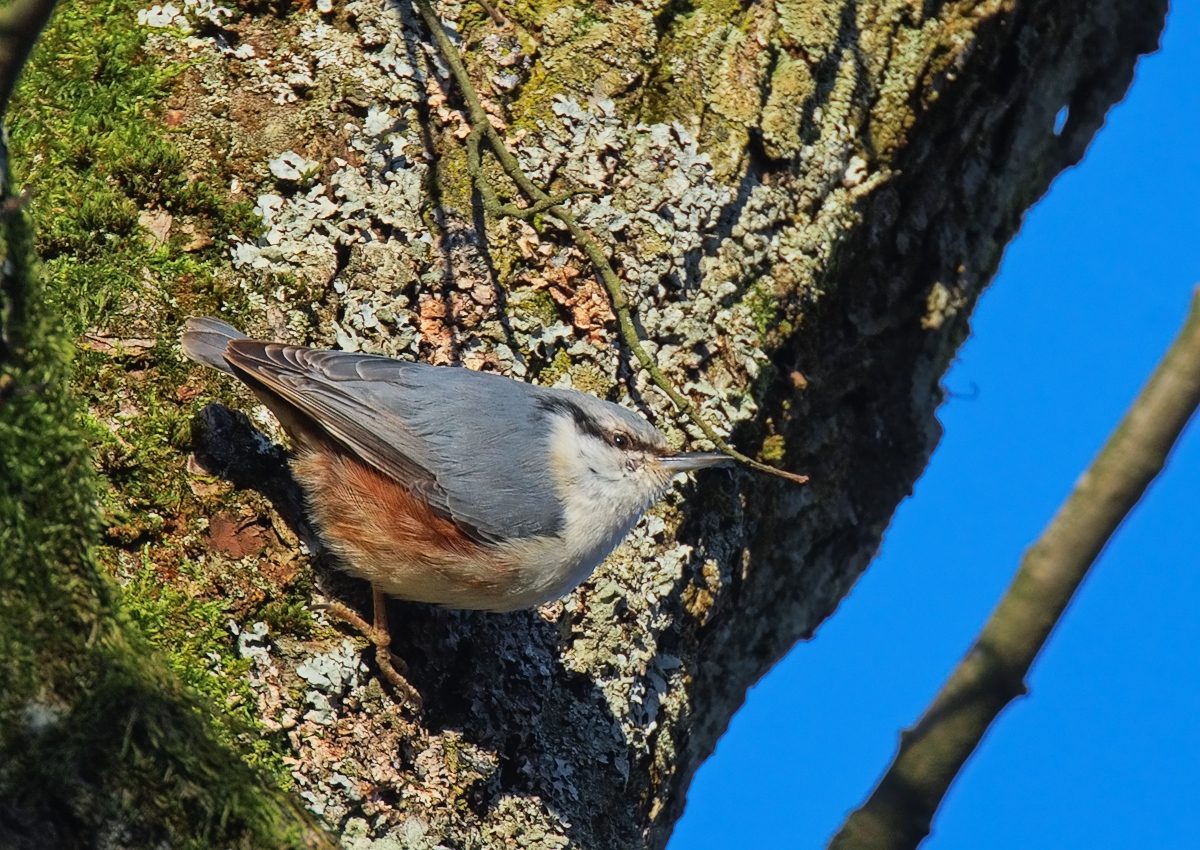
Eurasian nuthatch
Sitta europaea
The Eurasian nuthatch is a blue-grey acrobatic bird, the only one able to climb down tree trunks headfirst.
Characteristics
Temperament
Acrobatic, lively, territorial
Diet
Insects, spiders, seeds and nuts
Description
The Eurasian nuthatch is a small, stocky passerine with a short tail and a long, pointed bill. It has blue-grey upperparts, whitish or buff underparts depending on the region, and a clear black stripe through the eye. Despite the name, it is not a true woodpecker, but belongs to the nuthatch family.
Habitat and distribution
It occurs across much of Eurasia, in mature broadleaf and mixed woodland, parks and gardens with old trees. It is a sedentary, territorial bird, tied all year to its own wood, provided there are trees with cavities suitable for nesting.
Behaviour
It is a remarkable acrobat: it climbs nimbly over trunks in all directions and is the only European bird able to descend the bark headfirst. It feeds on insects, spiders and, in autumn and winter, on seeds and nuts, which it wedges into bark crevices and hammers open with its bill. Hence the name "nuthatch", from "nut-hacker".
Did you know?
Its behaviour of plastering the entrance of its nest cavity with mud, to shrink it to its own size and keep out larger intruders, is famous. It also hides food stores for the winter.
Conservation
It is classed as least concern. It depends on mature woodland with hollow trees; forestry that retains old and dead trees is particularly favourable to it.
(Note: the mass value given by Wikidata, 2.25 kg, is clearly wrong: the nuthatch actually weighs about 17–28 grams.)
Pros
- The only European bird to climb down headfirst
- Sedentary, present all year in gardens
- Easy to attract with seeds and nest boxes
Cons
- Depends on mature woodland with hollow trees
- Territorial, vigorously defends its area
- Sensitive to the removal of old trees