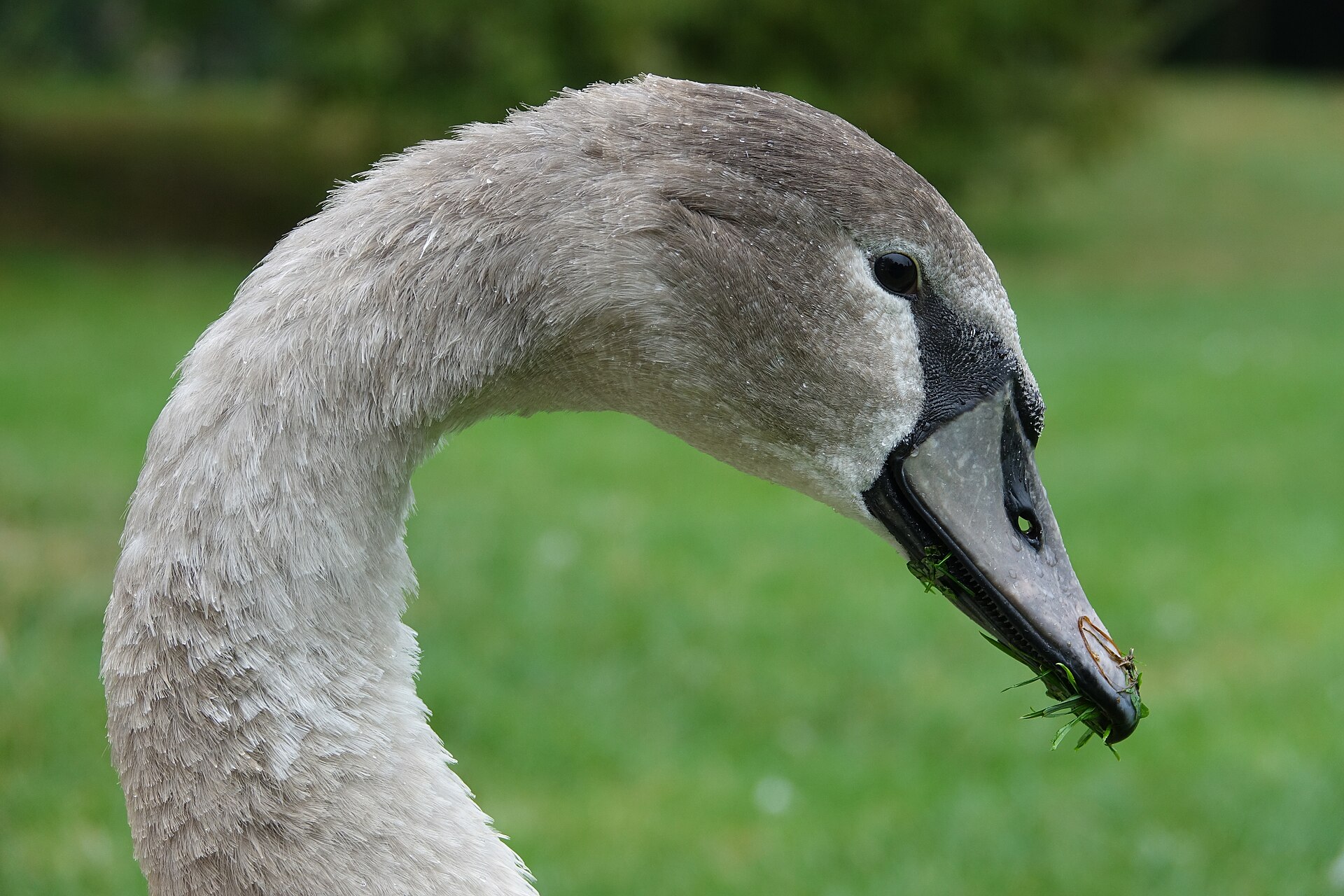
Mute Swan
Cygnus olor
Characteristics
Temperament
Monogamous, territorial, strongly bonded to its mate. Aggressive towards intruders during nesting. Silent flight accompanied by the characteristic metallic whistling of the wings.
Diet
Herbivore: submerged aquatic plants (Potamogeton, Myriophyllum), algae, marsh leaves and roots. 3-4 kg of vegetation per day. NEVER feed with bread!
The Mute Swan (Cygnus olor) is the largest waterbird of European wetlands and one of the most imposing flying birds of the Palearctic. Recognisable for its pure white plumage, long S-shaped neck and characteristic black knob at the base of the orange beak, it has long been a cultural symbol of elegance, purity and marital love: swans form monogamous pairs that can last for life.
Classification and category
The Mute Swan belongs to the order Anseriformes, family Anatidae, subfamily Anserinae. The genus Cygnus comprises six living species distributed across Europe, Asia, the Americas and Australia. The Mute Swan is one of the largest: body length is 125-170 cm, wingspan reaches 200-240 cm, average adult weight is 9-15 kg with males distinctly larger than females. It is among the heaviest flying birds in the world.
Habitat and distribution
Its natural habitat consists of lakes, ponds, slow-flowing rivers, marshes, coastal lagoons and various wetlands, both freshwater and slightly brackish. It prefers shallow waters with rich submerged vegetation, where it can feed by reaching the bottom with its long neck without having to submerge the body. The natural range covers much of central, southern and northern Europe, central Asia as far as Lake Baikal, with introduced populations in North America, Australia, South Africa and New Zealand.
Conservation status is listed as Least Concern (LC) by the IUCN. In Europe it is a protected species in many countries; historically in England, all Mute Swans belong to the British Crown, a tradition dating back to the 12th century and still formally in force.
Diet
The Mute Swan is predominantly herbivorous. The diet is composed mainly of submerged aquatic plants (Potamogeton, Myriophyllum, Chara), algae, leaves and roots of marsh vegetation, occasionally supplemented with small aquatic invertebrates (snails, insect larvae) and tadpoles accidentally ingested during filtering. An adult swan consumes 3-4 kg of fresh vegetation per day.
Feeding typically occurs through the upending technique: the animal tips its body vertically, submerging head, neck and front of the body to reach the bottom. It is important not to feed swans with bread: bread is poor in nutrients, can cause wing deformities ("angel wing") in young birds and metabolic diseases.
Physical features
The Mute Swan has a powerful, streamlined body, perfectly adapted to aquatic life. Adult plumage is uniform pure white, while juveniles (cygnets) wear a greyish-brown coat that turns white only by their second or third year. The beak is bright orange, with a black base and a more developed knob in adult males.
The feet are webbed, black, set very far back on the body — an adaptation to swimming that makes the terrestrial gait clumsy and waddling. The wings are powerful: each weighs up to 1 kg and can produce a strike capable of breaking human bones (a myth amplified but with a kernel of truth). The flight is elegant but noisy: the wingbeats produce a characteristic metallic whistling audible 1-2 km away, a kind of "aerial signature" that identifies the species.
Behaviour and curiosities
The Mute Swan is a monogamous species with extremely stable pair bonds: pair formation occurs at 2-3 years and usually lasts for life, although in case of partner death some individuals can form a new pair. Pairs defend large territories and are notoriously aggressive towards intruders, including dogs and sometimes humans.
The scientific name olor means "swan" in Latin but also "smell", chosen in contrast to the fact that the species is also called "mute" because it is generally less vocal than other swan species — though it does emit hisses, snorts and nasal sounds in contexts of threat or courtship. The famous "swan song" of literature referring to death is actually more fitting for the Whooper Swan (Cygnus cygnus). Lifespan is 10-20 years in the wild, up to 40 in captivity with adequate care. Nesting takes place between March and May: the female lays 5-8 eggs in a large nest of reeds and twigs on the water or shore, incubated for 35-41 days.
Pros
- Specie iconica e simbolica
- Longeva (oltre 40 anni in cattività)
- Fedele al partner per la vita
- Facile da osservare in laghi urbani
Cons
- Specie selvatica, NON è un animale da compagnia
- Aggressivo durante la nidificazione
- Protetto in molti paesi europei
- Vulnerabile a inquinamento delle acque