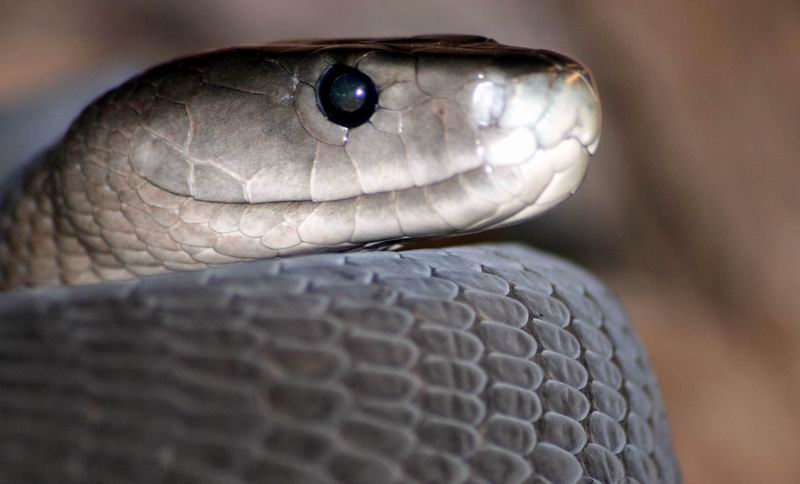
Black Mamba
Dendroaspis polylepis
Characteristics
Temperament
Solitary, diurnal, territorial. FASTEST LAND SNAKE IN THE WORLD (16-20 km/h, 11 km/h sustained). Shy, prefers to flee. Attacks only if cornered. Lightning venom (10-15 mg lethal, bite contains 100-400 mg).
Diet
Generalist carnivore: small mammals (rodents, hares, hyrax, young antelopes), birds, bats. Neurotoxic venom (dendrotoxins). Active technique: pursues prey, bites, retreats, follows olfactory trail. 1-2 prey/month.
The Black Mamba (Dendroaspis polylepis) is one of the most feared and fascinating snakes in Africa: the fastest land snake in the world (16-20 km/h in sprint, over 11 km/h sustained for hundreds of metres), the second-longest venomous snake after the King Cobra (average length 2-3 m, record 4.5 m), and one of the most lethal — its bite was considered "the kiss of death" throughout sub-Saharan Africa before the availability of antivenom serum (100% mortality without treatment, today reduced to 15-20% with antivenom). The name does not derive from the colour of the body (which is grey-brown) but from the inside of the mouth black as ebony, exposed as a visual threat when it feels intimidated. Despite its terrifying reputation, the Black Mamba is actually a shy and timid animal, which attacks only if cornered or surprised. Protagonist of African popular culture and action films, it is an iconic symbol of African wildlife.
Classification and category
The Black Mamba belongs to the order Squamata, suborder Serpentes, family Elapidae (the same as cobras, taipans, coral snakes), genus Dendroaspis. The genus comprises 4 species of "mamba": D. polylepis (Black Mamba), D. angusticeps (Eastern Green Mamba), D. jamesoni (Jameson's Mamba), D. viridis (Western Green Mamba). The "green mambas" are arboreal, the Black Mamba is predominantly terrestrial. The average length of adults is 2-3 metres, with documented record specimens up to 4.5 m (specimen captured in Kenya in 1970). Average weight is 1.5-3 kg, with records of 4.5 kg. Males are slightly larger than females. The species was scientifically described by German naturalist Albert Günther in 1864 based on South African specimens. The genus name Dendroaspis derives from Greek "dendro" (tree) and "aspis" (viper, snake), a reference to the fact that the other 3 species are arboreal.
Habitat and distribution
The habitat of the Black Mamba consists of savannahs, arid scrublands, open gallery forests, rocky terrain and agricultural areas of sub-Saharan Africa. Unlike the green mambas which are predominantly arboreal, the Black Mamba is semi-terrestrial: it lives mainly on the ground, but can climb with great agility (up to 3-4 m in height) to hunt or defend itself. It prefers areas with shelter availability (termite mounds, rock crevices, hollow trees, old animal burrows). It tolerates altitudes from 0 to 1,800 m above sea level.
The geographic distribution covers vast territories of East and Southern Africa: Senegal, Mali, Burkina Faso (in West Africa, isolated populations), Ethiopia, Eritrea, Somalia, Kenya, Tanzania, Uganda, Rwanda, Burundi, Democratic Republic of Congo, Zambia, Malawi, Mozambique, Zimbabwe, Angola, Namibia, Botswana, eastern South Africa. The global population is abundant and the species is not considered threatened: conservation status is listed as Least Concern (LC) by IUCN. Local threats are: killing out of fear (frequent in African rural areas), habitat loss, hunting for traditional medicine. Human mortality caused by the Black Mamba is estimated at 1,000-3,000 deaths per year in sub-Saharan Africa, mainly in rural areas with limited access to antivenom serum. In developed countries with medical access (South Africa, touristic Kenya), mortality is much lower. The "SAIMR Polyvalent" antivenom serum covers Black Mamba, Cobra, green mambas.
Diet
The Black Mamba is a generalist carnivore with varied diet: small mammals (main prey: rodents — rats, ground squirrels, rabbits; small mustelids; young small antelopes; hyrax), birds on the ground and their chicks/eggs, bats, occasionally other snakes, lizards. The food requirement is low: an adult can survive on 1-2 medium-sized prey per month.
The hunting technique is predominantly active: the Black Mamba moves rapidly through its territory actively searching for prey through smell (forked tongue + Jacobson's organ) and sight (it is one of the snakes with the most developed sight). Once it has located its prey, it attacks with a lightning bite and retreats; it does not constrict like pythons, but relies on venom to immobilise it. The venom is one of the most potent and fast in the animal kingdom: it contains dendrotoxins (a-blocking neurotoxins) and cardiotoxins. A single bite injection contains 100-400 mg of venom; the lethal dose for humans is only 10-15 mg. The prey dies in 5-10 minutes from respiratory paralysis. The Black Mamba can inflict multiple consecutive bites (up to 12 in a few seconds during a defensive attack), each potentially lethal. Untreated human victims die in 7-15 hours (the fastest fatality is documented in 20 minutes from direct cardiac puncture by venom fangs).
Physical features
The Black Mamba has a long, slender, muscular body, perfectly adapted to speed. The colour is not black (as the popular name suggests) but olive grey, bronze-brown or dark grey uniform, with lighter shades on the belly. Juveniles are lighter (greenish) and become darker with age. The skin of the scales is smooth and shiny.
The name "Black" derives from the inside of the mouth: open in threat position, it reveals a surface black as ebony, which the snake exposes as a visual deterrent before attacking. The head is characteristically "coffin-shaped" (elongated, narrow, with flat muzzle), a diagnostic criterion to distinguish it from cobras (round head). The eyes are of medium size, black with round pupil, excellent vision. It possesses fixed anterior venom fangs (proteroglyph), 6-7 mm long, positioned in the front of the jaw. Speed is legendary: the Black Mamba is the fastest snake in the world with peaks of 20 km/h (some sources report 23 km/h, but 16-20 km/h is the scientifically accepted figure), and can maintain 11 km/h sustained for hundreds of metres. By comparison, a king cobra reaches 12 km/h and an untrained human runs at 15-20 km/h. "You can run from a Black Mamba in a straight line on open ground, but it's difficult if it chases you" says a South African saying. Despite the speed, the Black Mamba attacks predominantly in defence: it prefers to flee at the first hint of danger. Only if cornered or surprised at close range can it attack, raising 1/3 of the body (up to 1 m in height) and displaying the inside of the black mouth as a final warning.
Behaviour and curiosities
The Black Mamba is a solitary, diurnal, territorial animal. Each adult maintains a territory of 1-3 km² aggressively defended from other mambas. It has multiple shelters (5-10 preferred dens, usually old termite mounds or rock crevices) that it uses rotatively. Communication includes loud hisses (more powerful than those of cobras), threat postures (body upright in "S"), urinary pheromones (during the breeding season).
Reproduction takes place in African spring (September-November in the southern hemisphere): males compete for females through ritual fights (they intertwine their bodies trying to lower the opponent's head, but without venomous bites between them). The female lays 6-17 eggs in abandoned underground cavities; incubation lasts 80-90 days at 28-32 °C. The young at birth measure 40-60 cm and are already completely venomous (the bite of a newborn mamba can kill an adult human). There is no parental care: the female abandons the nest after laying. Longevity in nature is estimated at 11 years; in captivity 20-22 years documented.
Curiosity: the term "black mamba" is iconic in popular culture. The basketball player Kobe Bryant (NBA) adopted the nickname "Black Mamba" during his career, in reference to the qualities of the snake: speed, precision, lethality on the court. The character "Black Mamba" played by Uma Thurman in the film "Kill Bill" by Quentin Tarantino (2003-2004) is an assassin as lethal as the snake. In sub-Saharan Africa, the Black Mamba is the subject of numerous legends and taboos: the Masai of Kenya/Tanzania believe it brings bad luck to name the snake by name (they call it "the unnameable" or "the one not looked at"). Scientifically, the venom of the Black Mamba is the subject of studies for new pain-relief drugs: mambalgin (protein isolated from the venom) is 1,000 times more potent than morphine without opioid side effects, and is in the development phase for the treatment of chronic pain.
Pros
- Serpente terrestre più veloce del mondo (record 20 km/h)
- Secondo serpente velenoso più lungo (4,5 m record)
- Icona della fauna africana, simbolo culturale globale
- Veleno fonte di nuovi farmaci (mambalgina antidolore)
Cons
- Morso letale al 100% senza siero antivenenoso
- Causa 1.000-3.000 morti umane/anno in Africa
- VELOCITISSIMO: 20 km/h supera quasi ogni uomo
- NON PER TERRARIOFILIA - vietato in UE detenzione amatoriale