Crested Gecko
Correlophus ciliatus
Characteristics
Temperament
A small, nocturnal, arboreal gecko, docile and calm. It is one of the most popular pet reptiles in the world precisely for its gentle temperament, ease of care and handleability. By day it hides among the vegetation; by night it becomes active and climbs nimbly thanks to its adhesive toes and prehensile tail. It needs no high temperatures or complex lighting, and can be fed with convenient commercial fruit-based diets: hence it is often recommended for beginners. It has no eyelids and cleans its eyes with its tongue; if it loses its tail, however, it does not regenerate it. In the wild it is a vulnerable wild species, endemic to New Caledonia.
Diet
Omnivorous: in the wild it combines ripe fruit and nectar (an important component, unusual for a gecko) with insects and other invertebrates (crickets, small arthropods) as a protein source. In captivity its feeding is particularly convenient thanks to complete powdered commercial fruit-based diets, formulated especially for the species, often supplemented with insects dusted with calcium and vitamins. It needs no strong heat sources: this ease of care, combined with the partly frugivorous diet, has hugely contributed to its spread as a terrarium reptile suitable even for beginners.
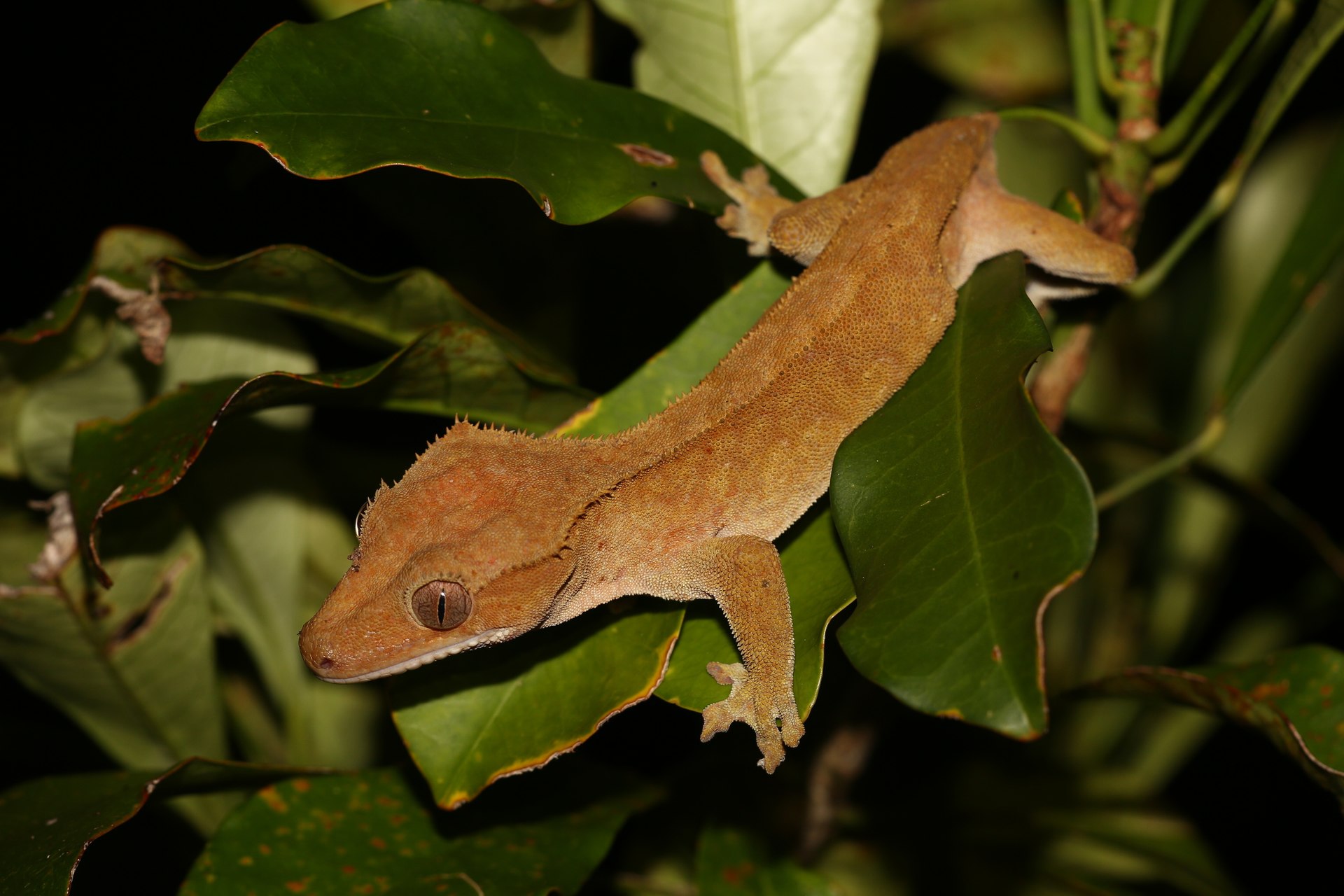
The Crested Gecko (Correlophus ciliatus), also called the eyelash gecko, is a small, fascinating arboreal gecko native to New Caledonia. It has become famous both for its unique appearance and for an extraordinary story. Unmistakable for:
- The crested "eyelashes": rows of soft, spiny skin projections above the eyes and down the back, recalling eyelashes or a mane
- The rediscovery story: thought extinct for decades, it was found again in 1994
- The great popularity: it is today one of the most widespread and beloved pet reptiles in the world
- The lack of eyelids: like many geckos, it cannot close its eyes and cleans them with its tongue
- The prehensile tail: useful for climbing, but which once lost does not regrow
- The countless colour varieties ("morphs") selected in captivity
IUCN status: Vulnerable (VU) in the wild, although extremely abundant in captivity. It enters the portal among the geckos, alongside the Common Gecko: with it, it doubles the portal's gecko group, pairing the Mediterranean house gecko with one of the best-known exotic geckos of the terrarium world.
Classification and category
The Crested Gecko belongs to the order Squamata, family Diplodactylidae (one of the gecko groups), genus Correlophus. The species is Correlophus ciliatus (formerly classified as Rhacodactylus ciliatus). In the portal it is placed among the geckos. It is useful to tell it apart from the portal's other geckos and lizards: the Common Gecko (the Mediterranean house gecko) — smaller and greyish, without the showy supraocular crests; it lives on walls and buildings, while the crested gecko is arboreal; the Leopard Gecko — unlike the crested, it has movable eyelids, lives on the ground and is spotted; the crested gecko is arboreal, without eyelids and with the "eyelashes"; the crested gecko is recognized at a glance by the rows of spiny projections ("eyelashes") above the eyes and down the back, and by its broad, wedge-shaped head. The combination of crested "eyelashes" + wedge-shaped head + arboreal habits + prehensile tail is the crested gecko's "identity card". Etymology: the species name ciliatus means "provided with eyelashes", referring precisely to the supraocular crests that look like eyelashes; hence also the English name "eyelash gecko". Parameters: Length usually about 10-25 cm, including the tail. Weight about 35-50 g. Appearance a small gecko with a soft body, broad head and large eyes. Longevity: remarkable for a small reptile — in captivity it can live 15-20 years with proper care. Peculiarity: like other geckos it has adhesive lamellae under its toes (and a pad on the tail tip) that let it climb smooth surfaces.
Habitat and distribution
The Crested Gecko is a restricted-range species, endemic to a corner of the Pacific: its origin is New Caledonia, an archipelago of the southwestern Pacific; in particular the main island (Grande Terre) and the Isle of Pines. Natural habitat — the island's humid forests: tropical and subtropical forests, among trees, shrubs and vegetation; and an arboreal life (it spends the day hidden and becomes active at night among branches and leaves). It is a nocturnal, arboreal animal. By day it hides in the vegetation, while by night it moves nimbly among the branches hunting for food, helped by its adhesive toes and prehensile tail. It is a mild-climate gecko that does not require high temperatures: this feature, combined with its docile nature and relatively simple care, has made it one of the most successful pet reptiles. IUCN status: Vulnerable (VU). Although bred in captivity worldwide in huge numbers, in the wild the crested gecko has a very limited range and is threatened by habitat loss and above all by the fire ant (an invasive species that preys on and disturbs the local fauna). The conservation of New Caledonia's forests, a true biodiversity hotspot, is essential for its survival in the wild.
Diet
The Crested Gecko is omnivorous, with a diet that in the wild combines fruit and small prey: ripe fruit and nectar (an important part of the diet, unusual for a gecko); and insects and other invertebrates (crickets, small arthropods, a protein source). In captivity its feeding is particularly convenient: commercial fruit-based diets (there are complete powdered foods, to be mixed with water, formulated especially for this species, which make breeding easier); supplementation with insects (crickets or other insects are often still offered, sometimes dusted with calcium and vitamins); and few "technical" requirements (it does not need strong heat sources or complex lighting, which simplifies care). Crucially, its partly frugivorous diet and the availability of ready commercial foods have hugely contributed to the spread of the crested gecko as a terrarium animal, making it suitable even for beginners.
Physical features
The Crested Gecko is a small reptile with a soft, likeable appearance and unmistakable traits. The crests and the head — the distinguishing trait: rows of spiny skin projections ("eyelashes") starting above the eyes and continuing along the neck and back; a broad, triangular (wedge-shaped) head, with large eyes; the absence of eyelids (the eyes are protected by a transparent scale, which the gecko cleans with its tongue). The body and limbs: a slender, soft body, covered with finely scaled skin; toes with adhesive lamellae, and an adhesive pad on the tail tip too, for climbing; a prehensile tail (it uses it as a "fifth limb"; if it loses it, however, it does not regrow, unlike many other geckos). The colour: in the wild (brown, tawny, grey and cream tones, with various camouflage patterns); in captivity (very many colour and pattern varieties, "morphs", much sought after by enthusiasts).
Curiosities and conservation
The Crested Gecko is a small reptile with an adventurous history and a docile character, which in a few decades went from being considered extinct to populating terrariums worldwide.
The "return from extinction": for much of the 20th century the crested gecko was considered extinct, known only from old museum specimens; in 1994, however, after a tropical storm, it was rediscovered in New Caledonia; from those few individuals, through breeding, derive the millions of crested geckos now in terrariums worldwide: an extraordinary story of "return from oblivion". The "eyelashes" that give the name: the rows of spiny projections above the eyes recall long eyelashes, and from this come both the scientific name (ciliatus, "eyelashed") and the English "eyelash gecko"; they are not real eyelashes, but skin outgrowths that, continuing along the back, give it a vaguely "spiny" look. Eyes cleaned with the tongue: like most geckos, the crested gecko has no movable eyelids and so cannot "blink"; its eyes are protected by a fixed transparent scale, which the gecko keeps clean by licking it with its tongue: a curious sight typical of these reptiles. The tail that does not regrow: many geckos and lizards, if grabbed, can drop their tail to escape predators and then regenerate it; the crested gecko too can lose its tail (autotomy), but, unlike many other species, it does not regenerate it: in the wild, and often in captivity too, many adults therefore live without a tail, without major problems. The "easy" gecko: the crested gecko's success as a pet is due to a rare combination of factors: it is docile and handleable, of modest size, needs no high temperatures or complex lighting, and can be fed with convenient commercial fruit-based diets; for this reason it is often recommended as one of the reptiles most suitable for beginners. Conservation: against its huge spread in captivity, the situation in the wild is far more fragile; the crested gecko is endemic to New Caledonia alone, a small biodiversity paradise, and is classified as Vulnerable; the main threats are habitat loss and the impact of invasive species, particularly the fire ant; protecting New Caledonia's forests is essential not only for this gecko, but for the many unique species that live there; the crested gecko's popularity, if accompanied by awareness, can also help raise awareness of the value of these ecosystems.
Pros
- Aspetto unico e simpatico, con le inconfondibili 'ciglia' crestate
- Docile, maneggevole e tra i rettili da terrario più adatti ai principianti
- Non richiede temperature elevate né illuminazione complessa
- Straordinaria storia di specie riscoperta dopo essere stata creduta estinta
Cons
- In natura è Vulnerabile (IUCN), endemico della sola Nuova Caledonia
- Se perde la coda non la rigenera (a differenza di molti gechi)
- Resta un animale esotico con esigenze specifiche di terrario e dieta
- La grande domanda come pet richiede provenienza responsabile (allevamento)