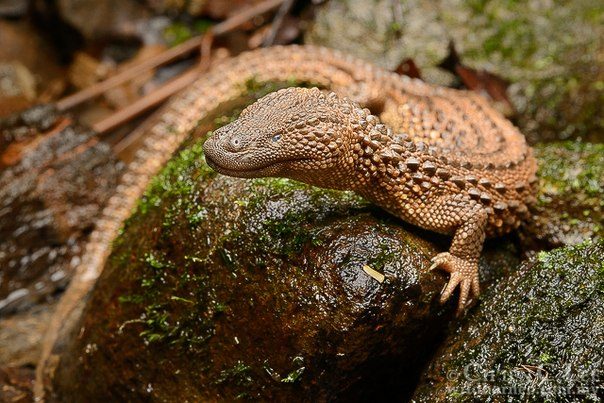
Earless monitor lizard
Lanthanotus borneensis
A rare semiaquatic reptile from Borneo, the earless monitor lizard is regarded as a 'living fossil' related to the monitors and is the only species in its family.
Characteristics
Temperament
Nocturnal, shy, semiaquatic and burrowing
Diet
Carnivore: worms, shrimps, fish, invertebrates
A 'living fossil' among lizards
The earless monitor lizard is a small, elongated, archaic-looking reptile, often called a 'living fossil'. It is the only living species of the family Lanthanotidae, an ancient lineage related to the monitor lizards and to the helodermas (the venomous lizards of the American deserts). Its brown body is covered in granular scales arranged in rows, with small eyes and, as the name says, no visible external ear openings. It has short legs and a strong, prehensile tail.
Habitat and distribution
It is endemic to northern Borneo, where it leads a shy, largely nocturnal life tied to water: it frequents streams, rice paddies and damp habitats, moving between land and water. It is so elusive that very few specimens were known for a long time.
Behaviour
It is a skilled swimmer and burrower. It feeds on small aquatic and terrestrial animals such as worms, shrimps, fish and other invertebrates, and appears to hunt mainly at night. It spends much time hidden in burrows and under banks, which makes its habits hard to study.
Curiosities
Its scientific interest is enormous: its anatomy helps explain the evolution of monitor lizards and snakes. Its very reputation as a rare, 'primitive' reptile has, however, made it a target of the illegal exotic pet trade since its reappearance in collectors' catalogues.
Conservation
The IUCN classifies the species as Endangered. The main threats are poaching for the collector reptile market and the destruction of wet habitats. The species is now protected and its trade regulated.
Pros
- 'Living fossil', unique in its family
- Valuable for the study of reptile evolution
- Fascinating semiaquatic lifestyle
Cons
- Endangered species
- Target of the illegal reptile trade
- Elusive, still poorly known