Photo: Joanne Merriam · CC BY-SA 3.0
Bongo
Tragelaphus eurycerus
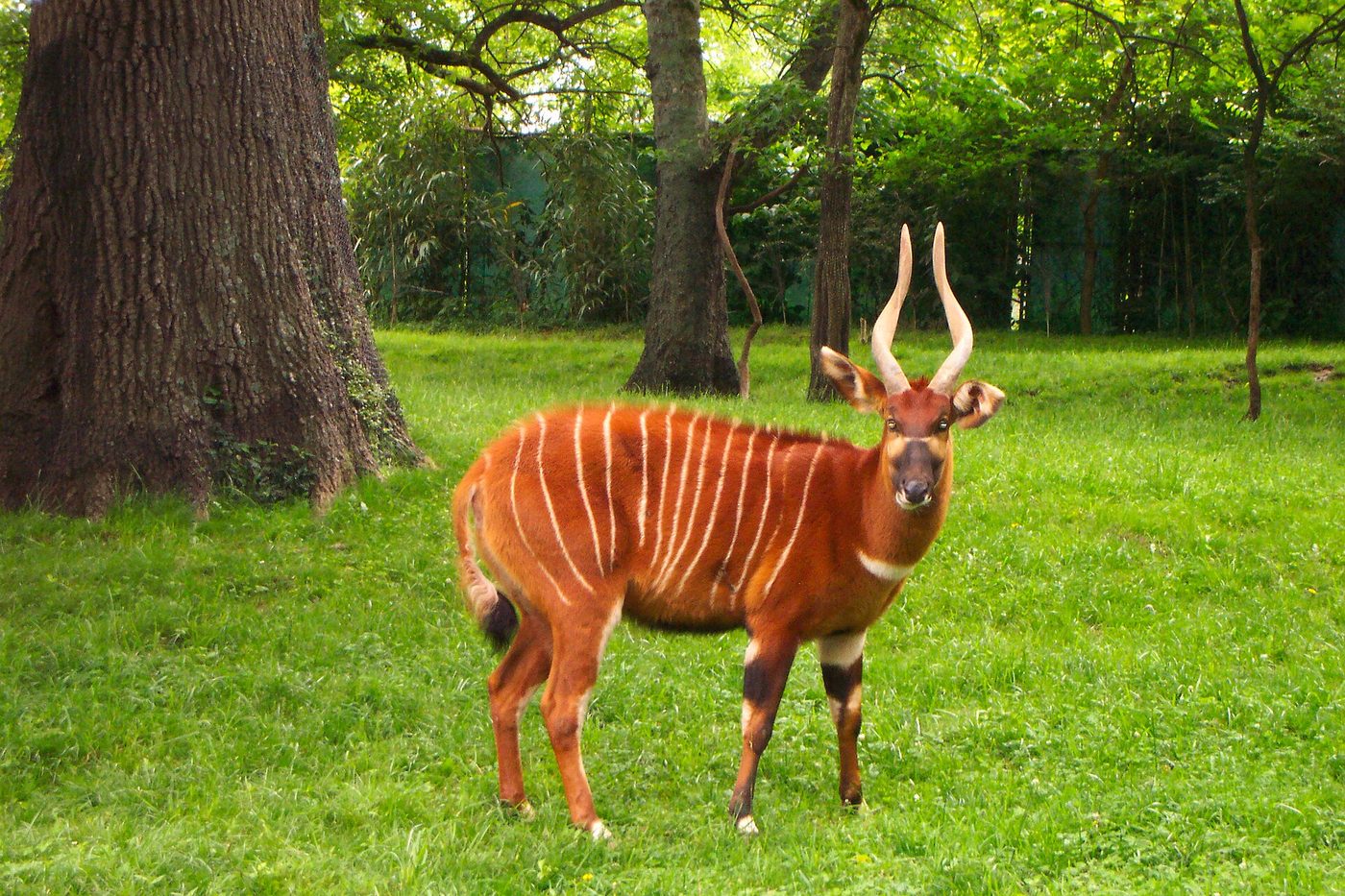
With its coppery-red coat crossed by white stripes and long spiral horns, the bongo is the largest and most colourful antelope of the African forests.
Characteristics
Temperament
Shy, nocturnal, in small groups or solitary
Diet
Herbivore: leaves, shoots, roots, bark, fruit
An antelope of striking colours
The bongo is the largest antelope living in the African forests, and also one of the most beautiful and unmistakable. Its coat is a warm coppery-red, crossed by a series of thin white vertical stripes, generally ten to fifteen per side, which stand out splendidly and help it blend in among the play of light and shade of the undergrowth. Both males and females bear long spiral horns, an unusual trait among antelopes, where often only the males are so equipped.
Habitat and distribution
It lives in the dense rainforests of central and western Africa, with some isolated populations also in mountainous areas of East Africa. It is an animal closely tied to dense, humid forest environments rich in undergrowth, where it finds food and shelter. Its shy nature and its life in dense vegetation make it hard to spot.
Behaviour
The bongo is a herbivore feeding on leaves, shoots, roots, bark and fruit. It is mainly nocturnal and crepuscular, which allows it to move about sheltered from predators and the heat. Females and young tend to live in small groups, while adult males are more solitary. Despite its large horns, the bongo moves with surprising agility through the vegetation, often tilting its head back to slide its horns along its body.
Curiosities
The bongo is known for loving places where the ground is rich in mineral salts, and even the clearings created by natural events, which it frequents to supplement its diet. The combination of coppery colour and white stripes makes it one of the most photogenic animals of the African forest.
Conservation
The bongo is classified as a near-threatened species. The mountain subspecies in particular are very rare and at risk. The main threats are the destruction of forests, poaching and habitat fragmentation. Protecting the African forests where it lives is essential for the survival of this splendid and imposing antelope.
Pros
- The largest antelope of the African forests
- Unmistakable striped coppery coat
- Spiral horns in both sexes
- Surprisingly agile in the undergrowth
Cons
- Near-threatened species
- The mountain subspecies are very rare
- Threatened by poaching and habitat loss