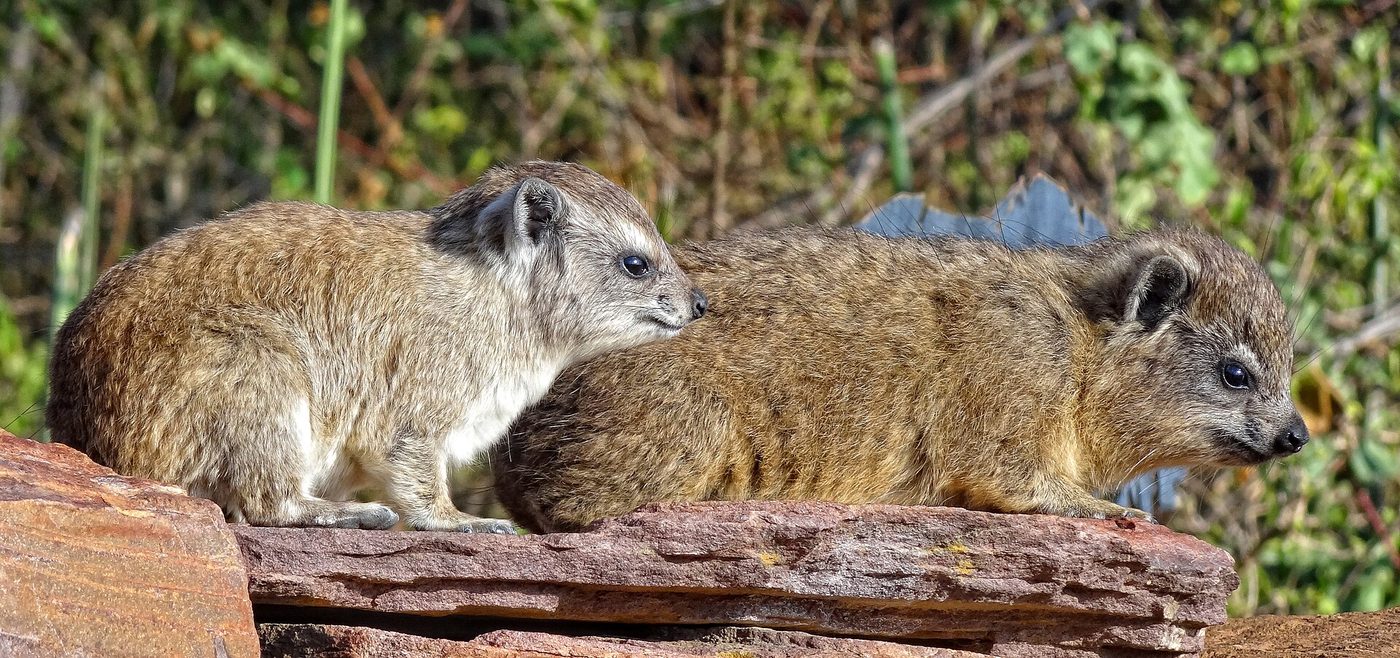
Photo: Bjørn Christian Tørrissen · CC BY-SA 3.0
Rock hyrax
Procavia capensis
A stout, guinea-pig-like mammal of African and Middle Eastern rocky outcrops, the rock hyrax looks like a rodent but counts elephants among its closest living relatives.
Characteristics
Temperament
Social, diurnal, alert; lives in colonies
Diet
Herbivore: grasses, leaves, shoots, fruit
An unlikely relative of the elephant
At first glance the rock hyrax resembles an oversized guinea pig or a tailless marmot. Its true affinities, however, are startling: its closest living relatives are not rodents but elephants and the sirenians (manatees and dugongs). Anatomical clues, such as tusk-like upper incisors and features of the skeleton, betray this ancient shared ancestry.
The body is compact, roughly 30–50 cm long, with no visible tail and a coat of brownish-grey fur. A conspicuous dorsal patch surrounds a scent gland used in communication. The soles of the feet are bare and kept moist, with rubbery pads that act like suction cups, letting the animal scramble confidently up smooth, steep rock faces.
Habitat and distribution
It is among the most widespread of the hyraxes, ranging across much of sub-Saharan Africa, along the north-eastern edge of the continent and into the Near East, from the Arabian Peninsula to the Levant. It favours rocky outcrops, boulder fields and cliffs, whose crevices offer shelter from predators and weather. It lives from sea level up to high mountain elevations.
Social life and warmth
Rock hyraxes live in colonies that may number several dozen individuals, centred on a dominant male with a group of females and their young. Because they thermoregulate poorly, they spend long morning hours basking in the sun, often huddled together. Sentinels watch for danger and give sharp alarm calls that alert the whole colony. Their vocal repertoire is unusually complex, with almost "dialect-like" differences between populations.
Diet and curiosities
The rock hyrax is a herbivore, feeding on grasses, leaves, shoots and fruit, and copes with tough, fibrous plants thanks to a compartmentalised stomach and lengthy gut fermentation. Colonies use fixed latrine sites; the crystallised deposits of urine and droppings, known as hyraceum, have been studied as a climate archive and were once used in perfumery. For all its placid looks, the hyrax is quick and agile among the rocks.
Conservation
The IUCN lists the species as Least Concern: its range is vast and populations are stable. It is locally hunted for meat or treated as a garden pest, but overall it faces no significant threat.
Pros
- Surprising living relative of elephants and manatees
- Complex social behaviour and rich vocal repertoire
- Wide range and stable populations
Cons
- Not a pet: highly specialised wild needs
- Poor thermoregulation, dependent on sunbathing
- Sometimes regarded as a garden pest