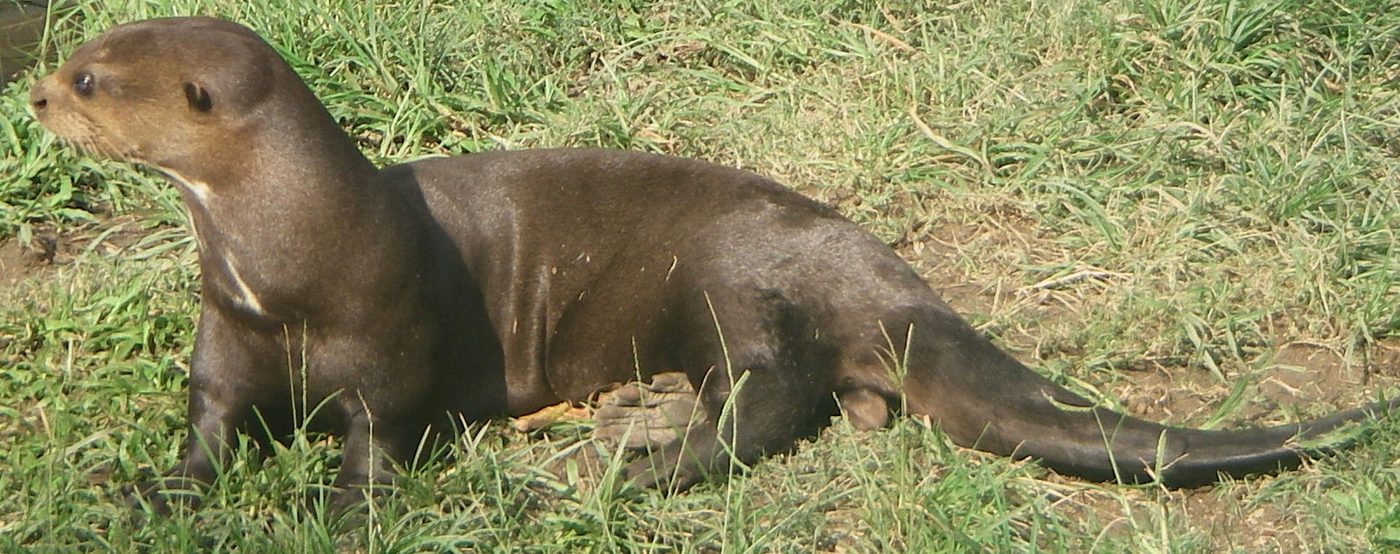
Photo: Wikimedia Commons · CC BY-SA 2.5
Giant otter
Pteronura brasiliensis
The giant otter is the longest of the weasel family, a social and noisy aquatic predator of Amazonian rivers, living in tightly-knit family groups.
Characteristics
Temperament
Diurnal, social and noisy; lives in cohesive family groups.
Diet
Carnivorous: mainly fish, but also crabs and small caimans.
The giant of Amazonian rivers
The giant otter (Pteronura brasiliensis) is the longest member of the weasel family, the Mustelidae: it can reach about 1.8 metres in length and weigh between 22 and 32 kg. (Note: the body-mass value listed on Wikidata, 200 kg, is clearly an error — the giant otter weighs about 22–32 kg.) It has a sleek, muscular body, thick velvety brown fur, webbed feet and a long, flattened tail that makes it a very fast swimmer. On its throat it bears a pale patch whose pattern is unique to each individual, serving as a kind of ID card.
Habitat and range
It lives in the large rivers, lagoons and wetlands of South America, especially the basins of the Amazon and Orinoco and the Pantanal. It needs clear, fish-rich water and banks suitable for digging dens.
Behaviour and diet
It is a diurnal and remarkably social predator: it lives in cohesive family groups of three to eight, centred on a dominant breeding pair, which hunt and defend themselves cooperatively. It feeds mainly on fish, but also on crabs and even small caimans. It is the noisiest otter, using a rich repertoire of distinct calls to signal alarm, aggression or reassurance.
Did you know?
It is territorial: groups mark the banks with communal latrines and may clash with neighbours. In some local languages it is called "lobo del río", river wolf, for its nature as a group-hunting predator.
Conservation
The IUCN lists it as Endangered. It was once hunted almost to extinction for its prized fur; today the main threats are the destruction of river habitats, pollution (including mercury from gold mining) and human disturbance.
Pros
- The longest of the mustelids
- Cooperative social life in family groups
- A very fast, agile swimmer
Cons
- Endangered
- Very sensitive to river pollution
- Needs large stretches of clear, fish-rich water