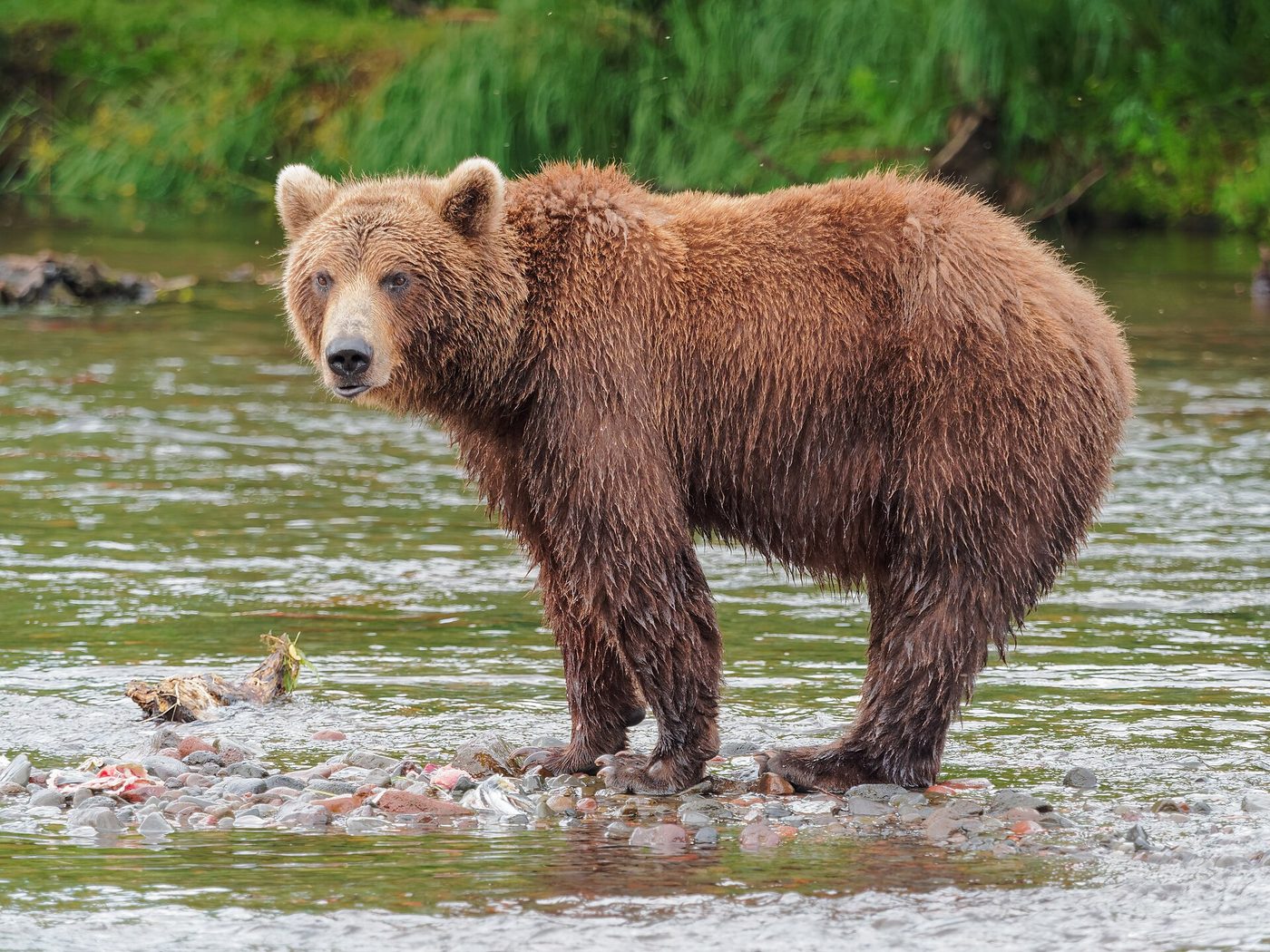
Photo: Robert F. Tobler · CC BY-SA 4.0
Brown bear
Ursus arctos
Europe's largest land carnivore is also one of its most elusive: an animal of remarkable bulk that spends most of its life avoiding us.
Characteristics
Temperament
Shy and solitary. It avoids people and attacks almost only when surprised at close range, or when a female perceives a threat to her cubs.
Diet
Opportunistic omnivore: berries, roots, acorns, insects, honey, fish and carrion. Plant matter dominates across most of its range.
A discreet giant
Anyone picturing the brown bear as a relentless predator is in for a surprise. An adult male may reach 500 kilograms, yet he spends most of his day carefully steering clear of people. The silhouette is unmistakable: heavy shoulders crowned by a muscular hump, broad paws, and long straight claws that are poor for climbing but excellent for digging.
Coat colour ranges from pale blond to near black, and that variability fooled naturalists for centuries, who described dozens of separate species where only one existed.
Where it lives
The brown bear's range spans three continents: Europe, Asia and North America, where it is known as the grizzly. Two nuclei survive in Italy, one in the central Alps and a far more fragile one in the central Apennines. These are small, isolated populations that depend on being able to move along woodland corridors which grow more fragmented every year.
An opportunist's diet
The word "carnivore" deserves caution here. The brown bear eats almost anything it finds: berries, roots, acorns, insects, honey, fish, carrion. Across much of its range, meat accounts for a small fraction of the diet. That flexibility is precisely what allowed it to colonise habitats as different as Arctic tundra and Mediterranean beech forest.
Winter dormancy
As the cold arrives the bear withdraws into a den and slows its metabolism. This is not the deep hibernation of a marmot: body temperature drops only a few degrees and the animal can wake if disturbed. It is during this period that females give birth, and the cubs, tiny and helpless, spend their first weeks in darkness, feeding on their mother's milk.
Conservation
Globally the species is listed as least concern, but the label misleads. It means the bear is abundant in Russia, Canada and Alaska, not that it thrives everywhere. Southern European populations remain vulnerable, threatened by poaching, road collisions and above all by conflict with human activity. Coexistence is possible, but it demands prevention: electric fencing, proper waste management and public information.