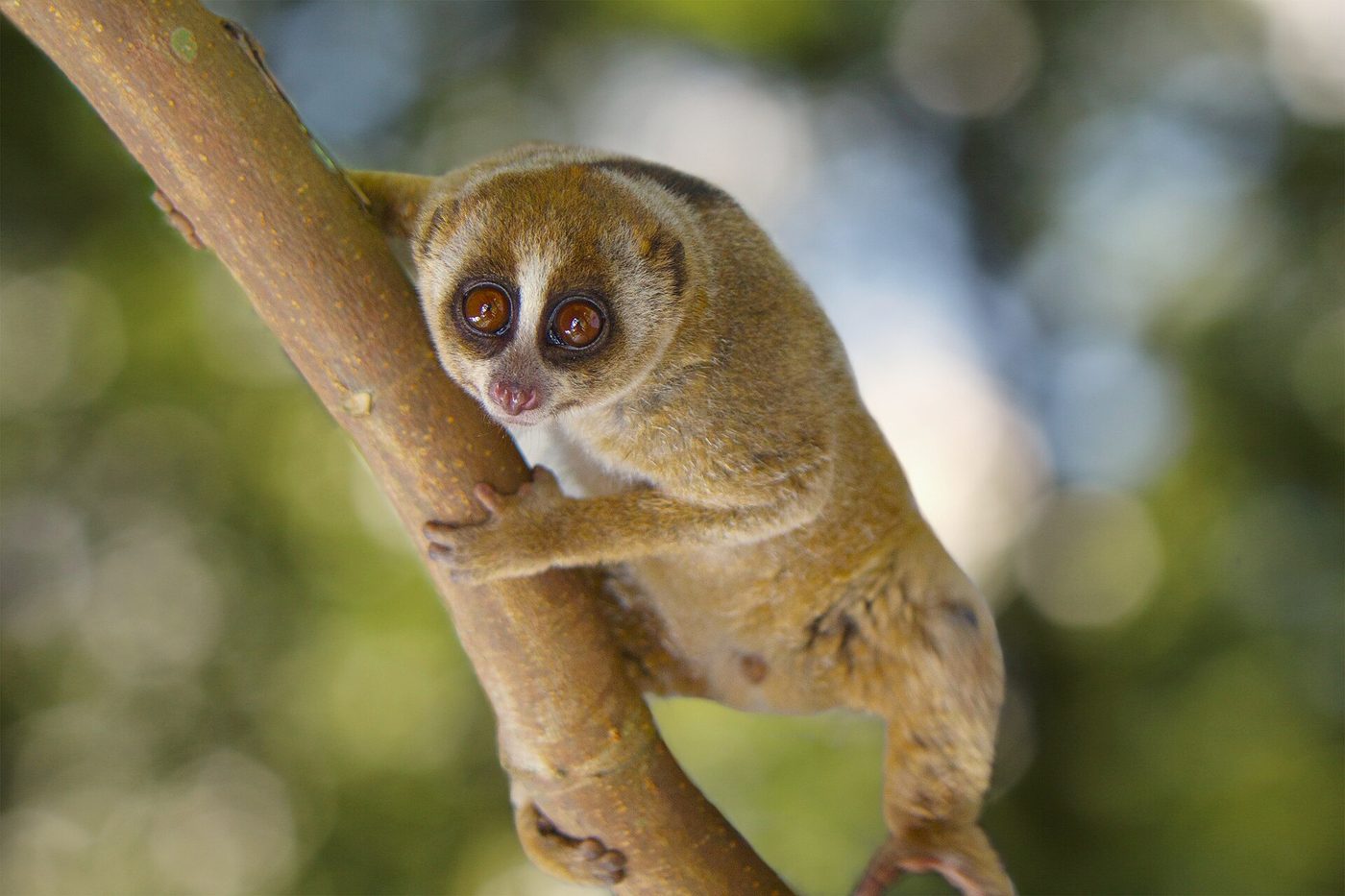
Sunda slow loris
Nycticebus coucang
A small nocturnal primate of Southeast Asia, the Sunda slow loris is the only venomous primate in the world, creeping silently through the forest canopy.
Characteristics
Temperament
Nocturnal, solitary, slow and secretive
Diet
Omnivore: insects, gum, nectar, small vertebrates
The only venomous primate
The Sunda slow loris is a small strepsirrhine primate with enormous eyes suited to a nocturnal life. It measures between 27 and 38 cm and weighs a little over half a kilogram. Its face is flat, the ears tiny and almost buried in dense fur, and the tail reduced to a stump. One trait sets it apart from every other primate: it is venomous. A gland on the elbow secretes a substance that, mixed with saliva, turns the bite toxic; the animal can also smear it through its fur to protect itself and its young.
Habitat and distribution
It lives in the tropical forests of Indonesia (Sumatra), Peninsular Malaysia, southern Thailand and Singapore, as well as several smaller Sundaic islands. It inhabits the canopy, where it moves with extreme slowness and caution, gripping branches with a powerful hold made possible by sturdy hands and feet and a network of blood vessels that lets it stay motionless for long periods without tiring.
Behaviour and diet
It is nocturnal and largely solitary, active from dusk to dawn. It feeds on insects, small vertebrates, eggs, nectar, gum and tree sap, which it gathers by gouging the bark. Its slow, silent movements make it nearly invisible to predators: when threatened it freezes or raises its arms over its head to reach the venom gland, ready to bite.
Curiosities
Its large, reflective eyes have earned it a reputation as a magical creature in many cultures. That same gentle, defenceless appearance has made it a victim of the illegal exotic pet trade: captured and sold as a "cuddly" pet, its teeth are often clipped, with serious consequences for its health.
Conservation
The IUCN classifies the species as Endangered. The main threats are forest destruction and poaching for the pet trade and traditional medicine. Rescue and awareness programmes work to confiscate individuals and return them to the wild.
Pros
- Remarkable adaptations to nocturnal, arboreal life
- The only primate with a venomous bite
- Long-lived, can exceed twenty years
Cons
- Protected species: illegal to keep as a pet
- Venomous bite, potentially dangerous to humans
- Endangered by poaching and habitat loss