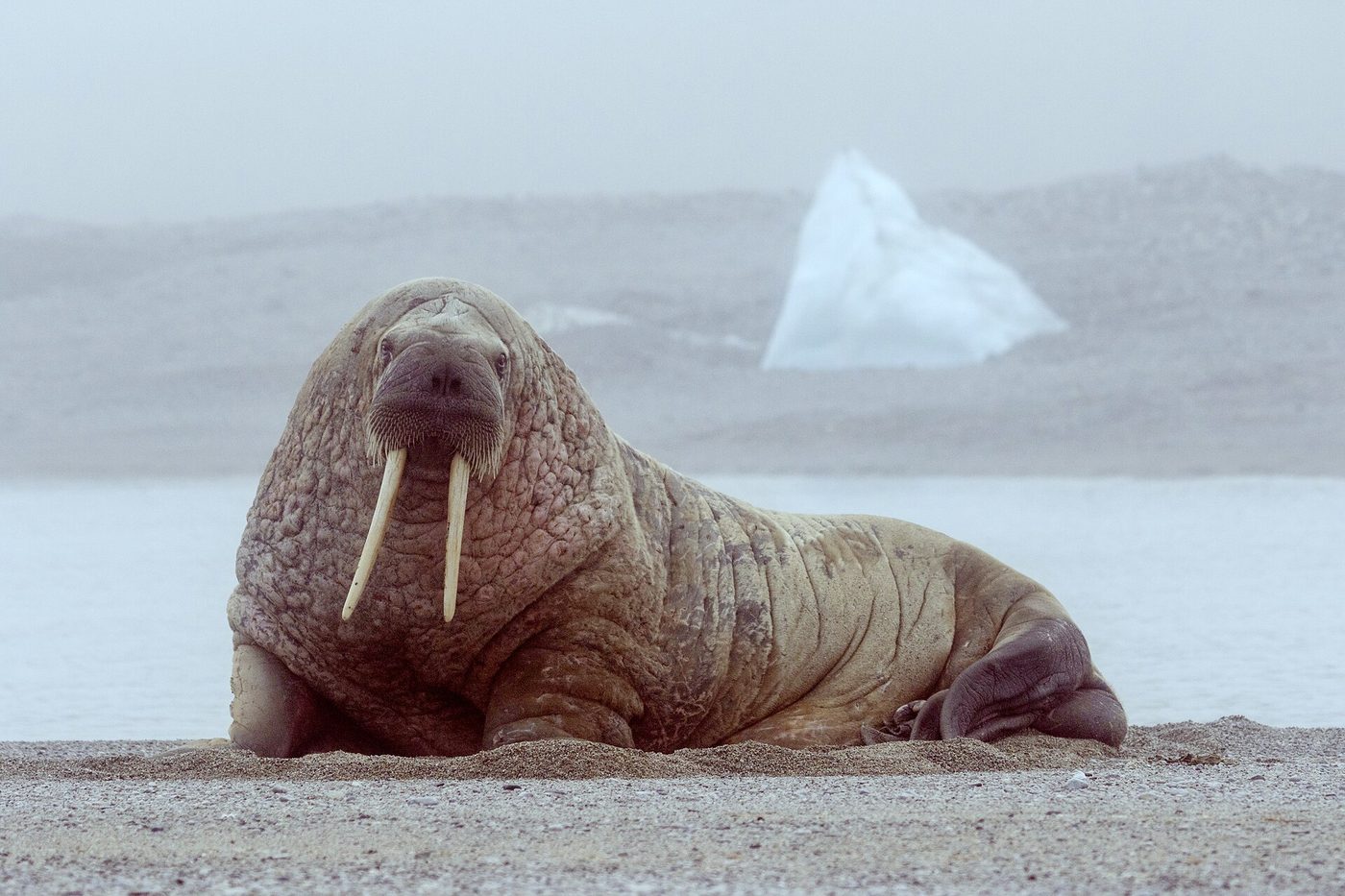
Photo: Nixette · CC BY-SA 4.0
Walrus
Odobenus rosmarus
A whiskered giant of the Arctic seas, the walrus uses its long tusks and highly sensitive whiskers to live on the ice and search for food in the muddy seabed.
Characteristics
Temperament
Very social and gregarious, gathering in large colonies on the ice and coasts. Peaceful but able to defend itself with its tusks; clumsy on land, agile in water.
Diet
Carnivore: mainly bivalve molluscs on the seabed, located with the whiskers and sucked out with a powerful suction.
A colossus of the cold seas
The walrus is an imposing marine mammal of the Arctic and subarctic seas, unmistakable for its massive bulk, its thick, wrinkled skin and above all for the two long tusks that descend from its mouth. An adult male can exceed a tonne in weight. Beneath the skin, a sturdy layer of blubber insulates it from the cold of the polar waters. Its limbs have turned into flippers that let it swim with agility, while on land it moves in a clumsy, heavy way.
Tusks for many uses
The great tusks, present in both sexes, are in fact enormously elongated canines. They do not serve mainly for hunting: the walrus uses them to haul itself out of the water onto the ice — hence the scientific name meaning 'one who walks with its teeth' — to make holes in the ice and to establish social hierarchy, since individuals with the longest tusks enjoy greater prestige.
The searching whiskers
The walrus's muzzle is covered with hundreds of stiff, extraordinarily sensitive whiskers, called vibrissae. Immersed in the murky, dark water of the seabed, this species does not hunt by sight but explores the mud with its whiskers, locating by touch the bivalve molluscs of which it is fond. It then sucks out the mollusc with a powerful suction of the mouth, leaving the shell.
Social life on the ice
Walruses are very social and gregarious animals: they gather in large groups, piled on top of one another on the ice floes and beaches, in colonies that can number hundreds or thousands of individuals. They communicate with a variety of sounds, some surprisingly melodious, produced even underwater.
Conservation
The walrus is classified as a vulnerable species. Its survival is closely tied to the Arctic sea ice, which it uses as a platform to rest and raise its young. Global warming, by reducing the ice, is its gravest threat, forcing the colonies to crowd onto the coasts with risks of overcrowding. Human disturbance and pollution also contribute to its decline.