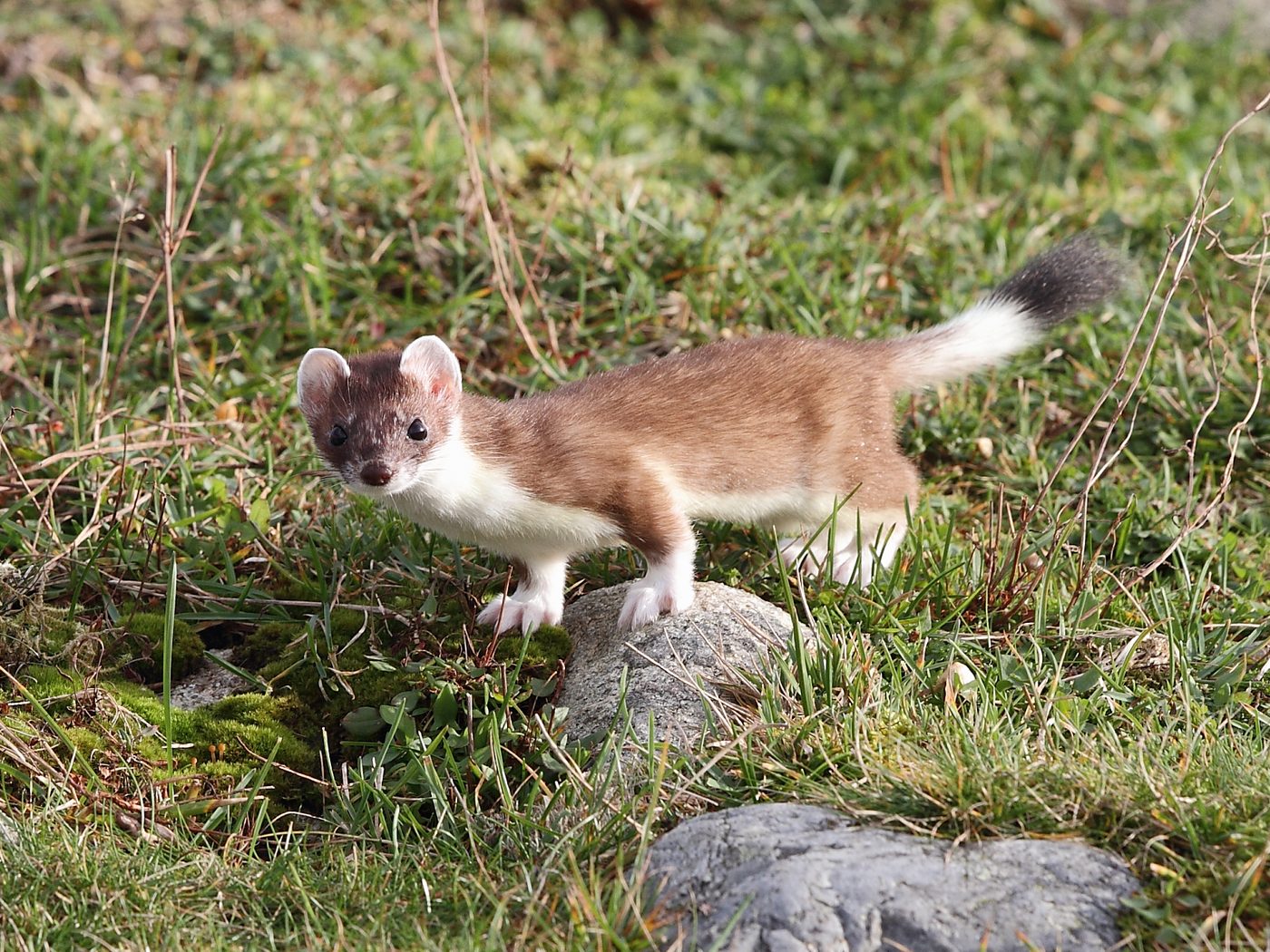
Stoat
Mustela erminea
Small, swift and bold, the stoat is a tireless hunter that in winter dons a coat of snowy white, with only the tip of its tail left black.
Characteristics
Temperament
Solitary, territorial, curious and extraordinarily active. A bold, tireless predator, it hunts day and night and does not fear prey larger than itself.
Diet
Carnivore: chiefly small rodents, but also rabbits, birds, eggs and insects according to availability.
A hunter in miniature
The stoat is one of Europe's smallest carnivores, yet also one of the most enterprising. It has a long, slender body, short legs and a tapered neck, a silhouette perfect for slipping into the burrows of its prey and pursuing them through their own tunnels. In summer the coat is brown above and pale below; its most famous feature, though, is the winter moult, when in cold regions it turns entirely white, save for the unmistakable black tip of the tail.
It is this white winter fur, called ermine, that for centuries was a symbol of royalty and purity, used to trim robes and insignia.
Where it lives
The stoat is widespread across much of Europe, Asia and North America. It adapts to a great many habitats: woods, grasslands, wetlands, cultivated edges and high mountain elevations. It favours places rich in hedgerows, dry-stone walls and heaps of stones, where the small rodents it feeds on abound.
A tireless predator
Despite its small size, the stoat is a formidable hunter. Its favoured prey are small rodents, but it does not hesitate to attack animals larger than itself, such as rabbits. It has a very fast metabolism that forces it to hunt continually, day and night. It is agile, quick and able to climb and swim when needed.
Behaviour
Solitary and territorial, the stoat communicates through scent marks. It is curious and lively, and sometimes rises on its hind legs to survey its surroundings. The female has an unusual reproductive biology: implantation of the embryo is delayed by many months, so that the young are born in the most favourable season.
Conservation
The stoat is listed as least concern and its populations are wide and stable. It raises no conservation worries in its native range; on the contrary, where it has been introduced by humans, as in New Zealand, it has proved a damaging predator of local wildlife, a testament to how effective a hunter it is.