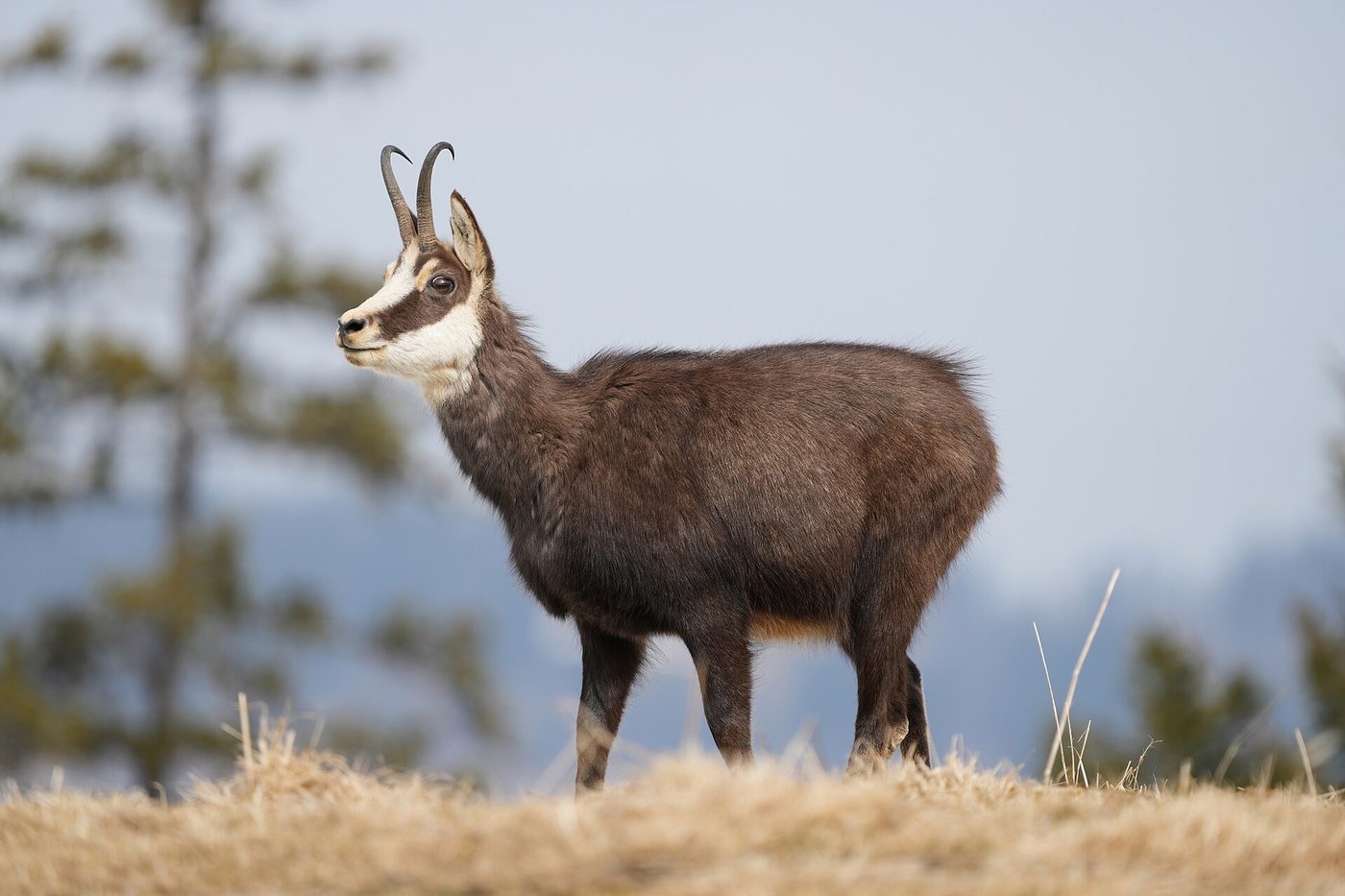
Photo: Giles Laurent · CC BY-SA 4.0
Chamois
Rupicapra rupicapra
An agile acrobat of rock and snow, the chamois moves across the steepest slopes with an ease that seems to defy gravity.
Characteristics
Temperament
Watchful, agile and cautious, active by day. Females live in herds with the young, males are more solitary; at alarm it gives a shrill whistle and flees across the slopes.
Diet
Herbivore: grasses and flowers of high pastures in summer, shoots, lichens, needles and bark in winter.
A bovid of the peaks
The chamois is a medium-sized bovid, slender and muscular, built for the mountains. Its most recognisable feature is its horns, present in both sexes: thin, black and straight, ending in a backward-curved hook that makes them unmistakable. The face bears a distinctive mask, with dark bands crossing the eyes against a pale ground. The coat changes radically with the seasons: tawny and short in summer, almost black and woolly in winter, when the animal must endure bitter cold.
Its hooves, springy and sharp-edged, give it an exceptional grip on both rock and ice.
Where it lives
The chamois inhabits the mountains of Europe, with the Alps as its chosen realm. It frequents high pastures, rock faces and gullies, moving vertically with the seasons: in summer it climbs towards the ridges for the cool air and the best grazing, in winter it descends into high-altitude woods, where the snow is shallower and food more reachable.
Behaviour
Females and young live in herds, while adult males are more solitary for much of the year. It is a watchful, cautious animal: at the slightest alarm it gives a shrill whistle, produced through the nostrils, and flees in prodigious leaps. In the rutting season, in autumn, the males chase and challenge one another along the slopes in breathtaking runs to win the females.
A master of balance
What strikes one most about the chamois is the ease with which it tackles impossible terrain. It can leap considerable drops and run at great speed across slopes where any other animal would slip. This agility is its main defence against predators, which rarely manage to pursue it among the rocks.
Conservation
The chamois is listed as least concern, and its populations are healthy and widely distributed across the Alpine arc. It raises no particular worry, though it remains sensitive to human disturbance at altitude and, like all mountain species, to the effects of a warming climate that shrinks its cooler habitats.