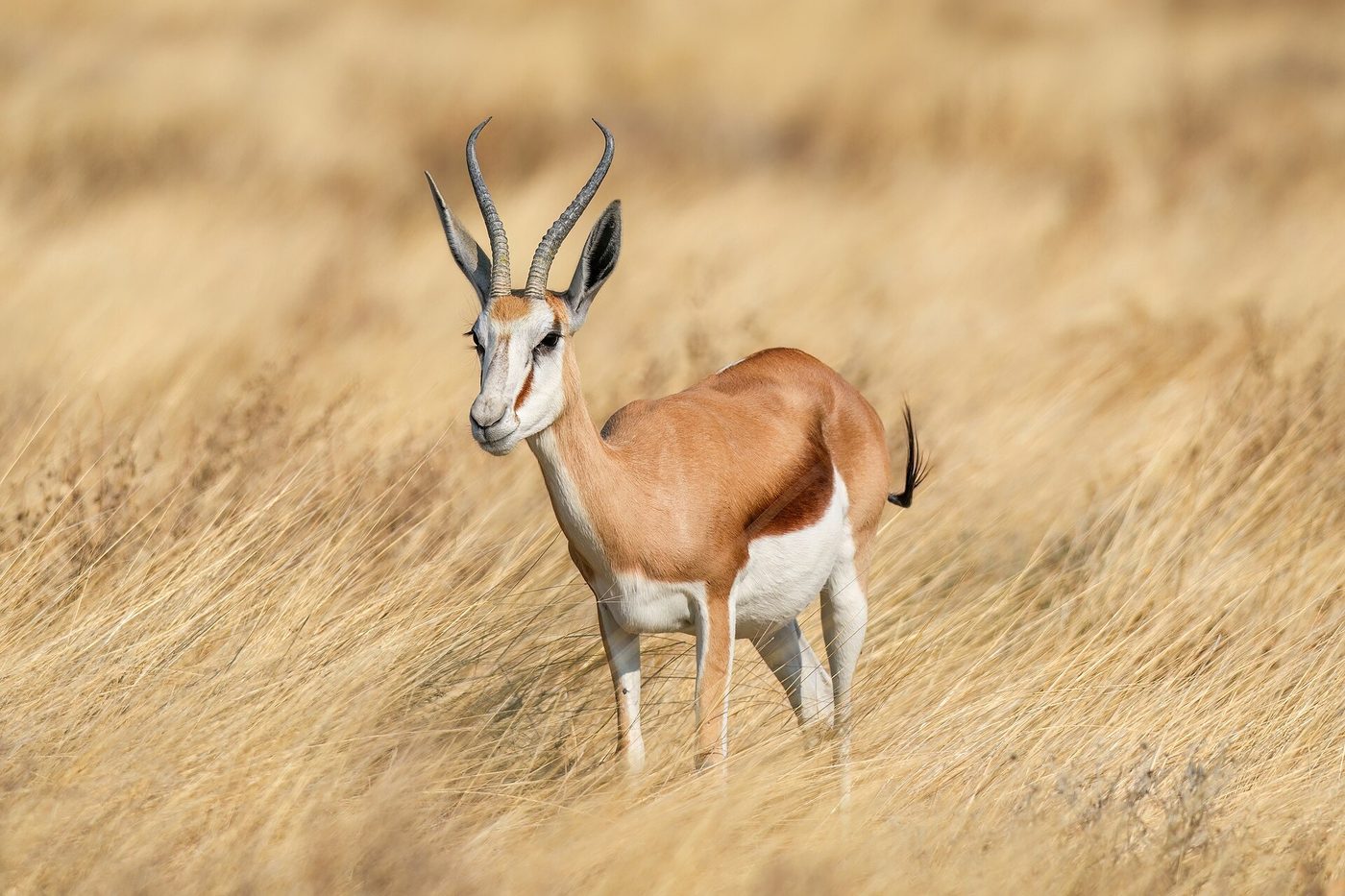
Photo: Giles Laurent · CC BY-SA 4.0
Springbok
Antidorcas marsupialis
A slender, very fast antelope of southern Africa, the springbok is famous for its spectacular stiff-legged vertical leaps, a behaviour known as pronking.
Characteristics
Temperament
Fast, gregarious, watchful
Diet
Herbivore: grasses, leaves, shoots and shrubs
An elegant and fast antelope
The springbok is a medium-sized antelope with a slim, elegant build and long, slender legs made for running. Its coat is light brown on the back and white on the belly, separated by a sharp reddish-brown band running along the flanks. The face is white, crossed by a dark stripe running from the eyes to the mouth. Both sexes carry black horns curving backwards, which in males can exceed 35 cm. It is among the fastest antelopes in Africa and can reach very high speeds when running.
Habitat and distribution
It lives exclusively in southern and south-western Africa, in countries such as Namibia, Botswana, Angola and South Africa. It prefers open savannas, arid plains and semi-desert areas, where the vegetation is sparse but where it can rely on its speed to escape predators. Well adapted to dry climates, it can survive for long periods by obtaining the water it needs from the plants it feeds on.
Behaviour and the famous pronking
The most spectacular trait of the springbok is so-called pronking (or stotting): the animal performs a series of vertical leaps, with stiff legs and an arched back, raising a crest of long white hairs along its spine. This behaviour probably serves to signal to predators its physical fitness and how difficult it would be to catch. The springbok lives in herds that, in favourable periods, can number a great many individuals.
Feeding
It is a herbivore that feeds on grasses, leaves, shoots and shrubs. In the dry season it turns towards more succulent plants to supplement its water needs, while in the wet season it grazes on fresh grasses. This dietary flexibility allows it to thrive in environments where water is scarce.
Conservation
The springbok is classified as a species of least concern. Its populations are numerous and stable, and in many areas it is a characteristic presence of the southern savannas. It is also the emblematic animal of South Africa, of which it is a national icon.
Pros
- Among the fastest antelopes in Africa
- Spectacular vertical leaps (pronking)
- Excellent adaptation to arid climates
- Numerous, unthreatened populations
Cons
- Vulnerable to many savanna predators
- Depends on open savannas and semi-deserts
- Sensitive to alterations of natural habitats