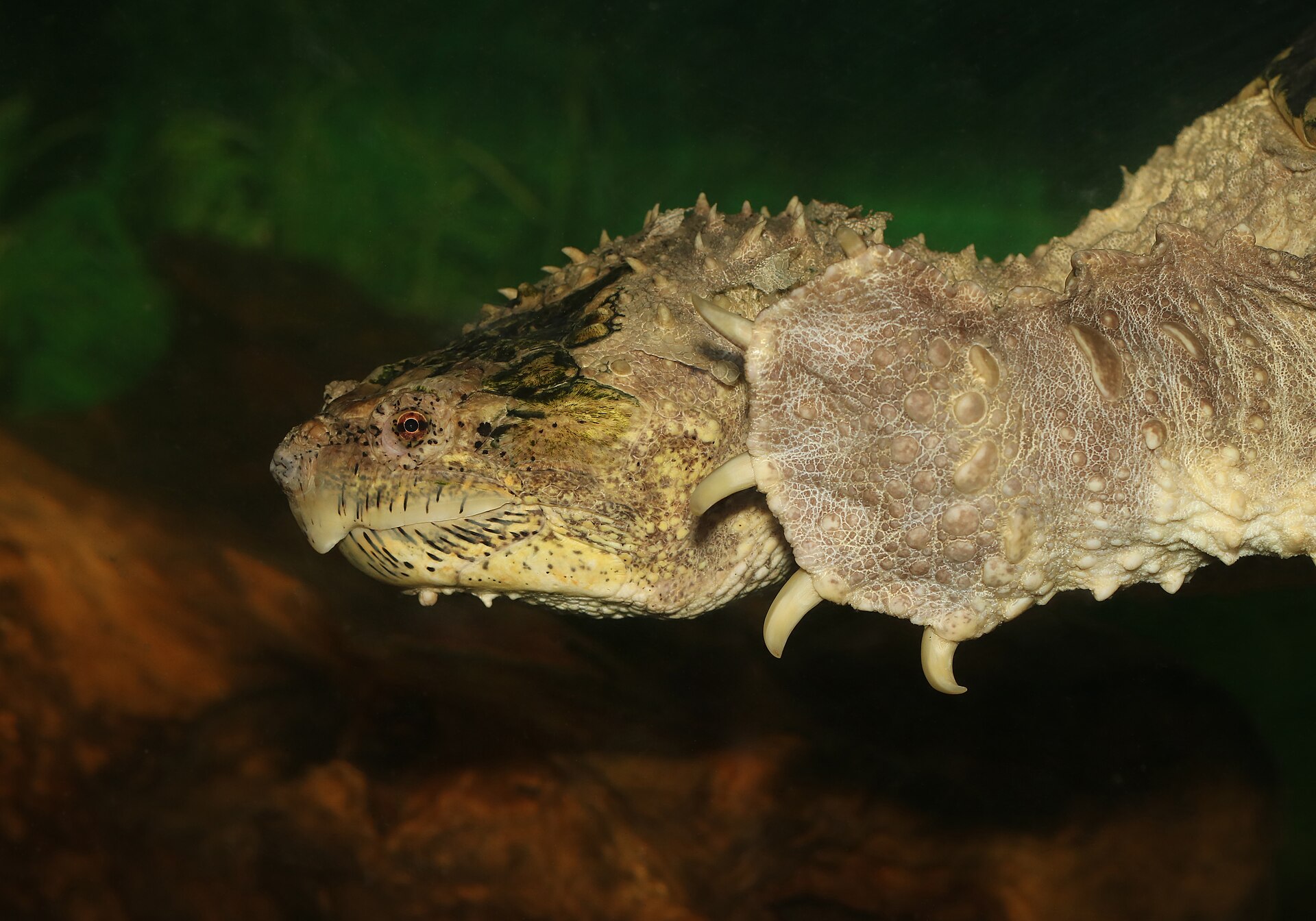
Common Snapping Turtle
Chelydra serpentina
Characteristics
Temperament
Solitary and almost entirely aquatic, with two opposite tempers: shy and placid in water, where it flees and hides in the mud and is harmless to swimmers; combative and defensive on land, where it can strike with its neck because its small plastron prevents withdrawing into the shell. An ambush hunter and patient scavenger, it spends much of its time motionless on the bottom. Long-lived and slow-growing. Not an animal to handle casually.
Diet
Opportunistic omnivore and scavenger. Eats fish, frogs, tadpoles and aquatic invertebrates, plenty of carrion (an important water clean-up role), aquatic plants (a significant plant share) and, when the chance arises, small snakes, waterbirds and nestlings. Hunts by ambush on the bottom, projecting the neck in a lightning strike, or by actively probing vegetation; the hooked horny beak grips slippery prey and shears carrion.
The Common Snapping Turtle (Chelydra serpentina) is North America's large freshwater turtle, among the most distinctive reptiles of its ponds and rivers. Famous for:
- Its lightning bite: the long mobile neck shoots forward with surprising speed, and the hooked beak-like jaws seize prey firmly
- Its prehistoric look: a big head, a rugged shell often coated in algae, and a long tail with a saw-toothed crest that give it a dinosaur-like air
- Its dual temperament: shy and placid in water, where it prefers to hide, but combative and defensive on land
- The ambush hunter: it spends much of its time motionless on the bottom, half-buried in mud, waiting for prey
- The scavenger of aquatic ecosystems: an omnivore that clears the water of carrion and remains
- Its long life: it can live for decades, often more than 40 years
IUCN status: Least Concern (LC), with wide, widespread populations. A quintessential North American reptile — it shares the freshwater habitats of much of the continent, the same woods and wetlands used by the Wild Turkey, Coyote and Bobcat — and plays a key ecological role as both predator and scavenger.
Classification and category
Order Testudines (turtles), family Chelydridae, genus Chelydra. It is the most widespread and best-known species of the snapping-turtle family. Not to be confused with a larger, rarer relative: the common snapping turtle (Chelydra serpentina) of this profile has a smoother shell, a very agile neck and is widely distributed; the alligator snapping turtle (Macrochelys temminckii) is a different, even larger genus with three spiny ridges on the shell and a worm-shaped lingual "lure" that draws fish straight into its mouth. Etymology: "Chelydra" is from Greek for water turtles; "serpentina" is Latin for "snake-like", for the long mobile neck and tapering tail — the animal's most striking feature. The common name "snapping" describes its characteristic bite. Parameters: Carapace 25-47 cm long. Weight typically 4.5-16 kg in the wild (well-fed captives can exceed 30 kg). Tail long, sometimes nearly as long as the shell, with a saw-toothed dorsal crest. Longevity 30-45 years in the wild, with estimates over 100 in the longest-lived. The female matures late and travels overland to nest, laying 20-40 spherical eggs in a hole dug in sandy soil; the hatchlings' sex depends on incubation temperature.
Habitat and distribution
The Common Snapping Turtle has a vast North American range: from southeastern Canada, through the entire eastern and central USA east of the Rocky Mountains, to the Gulf of Mexico, with related populations reaching toward Central America. Preferred habitats — almost all still or slow fresh water: ponds, pools and marshes (its prime habitat, with muddy bottoms to settle into); slow rivers and streams, canals and wetlands; and brackish water (it occasionally tolerates slightly salty environments too). It prefers water with a soft bottom and abundant vegetation, where it can lie half-buried waiting for prey. It spends almost its whole life in water: unlike many turtles it rarely basks on logs, preferring to "warm up" floating just below the surface. In winter, in cold regions, it brumates on the bottom under the ice, able to absorb a little oxygen from the water through its skin and mucous membranes. IUCN: Least Concern; a common, adaptable species, its main threats are local — road mortality of females seeking nest sites, wetland loss and collection.
Diet
An opportunistic omnivore and scavenger with a very varied diet: fish, frogs, tadpoles and aquatic invertebrates (much of its animal diet); carrion (an important "clean-up crew" of freshwater habitats); aquatic plants (a significant share of its diet is vegetable); and larger, unexpected prey (small snakes, waterbirds, nestlings and occasionally small mammals that venture into the water). Hunting strategies: ambush (lying motionless on the bottom, camouflaged and often half-buried in mud, then projecting the long neck forward in a lightning strike when prey comes within range); active searching (walking the bottom, probing vegetation and cover for food); and a powerful beak (hooked horny jaws that grip slippery prey like fish and shear chunks from carrion). Despite its reputation as a voracious hunter, much of its success comes from opportunism and scavenging. It is an important cog in the food web of North American ponds, controlling prey and clearing carrion.
Physical features
A massive, almost prehistoric-looking animal. Shell and body: a rugged carapace, brown to blackish, with three faint keels in adults, often coated in algae and mud that camouflage it on the bottom; a small, cross-shaped plastron (the underside) that covers only part of the body, leaving limbs and neck exposed; and, precisely because the plastron is reduced, it cannot fully withdraw into its shell — hence its active, aggressive defence when threatened out of water. Head, neck and tail: a big head with powerful hooked beak-like jaws; a long, muscular, very mobile neck able to reach almost the rear sides of the body (beware anyone who lifts it thinking they are safe from behind!); a long tail with a dorsal crest of saw-toothed tubercles, the source of the name serpentina; and sturdy limbs with strong claws for digging and walking the bottom. Performance: a lightning neck strike (its main defence and hunting weapon); prolonged breath-holding (it stays underwater a long time and, in the right conditions, absorbs oxygen through skin and membranes); camouflage (the algae-covered shell makes it nearly invisible on the bottom); and a slow walk on land but a startlingly fast head strike.
Behaviour and curiosities
A solitary, mostly aquatic animal whose behaviour differs deeply in and out of water. In water it is shy and calm: if disturbed it flees or hides in the mud, and it is practically harmless to swimmers because it avoids contact. On land, however — where females venture to lay eggs — it becomes defensive and can strike decisively, because its small plastron offers no shelter.
The "serpentine" neck: the name serpentina is no accident — the neck is so long and mobile it can reach back over much of the animal's flanks and back. This matters for handlers: lifting one "from behind" thinking you are out of reach is a classic mistake, as the head can swing surprisingly far. The bite (myth versus reality): the snapping turtle's bite reputation is partly exaggerated; scientific measurements show its bite force is not exceptional and not even greater than a human's, yet the sharp, hooked horny beak combined with the very fast neck strike can still cause serious injury. Its aggression on land is purely defensive; in water it has no interest in attacking people. The relative with the lure: its larger, rarer cousin, the alligator snapping turtle (Macrochelys), has one of the most remarkable reptile adaptations — a small pink worm-like appendage on its tongue that, wiggled, draws curious fish straight into its open jaws; the common snapping turtle has no such lure and hunts by ambush and active search. Winter breathing: in cold regions it overwinters in brumation on the bottom of ponds and rivers, often under ice, surviving for months by absorbing small amounts of oxygen from the water through richly vascularized skin and membranes, without surfacing to breathe. The dangerous crossing: the riskiest time in a female's life is the migration to nest sites — to find suitable sandy ground she may travel considerable distances overland, often crossing roads, which makes her very vulnerable to vehicles, a leading cause of mortality; helping one across in the direction it was heading (carefully, given its defence) is a small act of conservation. Longevity: like many turtles it "invests" for the long term, growing slowly, maturing after many years and living for decades — commonly over 40 years, with estimates approaching a century in some cases; this long-life, delayed-reproduction strategy makes it sensitive to adult mortality, so every long-lived female is precious to the population.
Pros
- Tartaruga d'acqua dolce iconica e adattabile del Nord America
- IUCN Least Concern: popolazioni ampie e diffuse
- Predatore e spazzino chiave degli ecosistemi acquatici
- Molto longeva (spesso oltre 40 anni)
Cons
- Difensiva e capace di morsi seri se maneggiata a terra
- Le femmine in deposizione muoiono spesso investite sulle strade
- Crescita lenta e maturità tardiva: sensibile alla mortalità degli adulti
- Non è un animale da compagnia adatto ai più (richiede spazio e cautela)