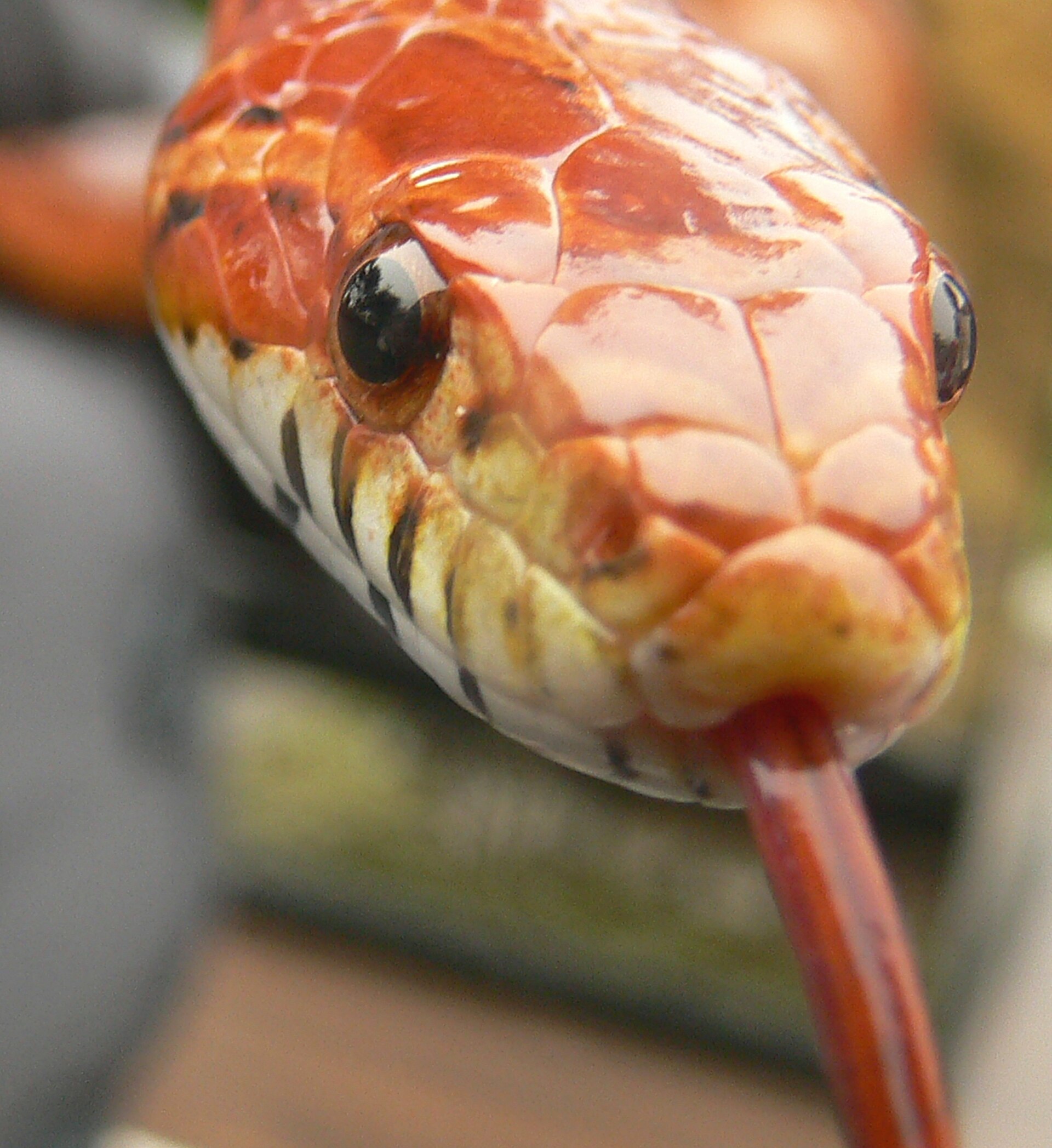
Corn Snake
Pantherophis guttatus
Characteristics
Temperament
A harmless, non-venomous colubrid snake with a famously docile, tolerant temperament: it is the "beginner's" terrarium snake par excellence, rarely inclined to bite and easy to handle calmly. It is mainly terrestrial but an excellent climber, active mainly at dusk and night, and likes to hide. Although relatively simple, it is NOT a toy: it requires a suitable terrarium, feeding on thawed rodents, and awareness of its long life (15-20 years and more) and its escape skills. Captive-bred specimens are always preferable.
Diet
A carnivorous constrictor: it catches its prey by wrapping it in its coils until it suffocates, then swallows it whole. In the wild it feeds mainly on rodents (mice and small rats) and other small vertebrates, eggs included, and is a valuable regulator of mouse populations. In the terrarium it should be fed prey of suitable size given dead and thawed (never alive), with a frequency calibrated to age: more often for the young, more spaced for adults, avoiding overfeeding and obesity.
The Corn Snake (Pantherophis guttatus) is probably the best-known snake among terrarium enthusiasts: a harmless, docile North American colubrid with spectacular colours, considered the "pet snake" par excellence. Famous for:
- The vivid colours: bright orange with large red-orange blotches bordered in black
- The "checkerboard" belly: black and white, recalling the kernels of maize
- The docile nature: calm and easy to handle, rarely aggressive
- The harmlessness: it is non-venomous and kills its prey by constriction
- The usefulness: an excellent hunter of rodents
- The endless "morphs": selectively bred in captivity in very many colour variants
IUCN status: Least Concern (LC). It enters the portal among the snakes, alongside native species such as the Western whip snake, the Aesculapian snake and the grass snake, and large exotic snakes such as the anaconda and the ball python: with them it represents the diversity of snakes, here in the guise of the most popular terrarium snake.
Classification and category
Order Squamata, suborder Serpentes, family Colubridae (the colubrids, the great family of "typical", largely harmless snakes). It is a rat snake of the genus Pantherophis; the species is Pantherophis guttatus (once classified as Elaphe guttata). In the portal it is placed among the snakes. It is very important to tell it apart from species it can be confused with, some dangerous: the copperhead, a venomous North American pit viper: the corn snake vaguely resembles it and is therefore often killed by mistake, though it is entirely harmless; the narrow head, round pupil and different pattern help distinguish it; other rat snakes (e.g. Pantherophis obsoletus): darker and less vivid; the milk and king snakes (Lampropeltis): with a ringed pattern, different from the corn snake's "saddles". Etymology: the name "corn snake" probably has a double origin — the black-and-white checkerboard belly recalling Indian corn, and the habit of frequenting barns and grain stores in pursuit of the rodents sheltering there. Parameters: Length roughly 100-150 cm (sometimes up to about 180 cm). Build slender. Appearance a head little distinct from the neck, a round pupil (not a slit). Longevity: remarkable — in captivity it commonly lives 15-20 years and more. Reproduction: it is oviparous, laying eggs; the ease of captive breeding underlies the great variety of selected morphs.
Habitat and distribution
The corn snake is a North American reptile: its range covers the southeastern and central United States, from coastal plains to hilly areas. Preferred habitats — varied environments, often tied to the presence of rodents: open woods, forest edges and clearings; grasslands, fallow land and cultivated areas; and rural environments with barns, granaries and buildings, where it hunts mice. It is a mainly terrestrial but excellent-climbing snake, active mainly at dusk and night, though it may appear by day. It spends much time hidden under logs, stones, leaf litter or in rodent burrows. Its frequenting of rural and agricultural environments, in search of prey, is the very origin of its name and makes it a natural ally against mice. IUCN status: Least Concern (LC). In the wild it is common and not threatened. It should be remembered that, as a terrarium animal, it is almost always captive-bred, not taken from the wild: a correct practice that protects wild populations.
Diet
The corn snake is a carnivorous constrictor: it catches its prey and wraps it in its coils until it suffocates, then swallows it whole. It feeds on: rodents (mice and small rats, the basis of the diet); and other small vertebrates (small birds, eggs, occasionally small reptiles or amphibians). In the terrarium, feeding follows precise rules: thawed prey (mice, then rats, of suitable size are used, given dead and thawed, never alive, for the snake's safety and for ethics); calibrated frequency (more frequent meals for the young, more spaced for adults, avoiding overfeeding and obesity); and prey of the right size (usually proportionate to the snake's width). Crucially, in the wild the corn snake is a valuable regulator of rodent populations. Its very diet of mice makes it a useful, beneficial animal in rural environments, as well as relatively simple to feed in captivity.
Physical features
A slender colubrid with, in the wild form, warm and vivid colours. The livery — the distinguishing trait (wild form): an orange or orange-brown ground, sometimes tending to reddish; large dorsal blotches ("saddles") of red-orange, sharply bordered in black; a black-and-white "checkerboard" belly, recalling the kernels of maize. The head and body: a head little distinct from the neck, with a characteristic "spear-point" or "V" on the crown; a round pupil, typical of harmless colubrids (not a slit as in many vipers); a slender, muscular body, suited both to crawling and to climbing. The morphs: countless colour variants selectively bred in captivity — amelanistic (albino), "snow", anerythristic and many others, in tones ranging from white to pink, from yellow to grey; a great variability that has made this species a classic of the hobby.
Curiosities, care and protection
The corn snake is a calm, shy animal, active mainly at dusk. Its fame stems precisely from the combination of beauty, docility and relative ease of care, which have made it the "beginner's" snake par excellence — while still being an exotic animal with specific needs, not to be underestimated.
The name "corn snake": the English name probably has two complementary explanations; on one hand the black-and-white checkerboard belly recalls variegated maize (Indian corn); on the other, these snakes frequented barns and grain stores, attracted by the mice sheltering there; in both cases, the "corn" tells of its bond with fields and farms. The harmless one mistaken for venomous: because of its vivid livery and blotched pattern, the corn snake is sometimes confused with the venomous copperhead and, unfortunately, killed by mistake; in reality it is entirely harmless to humans, non-venomous, and indeed very useful as a predator of rodents: a classic example of how important it is to recognize snakes before fearing them. The king of "morphs": thanks to the ease of captive breeding, the corn snake has become one of the species with the greatest number of selected colour variants (the so-called "morphs"); there are albino, "snow" (whitish), pastel and very many other combinations, the fruit of decades of hobby breeding; this variety is one of the reasons for its enormous popularity. The "gentle" constrictor: like many colubrids, the corn snake kills its prey by constriction, wrapping it in its coils; despite this efficient predator's technique, towards humans it is among the most tolerant and easily handled snakes, rarely inclined to bite: a contrast that well represents the difference between its ecological role and its behaviour in captivity. Responsible care: although "easy" compared with other reptiles, the corn snake is not a toy. It requires a suitable terrarium, with correct temperature gradients and hides, appropriate feeding on thawed rodents and attention to its notable longevity (15-20 years and more). It is also a most skilled "escapee": the terrarium must be well closed. The right choice is to opt for captive-bred specimens and to inform oneself thoroughly before purchase, avoiding impulsive decisions.
Pros
- Serpente innocuo, non velenoso, dal carattere docile e maneggevole
- Colori bellissimi e infinite varietà (morph)
- Taglia gestibile e cure relativamente semplici: ottimo per chi inizia (con consapevolezza)
- Utile in natura come predatore di roditori; IUCN Least Concern
Cons
- NON è un giocattolo: richiede terrario adeguato, dieta a base di roditori e competenze
- Molto longevo (15-20+ anni): impegno a lungo termine
- Abilissimo evasore: il terrario deve essere ben chiuso
- Scegliere SOLO esemplari nati in cattività; spesso ucciso per errore in natura perché scambiato per velenoso