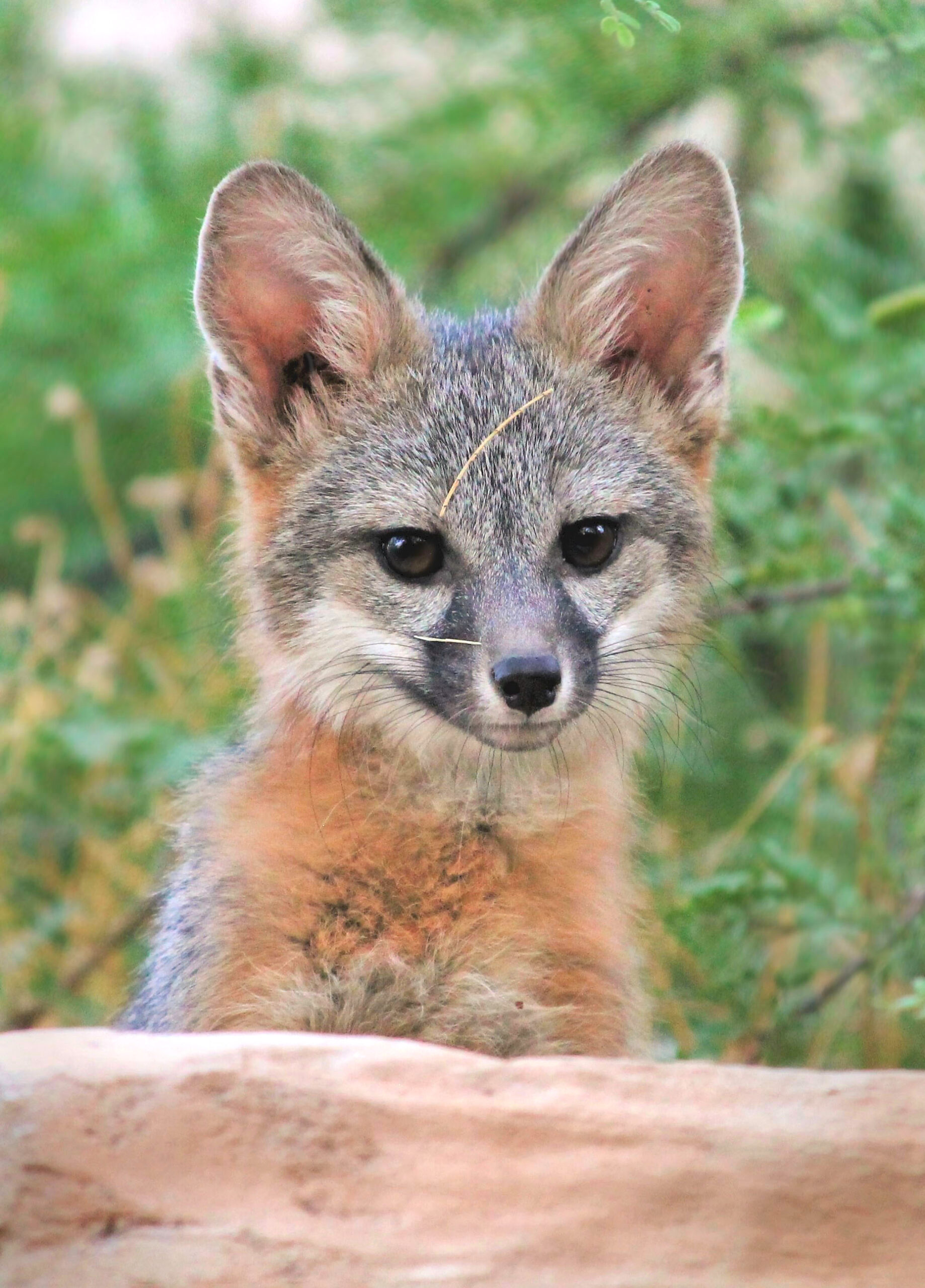
Gray Fox
Urocyon cinereoargenteus
Characteristics
Temperament
Shy, nocturnal and mostly solitary; it forms monogamous pairs in the breeding season and defends a territory. Unlike other canids, much of its life is tied to trees: it climbs them to hunt, escape predators, rest and even den up high. Omnivorous and adaptable, surprisingly fond of fruit. Discreet and inconspicuous despite being common. Not a pet: a wild canid, an ancient American "climbing fox".
Diet
An opportunistic omnivore with a diet unusually rich in plants for a canid. It eats small mammals (rodents, rabbits, hares), birds, eggs, reptiles and insects, and large amounts of fruit, berries, nuts and seeds (especially in summer-autumn: among the most "frugivorous" canids); carrion on occasion. It hunts small prey on the ground but, thanks to climbing, also reaches fruit, eggs and nestlings among the branches, a resource closed to other canids. By eating fruit, it is also an effective seed disperser.
The Gray Fox (Urocyon cinereoargenteus) is a canid of North and Central America gifted with a talent almost unique in its family. Famous for:
- Tree climbing: it is one of the very few canids in the world able to climb trees, as cats do — an ability extremely rare among dogs, wolves and foxes
- The grizzled coat: a "salt-and-pepper" grey back, with conspicuous rusty tinges on the neck, sides and legs, and a white throat and belly
- The black-tipped tail: with a characteristic dark crest along the top of the tail (unlike the red fox, which has a white tip)
- An omnivorous, "fruit-loving" diet: unusually fond of fruit and berries for a canid
- Evolutionary antiquity: it belongs to one of the oldest, most "primitive" lineages of living canids
- A discreet life: nocturnal and shy, often little noticed despite being common
IUCN status: Least Concern (LC), common and widespread. Among the many foxes and canids in this portal — the Red Fox, the Arctic Fox, the Fennec, the Bat-eared Fox — the gray fox stands out for a behaviour that defies the very image of the "dog": a predator that, when needed, vanishes upward, into the branches.
Classification and category
Order Carnivora, family Canidae, genus Urocyon — a genus of its own, distinct from the "true foxes" (Vulpes, which include the red fox, arctic fox and fennec). Together with its very close relative, the island fox (Urocyon littoralis) of California's Channel Islands, it represents one of the oldest evolutionary lineages among living canids: a "basal branch" that split very early from the rest of the family. Not to be confused with: the red fox (Vulpes vulpes), slimmer, usually reddish and with a white tail tip (the gray's is black); and other foxes of the genus Vulpes and the jackals. Etymology: "Urocyon" is from Greek and means roughly "tail-dog" (from oura, tail, and kyon, dog), referring to the conspicuous dark crest on the tail; "cinereoargenteus" is Latin for "ash-grey silvery", for the coat colour. Parameters: Body 50-69 cm. Tail 27-44 cm (with a dorsal black crest and black tip). Weight 3.5-7 kg. Longevity about 6-10 years in the wild, up to ~14-15 in exceptional cases. Reproduction: usually monogamous pairs; gestation ~53-60 days; litters of 3-5 pups, raised in dens in hollow trees, rock piles or old burrows.
Habitat and distribution
The Gray Fox has a vast American range: from southern Canada, through much of the USA and Mexico and all of Central America, to northern South America (Venezuela and Colombia). Preferred habitats — it favours wooded, bushy environments: deciduous and mixed woods, forests and scrub (its prime habitat, where it can use the trees); chaparral and shrubland, especially in the more arid southwest; and woodland edges, rural areas and suburbs, where it adapts to human presence. Unlike the red fox, which prefers open spaces, the gray fox is more tied to covered, wooded areas, thanks also to its climbing ability. It is nocturnal and crepuscular, generally solitary or in pairs, and marks and defends a territory. It often shelters in elevated cavities, hollow trees or crevices. IUCN: Least Concern. A common, adaptable species over much of its range; locally it can suffer from woodland loss, competition with the coyote, and road mortality.
Diet
The Gray Fox is an opportunistic omnivore, with a diet surprisingly rich in plants for a canid. It eats: small mammals (rodents, rabbits and hares, an important staple); birds, eggs, reptiles and insects; fruit, berries, nuts and seeds (a very significant component, especially in summer and autumn — it is among the most "frugivorous" canids); and carrion and scraps when the chance arises. Hunting and foraging strategies: ground hunting (stalking and chasing small prey, using keen hearing and smell); foraging in trees (thanks to its climbing ability, it can reach fruit, eggs and nestlings among the branches, a resource closed to most canids); and seasonal opportunism (alternating animal prey and abundant plants depending on what the season offers). Crucially, the strong plant component of the diet and the ability to exploit tree resources make the gray fox ecologically flexible and let it coexist with other carnivores, occupying a niche somewhat different from that of the red fox and coyote.
Physical features
A small-to-medium, sturdy canid with "mineral" colours. Coat: a "salt-and-pepper" grizzled grey back, from hairs with light and dark bands; rusty/fulvous tinges on the neck, ears, sides and legs (sometimes leading to confusion with the red fox); a white throat, chest and belly; and a tail with a crest of black hairs along the top and a black tip. Climbing adaptations: curved, sharp, semi-retractable claws for gripping bark; forelegs able to rotate, letting it "hug" the trunk and descend with more control; and an agile, muscular build. Performance: climbing (its "superpower", almost unique among canids); agility and jumping (it moves smoothly even among branches); acute senses (a nocturnal hunter's hearing, smell and sight); and a ground dash to chase prey.
Behaviour and curiosities
The Gray Fox is a shy, nocturnal, mostly solitary animal. It forms monogamous pairs in the breeding season and defends a territory, but otherwise leads a reserved life that makes it less familiar to the public than the red fox, despite being very common across much of the Americas.
The "climbing canid": its most extraordinary trait — while practically all dogs, wolves and foxes are ground-bound, the gray fox climbs trees with the ease of a cat; it does so to escape predators (coyotes included), to find fruit, eggs and small animals among the branches, and even to rest or sleep aloft; it can go up vertical trunks and, once among the branches, move and jump from tree to tree; it shares this ability almost only with its relative, the island fox. The "rotating legs": the secret of its climbing is anatomy — the gray fox has strong curved claws, ideal for gripping bark, and, rare among canids, forelegs able to rotate so as to "hug" the trunk, which lets it not only climb but also descend with more control, where many other climbing animals struggle. The living fossil: evolutionarily, the gray fox is special — together with the island fox it belongs to the genus Urocyon, considered one of the oldest, most basal lineages of the entire dog family; its ancestors split very early from the branch that later gave rise to wolves, dogs, coyotes and "true" foxes — in a sense, a window onto what the canids of the past may have been like. "Don't confuse it with the red one": the gray fox is often mistaken for a red fox, helped by the rusty tinges on its neck and legs; the detail that reliably tells them apart is the tail — the gray fox has a black tail tip and a dark crest along the top of the tail, while the red fox has a white tail tip; the base colour (grizzled grey versus bright red) and the habitat (more wooded for the gray) also help. The fruit-lover: for a member of the dog family, the gray fox has a surprisingly plant-based diet — in summer and autumn it consumes large amounts of fruit and berries, becoming an important seed disperser: many plants use the fox to spread their fruit, in exchange for a sweet, nourishing meal; it is an example of how even a carnivore can act as a "gardener" of nature. The shelter up high: unlike other foxes, which almost always shelter in burrows dug in the ground, the gray fox often uses elevated refuges — cavities in tree trunks, old nests and crevices up high, where it is safer from ground predators; this bond with trees pervades its whole life, from hunting to resting to denning.
Pros
- Canide unico: uno dei pochissimi che si arrampicano sugli alberi
- IUCN Least Concern, comune e adattabile
- Utile disseminatrice di semi (dieta ricca di frutta)
- Linea evolutiva antichissima: un 'fossile vivente' dei canidi
Cons
- Non è un animale da compagnia (canide selvatico)
- Spesso scambiata per la volpe rossa
- Localmente in competizione con il coyote e vittima di investimenti
- Schiva e notturna: difficile da osservare in natura