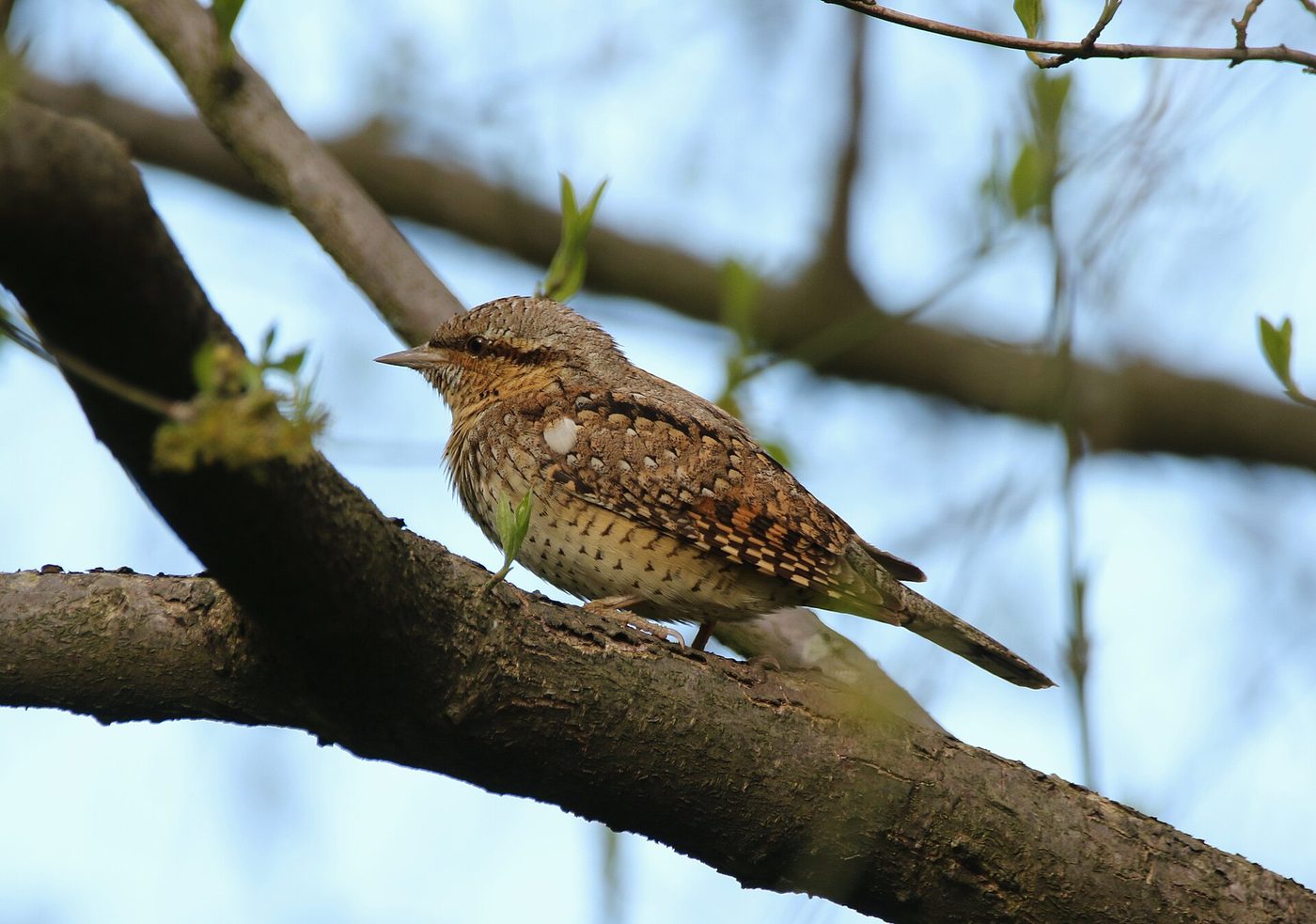
Eurasian wryneck
Jynx torquilla
The Eurasian wryneck is a curious woodpecker with bark-coloured camouflage plumage, famous for its ability to twist its neck in an almost snake-like way.
Characteristics
Temperament
Shy, camouflaged, migratory
Diet
Insectivore: mainly ants and their larvae
Description
The Eurasian wryneck is a small bird of the woodpecker family, quite unlike its relatives. Its plumage is finely mottled with grey, brown and black, so that it resembles a piece of bark or a dead leaf: perfect camouflage that makes it almost invisible on a branch. Unlike other woodpeckers it does not chisel wood and has a short, pointed bill.
Habitat and distribution
It breeds in the temperate regions of Europe and Asia, favouring open countryside, light woodland, orchards and gardens with old trees. It is the only truly migratory woodpecker of the Old World: most populations winter in tropical Africa and southern Asia.
Behaviour
It feeds almost entirely on ants and their larvae, gathered from the ground with its long, sticky tongue. It nests in existing cavities, as it cannot excavate its own. When threatened it performs a striking display: it twists and rotates its neck in sinuous, snake-like movements, hissing, to frighten off predators. Hence its name.
Did you know?
The scientific name Jynx and the bird's curious neck movements fed ancient magical beliefs: in ancient Greece it was used in love charms and divination, and the word "jinx" derives from it.
Conservation
It is classed as least concern globally, but in many European regions populations are declining sharply, owing to the loss of meadows, hedgerows and old orchards and the decline of ants.
(Note: the mass value given by Wikidata, 2.7 kg, is clearly wrong: the wryneck actually weighs about 30–45 grams.)
Pros
- Valuable natural controller of ants
- Extraordinary camouflage, hard to spot
- The only truly migratory European woodpecker
Cons
- Declining through loss of orchards and meadows
- Depends on existing cavities to nest
- Hard to observe due to its cryptic plumage