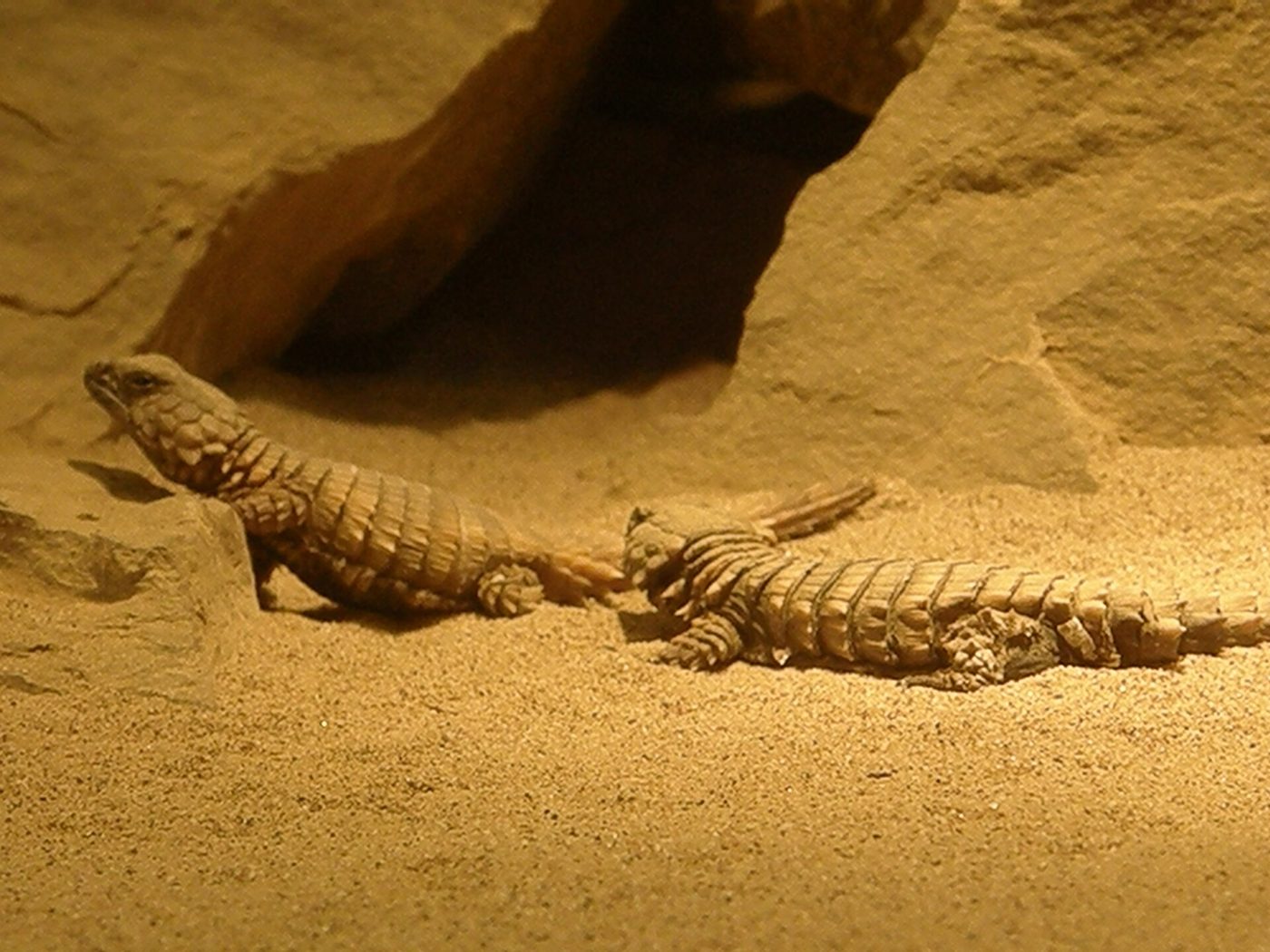
Photo: frank wouters · CC BY 2.0
Armadillo girdled lizard
Ouroborus cataphractus
The armadillo girdled lizard is a small armoured lizard of South Africa, famous for its doughnut defence: when threatened it bites its own tail and rolls into a spiny ring.
Characteristics
Temperament
Shy and secretive, but social; lives in groups among rocks.
Diet
Insectivorous: mostly termites and other small invertebrates.
A lizard clad in spines
The armadillo girdled lizard (Ouroborus cataphractus) is a small reptile of the family Cordylidae and the sole member of the genus Ouroborus. Its yellowish-brown body is covered in rows of heavily keeled, spiny scales arranged in girdles along the back and tail — a natural armour reminiscent of an armadillo's. When threatened, the lizard grasps its own tail in its mouth and curls into a rigid, spike-studded ring that shields its soft belly and makes it very hard for a predator to swallow. This behaviour inspired the genus name Ouroborus, after the mythical serpent that bites its own tail.
Habitat and range
It is endemic to the arid and semi-desert regions of the western coast of South Africa, within the Succulent Karoo biome. It lives among rocky outcrops, sheltering in cracks and crevices and in low shrubby vegetation. The structure of its rocky home is vital both for escaping the heat and for evading predators.
Behaviour
Unlike most lizards, it is a social species that lives in groups, sometimes numerous, sharing the same rock crevices. It feeds mainly on small invertebrates, especially termites gathered near its refuge. It is viviparous: the female gives birth to one or two well-developed young, an unusually large reproductive investment for a reptile.
Did you know?
It has the largest genome yet known among all squamates. Its ball-curling defence and little-dragon looks have made it highly sought after in the exotic pet trade — a pressure that has helped push it toward threatened status.
Conservation
It is listed as Near Threatened by the IUCN. Illegal collection for the reptile pet market and its restricted range are the main concerns for the species.
Pros
- Spectacular ball-curling defence
- Social species that lives in groups
- Superbly adapted to arid habitats
Cons
- Near Threatened due to illegal collection
- Restricted range and specialised habitat
- Slow reproduction with few young