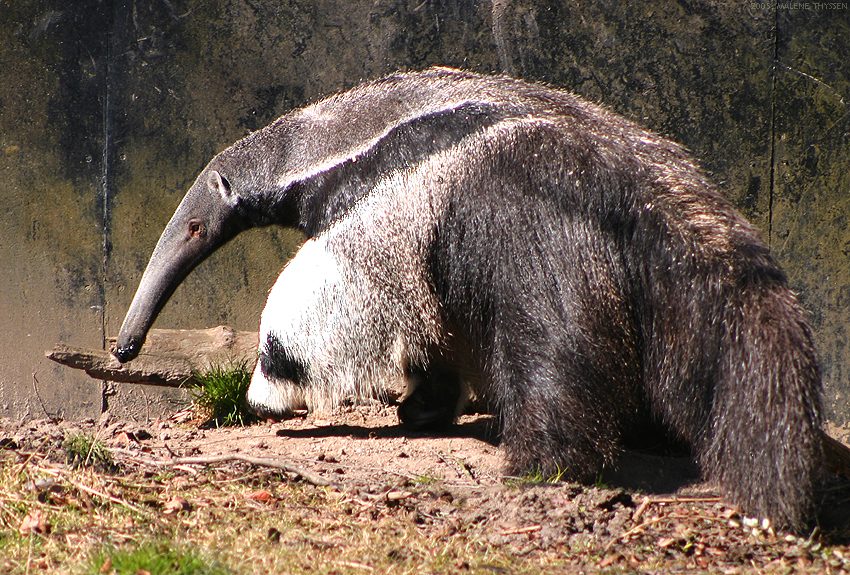
Photo: Malene Thyssen · CC BY-SA 3.0
Giant anteater
Myrmecophaga tridactyla
With its tube-like snout and a very long tongue, the giant anteater devours thousands of ants and termites a day, sweeping the plains of South America.
Characteristics
Temperament
Solitary, calm but able to defend itself
Diet
Insectivore: ants and termites
A specialised ant-eater
The giant anteater is a mammal of unmistakable appearance, the largest of its family. It has an elongated body covered with coarse hair, a striking flag-like tail, bushy and bristly, and above all a head ending in a long, tubular, toothless snout. From this snout it can extend an extraordinary tongue, thin and sticky, up to half a metre long, which it uses as a precision tool to gather its prey. Its sturdy front legs are armed with powerful claws.
Habitat and distribution
It lives in Central and South America, from tropical forests to savannas and open grasslands. It prefers environments rich in ant and termite nests, its only source of food. It moves slowly on the ground, walking in a curious way on the backs of its front claws so as not to wear them down, and it can also swim when needed.
Behaviour
It is a mainly solitary animal. It spends its days searching for food: it locates ant and termite nests thanks to its very keen sense of smell, opens them with its powerful claws and inserts its snout, catching insects with rapid movements of its tongue, up to thousands of prey a day. It never completely destroys a nest, allowing it to recover: a behaviour that guarantees it lasting resources. Having no teeth, it swallows the insects whole.
Curiosities
The famous bushy tail is not merely decorative: the anteater uses it as a blanket, wrapping itself in it to protect against cold and rain while it rests. Despite its peaceful air, if threatened it can defend itself by rearing up on its hind legs and striking with its formidable front claws.
Conservation
The giant anteater is classified as a vulnerable species. The main threats are habitat loss and fragmentation, grassland fires, road accidents and hunting. Protecting the savannas and forests in which it lives is essential for the survival of this extraordinary and irreplaceable ant-eater.
Pros
- Extraordinary adaptations: unique snout and tongue
- Valuable regulator of ants and termites
- Fascinating, specialised behaviour
Cons
- Vulnerable species
- Threatened by fires, roads and habitat loss
- Extremely specialised diet