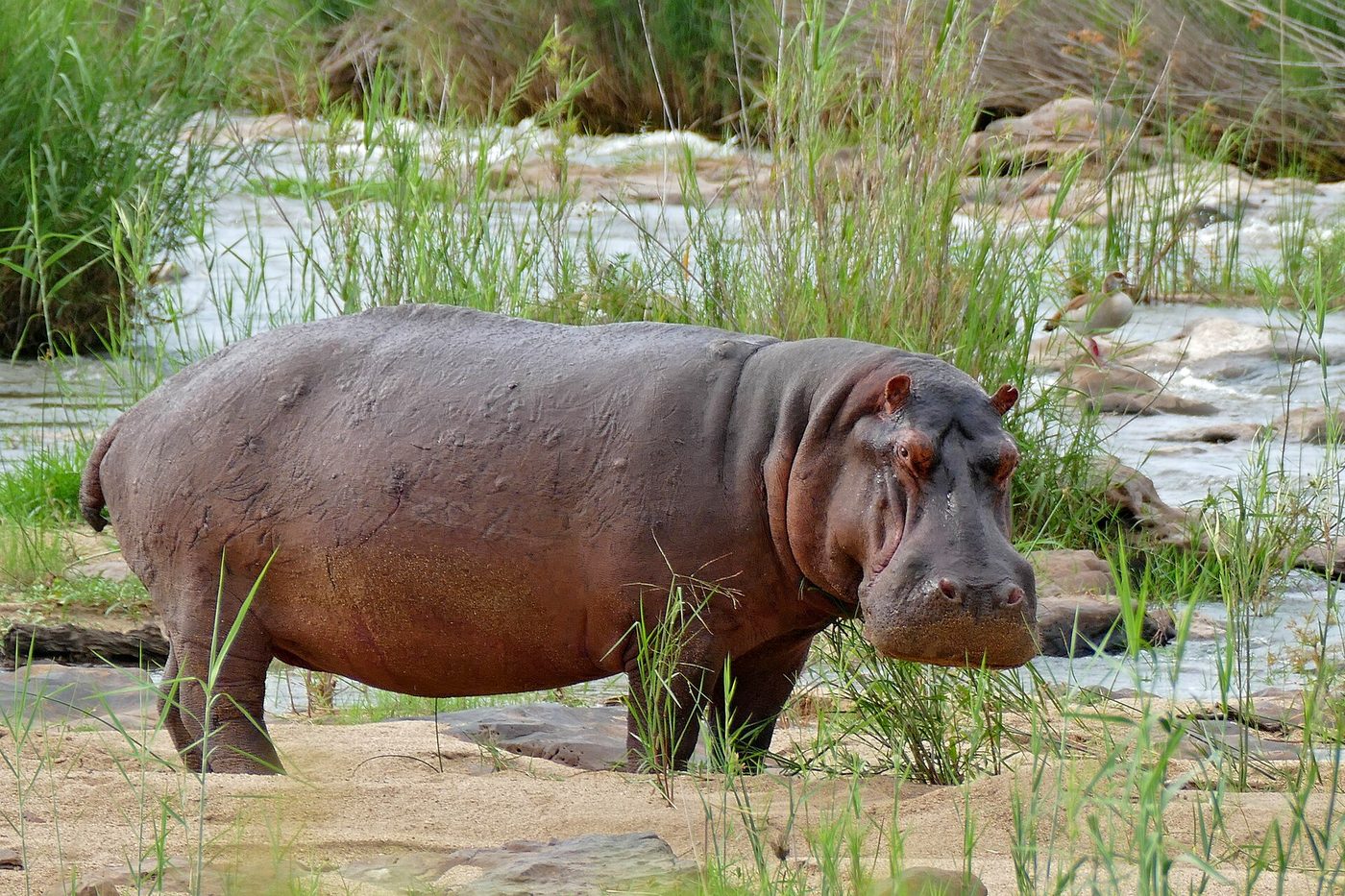
Photo: Bernard DUPONT from FRANCE · CC BY-SA 2.0
Hippopotamus
Hippopotamus amphibius
A river giant of placid appearance but surprisingly dangerous, the hippopotamus spends its days immersed in water and its nights grazing the savanna grass.
Characteristics
Temperament
Territorial, unpredictable and aggressive despite its herbivorous diet, especially in water and in defence of its young. It lives in groups led by a dominant male.
Diet
Herbivore: it grazes grass at night on land, travelling several kilometres.
A semi-aquatic giant
The hippopotamus is one of the largest land mammals, with a massive barrel-shaped body, short sturdy legs and an enormous head with a mouth that can gape open impressively. An adult can weigh over a tonne and a half, in some cases exceeding three tonnes. Its thick, almost hairless skin secretes a reddish oily substance that acts as a natural sunscreen and antibacterial. Despite its ungainly appearance, the hippo is agile in water and can run surprisingly fast on land.
A life between water and land
The name hippopotamus means 'river horse', and reflects its habits well. It spends much of the day immersed in rivers and lakes, where the water supports its enormous weight and shelters it from the heat and sun. Its eyes, ears and nostrils are set high on the head, so as to stay in the air while the rest of the body is submerged. At nightfall it leaves the water to graze, travelling several kilometres in search of grass.
A dangerous herbivore
Despite its entirely plant-based diet, the hippopotamus is regarded as one of the most dangerous animals in Africa. It is territorial, unpredictable and highly aggressive, especially in water and in defence of its young. Males clash in violent fights, gaping their jaws and using the large tusks of the lower canines, which grow throughout life.
Social life
Hippos live in groups ranging from a few to several dozen individuals, led by a dominant male who controls a stretch of river. Communication takes place through powerful calls, some of which are made even underwater.
Conservation
The hippopotamus is classified as a vulnerable species. The main threats are habitat loss, the reduction of water resources and poaching for meat and teeth. The conservation of this species depends on protecting the watercourses and African environments in which it lives.