Photo: Alex Dunkel (Maky) · CC BY 3.0
Ring-tailed lemur
Lemur catta
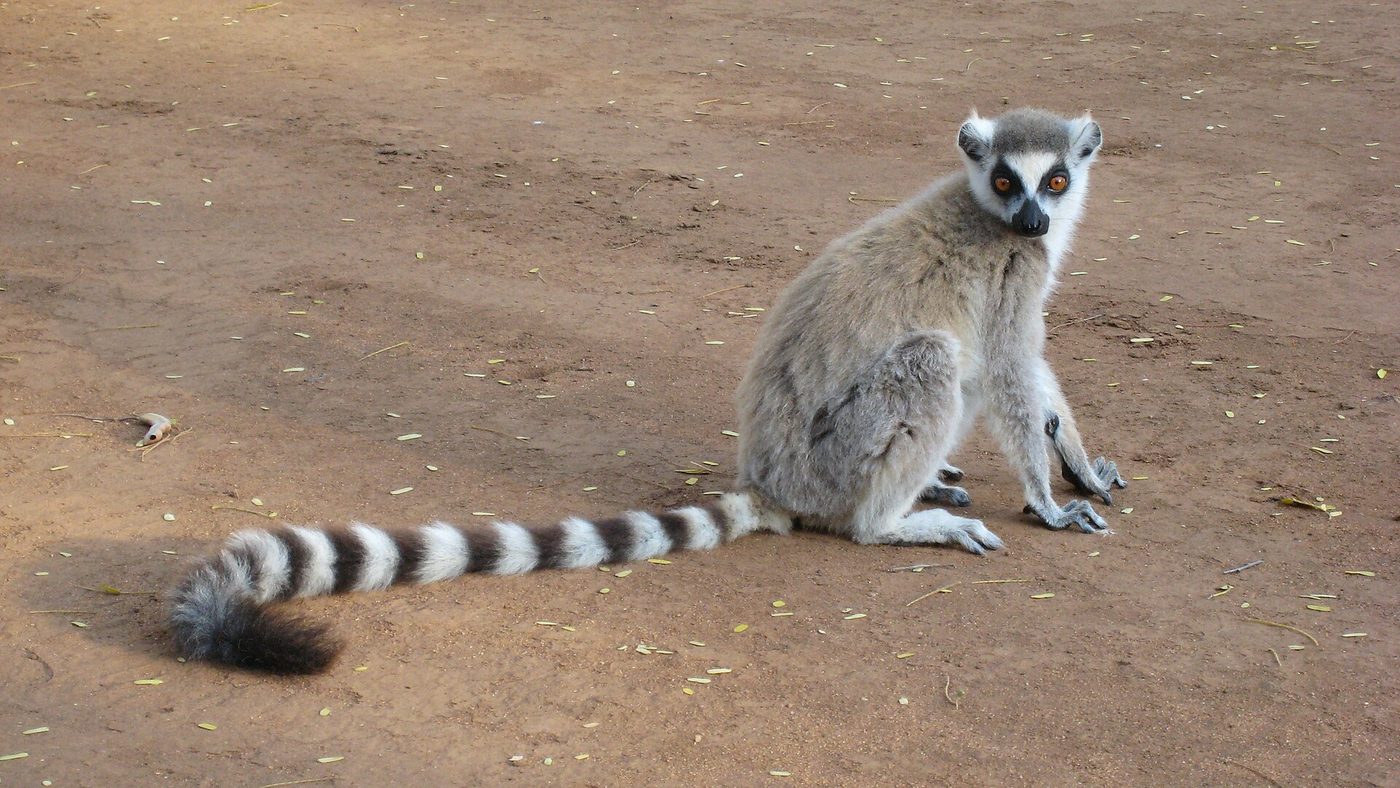
With its black-and-white ringed tail raised like a flag, the ring-tailed lemur is the primate symbol of Madagascar: social, noisy and a lover of the sun.
Characteristics
Temperament
Very social and noisy, living in groups led by females. It spends much time on the ground, loves sunbathing and communicates heavily through scent.
Diet
Omnivore with a plant bias: fruit, leaves, flowers, bark and occasionally insects.
The symbol of Madagascar
The ring-tailed lemur is the most recognisable of the lemurs and one of the symbols of Madagascar, the only place in the world where it lives in the wild. Its unmistakable feature is its long tail ringed in black and white, which does not serve to grasp branches but to communicate: raised like a flag, it lets individuals keep visual contact while the group moves through the vegetation. Its muzzle is pointed and fox-like, its eyes large and amber, its coat grey with a black-and-white face.
A life on the ground, unusual for a lemur
Unlike most lemurs, which live almost entirely in the trees, the ring-tailed lemur spends much time on the ground, where it moves about walking with its tail held high. It lives in large groups where — a rarity among primates — the females are dominant: they have priority over food and lead the group's movements.
The sunbath
One of the most famous images of the ring-tailed lemur is that of the animal sitting, legs splayed and belly exposed to the first rays of morning, in a pose that recalls meditation. It is not a ritual: it is a practical way to warm up after cool nights, using the belly, where the fur is thinner, as a natural solar panel.
Communication and conflicts
The ring-tailed lemur has a rich repertoire of calls and makes heavy use of scents to communicate. The males engage in curious 'stink fights': they rub their tails against scent glands on their wrists and then wave them at their rival, challenging him with smell rather than with fangs. It is an elegant way of settling disputes without bloodshed.
Conservation
The ring-tailed lemur is classified as an endangered species. Its populations have fallen drastically because of the destruction of Madagascar's forests, hunting and capture for the animal trade. Like all lemurs, it exists only on this island: if it disappears there, it disappears from the world. Its survival depends entirely on the protection of Malagasy habitats.